Deep Dives
How a Robot Reads an Instruction: Vision-Language-Action Models
A vision-language-action model is a language model whose output has been bent into motor commands. Its real limits are the scarcity of robot demonstration data and the speed needed to act, not the…
What a VLA Is
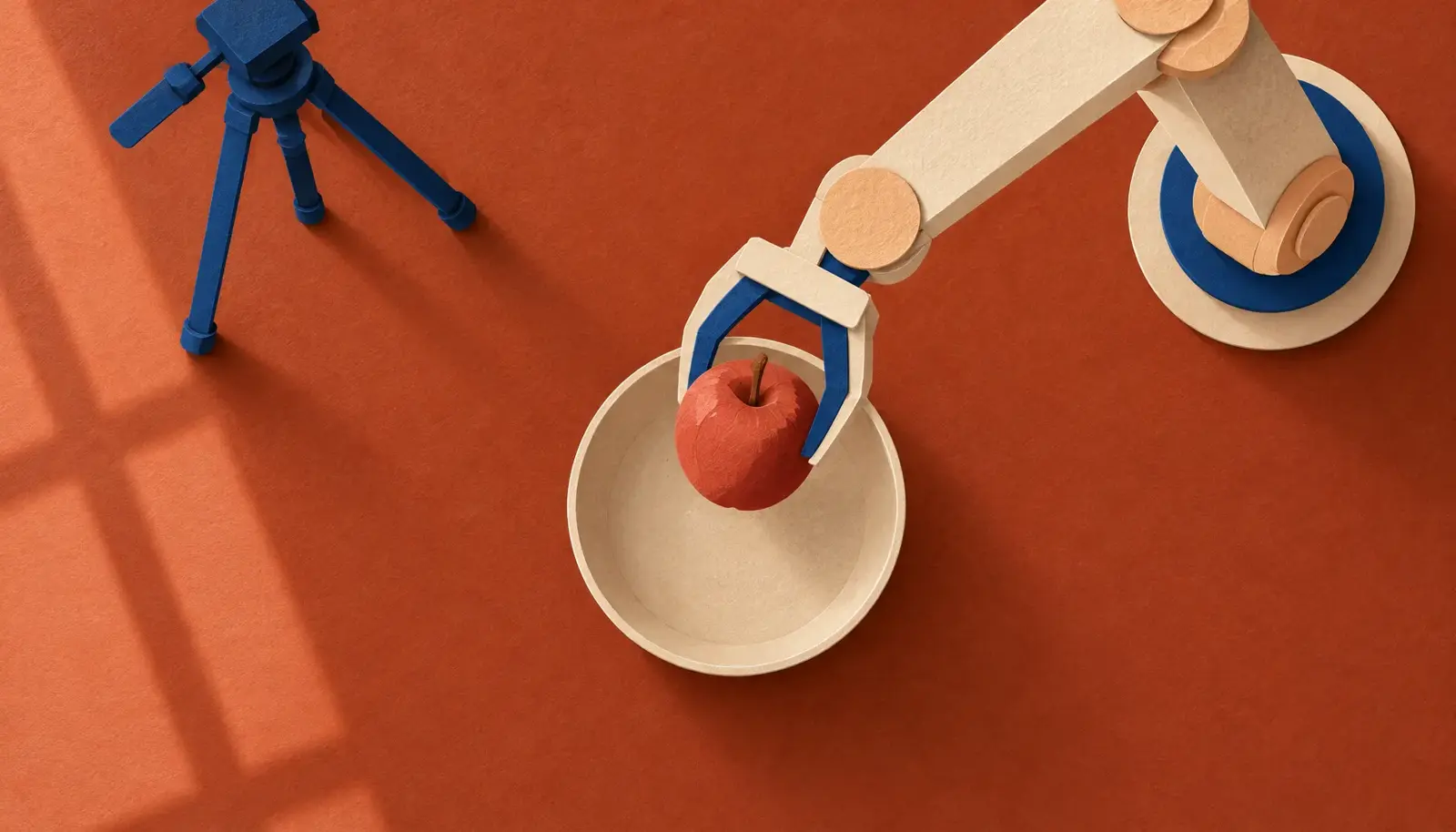
A vision-language-action model, or VLA, is a language model whose output has been bent into motor commands. It receives camera images and a sentence such as "put the apple in the bowl", and it returns the numbers that drive a robot's arm and gripper. Two constraints limit it, and language training removes neither: robot demonstration data is scarce, and a robot has to act many times per second.
The term entered the literature with RT-2, a Google DeepMind paper submitted to arXiv in July 2023. Its authors co-fine-tuned existing vision-language models on robot trajectories together with web tasks such as visual question answering, and they named the resulting category "vision-language-action models". The paper reports 6,000 evaluation trials and better generalization to novel objects and to commands that never appeared in the robot training data.
A VLA can be described in three layers: how an action leaves the model, how fast it has to leave, and what data the model learned from. The language and vision halves arrive nearly free from the internet, so the limits of VLAs sit in speed and data.
The Three Parts of a VLA
VLAs share a common skeleton. A vision encoder turns camera frames into embeddings. A language backbone, usually a pre-trained vision-language model, combines those embeddings with the instruction text. An action decoder then produces the robot's next movement. The models differ mostly in that last piece.
The action in question is rarely a full trajectory. In RT-2 it covers a 6-degree-of-freedom displacement of the robot's end effector (position and rotation), the gripper extension, and a discrete command to terminate the episode. Other designs output joint targets for two arms at once. What they share is that the output is a short stretch of future motion, recomputed continuously as the camera shows what happened.
The backbone is where the web knowledge lives. RT-2 was built on PaLI-X (5B and 55B parameters) and PaLM-E (12B). OpenVLA, published in June 2024, uses a Llama 2 language model with a visual encoder that fuses DINOv2 and SigLIP features. The pi0 model uses the roughly 3-billion-parameter PaliGemma. In each case, the robot inherits the ability to recognize objects and parse phrasing from a model trained on internet-scale data.
Three Ways to Emit an Action
The first approach treats actions as words. RT-2 discretizes each continuous dimension into 256 bins and writes the bin indices as text, so an action becomes a short sequence of integers the language model predicts like any other tokens. For PaLM-E, the 256 least frequently used tokens in the vocabulary are overwritten to serve as action tokens.
OpenVLA does the same: it discretizes each action dimension separately into 256 bins and overwrites the 256 least-used tokens of the Llama tokenizer, training with next-token prediction and a loss on the action tokens only.
The second approach replaces tokens with a generative process for continuous values. The pi0 model, from Physical Intelligence, attaches an action expert of 300 million parameters to the PaliGemma backbone, for 3.3 billion parameters in total. The expert is trained with conditional flow matching, which the paper describes as a variant of diffusion. At inference it integrates from random noise to an action over 10 steps and emits a chunk of 50 actions, which allows control at up to 50 Hz.
The third approach splits the model in two. NVIDIA's GR00T N1, released in March 2025, is described by its authors as a VLA with a dual-system architecture. A vision-language module, System 2, interprets the scene and the instruction. A diffusion transformer module, System 1, produces motor actions in real time, and the two are jointly trained end to end. The split separates scene understanding, which can run slowly, from motor control, which has to run in real time.
Tokens have the advantage of reusing the language-model training recipe unchanged. Continuous generation avoids the rounding that 256 bins impose and suits fast, dexterous movement. The dual-system design is a way to let a large slow model and a small fast one each do the job they are suited to. None of these choices has been shown to dominate the others across the board.
Inference Speed and Control Frequency
A language model can take a second to answer a question, while a robot arm needs a new command many times per second, so inference speed is the first constraint, and the papers report their numbers.
RT-2's 55-billion-parameter variant ran at 1 to 3 Hz, and the 5B variant at around 5 Hz, with the models served on a multi-TPU cloud service that robots query over the network. The authors list costly real-time inference as a possible bottleneck for high-frequency control. OpenVLA runs at approximately 6 Hz on one NVIDIA RTX 4090 without compilation or speed-up tricks, and its authors write that faster inference is needed for setups like ALOHA, which runs at 50 Hz.
Action chunking and architectural splitting are the two answers. Predicting 50 actions at once, as pi0 does, lets the robot execute many control steps per model call; in the paper, the 20 Hz robots re-run inference every 0.8 seconds and the 50 Hz robots every 0.5 seconds. On an RTX 4090 the paper reports about 73 ms of total on-board inference, of which the ten flow-matching steps take 27 ms.
GR00T N1 pushes the split furthest. Its System 2 runs at about 10 Hz on an NVIDIA L40 GPU, while System 1 operates at 120 Hz, sampling a 16-action chunk in about 63.9 ms. The 2B-parameter model has 1.34B parameters in its vision-language part.
A third path is to shrink the whole thing: SmolVLA, from June 2025, is trained on a single GPU, runs on consumer GPUs or CPUs, and decouples perception and action prediction from action execution. Its authors report performance comparable to models 10 times larger.
Robot Training Data
Language models learned from trillions of words on the web. Robots have nothing comparable, because every demonstration is a physical event that someone had to record on a real machine. The largest pre-training mixture in the pi0 paper holds about 10,000 hours of robot data, drawn from 7 robot configurations and 68 tasks. Open-source datasets such as Open X-Embodiment, Bridge v2 and DROID make up only 9.1% of that mixture, so most of it comes from the authors' own robots.
Open X-Embodiment, released in October 2023, shows what community pooling achieves. It assembles data from 22 robots, collected by 21 institutions, covering 527 skills and 160,266 tasks. Its authors report positive transfer: the RT-X model improved the capabilities of several robots by using experience from other platforms, though the collection remains far smaller than a web corpus.
The pi0 authors are frank about the gap in understanding. Their paper states that the experiments "do not yet provide a comprehensive understanding of how the pre-training datasets should be composed", and that it is unclear how much and what kind of data is needed to attain near-perfect performance. The same paper finds that pre-training and post-training do different work: pre-training gives broad coverage, while fine-tuning on curated data teaches the model to perform a task well.
Because robot data is scarce, recent designs are measured partly by how much they achieve with little of it. OpenVLA, trained on 970,000 real-world robot demonstrations, outperforms the closed RT-2-X (55B) by 16.5% absolute task success across 29 tasks with 7 times fewer parameters, and it can be fine-tuned on consumer GPUs with low-rank adaptation. Gemini Robotics, a March 2025 report from Google DeepMind built on Gemini 2.0, states that it can learn new short-horizon tasks from as few as 100 demonstrations.
GR00T N1 organizes the problem as a data pyramid: web data and human videos at the base, synthetic data from simulation in the middle, and real-robot data at the top. On the Fourier GR-1 humanoid, the paper reports 76.8% average success with full data against 46.4% for Diffusion Policy, and 42.6% against 10.2% when only 10% of the data is used.
A related line uses non-robot sources to widen generalization. The pi0.5 paper, submitted in April 2025, co-trains on data from multiple robots, high-level semantic prediction and web data, and reports long-horizon manipulation such as cleaning a kitchen or a bedroom in "entirely new homes". Gemini Robotics 1.5, from October 2025, adds a motion transfer mechanism so that one VLA can learn from data gathered on different robot bodies, and it interleaves actions with natural-language reasoning.
Limits Reported by the Authors
The limits are stated by the authors themselves. OpenVLA's paper notes that it supports only single-image observations and that it typically achieves less than 90% success. The pi0 paper says that not all tasks in its evaluation work reliably. RT-2 reports that the robot does not acquire the ability to perform new motions from web data; its physical skills remain limited to those in the robot dataset.
That last point separates semantic generalization from physical generalization. RT-2 scored an average of 62% on unseen objects, backgrounds and environments for both its 55B PaLI-X and 12B PaLM-E variants, against 32% for RT-1 and 35% for MOO. On seen tasks it performed similarly to RT-1, at 91 to 93% against 92%. The web knowledge helped RT-2 with novel objects, backgrounds and environments, while its physical skills stayed limited to those in the robot dataset.
Failures reported for RT-2 include grasping by specific parts, precise or dexterous motion, and dynamic objects that roll or are hard to push. Those are the situations where raw control matters more than understanding, and where a slow, large model is at the greatest disadvantage.
What a Demo Video Shows
A demonstration video shows what happened on camera; how the robot was controlled, how many attempts preceded the take and how fast the footage is playing are not visible in it. Whether a clip reflects a VLA acting autonomously, a human teleoperating, or a sped-up edit is a fact to look up in the accompanying paper or release notes.
The papers supply a template for what to look for. They report success rates over many trials, the number of tasks, the robot platform, the control frequency and the amount of fine-tuning data. A model that completes a task in a video and a model that completes it reliably are separate claims, and the OpenVLA and pi0 authors both say as much about their own work.
The pi0 inference figures come from an RTX 4090, and the GR00T figures from an L40. A model that needs a datacenter GPU or a cloud round trip behaves differently on a robot with its own battery and compute. The openpi repository for pi0 lists inference at more than 8 GB of GPU memory, LoRA fine-tuning at more than 22.5 GB and full fine-tuning at more than 70 GB.
Open Questions and Open Releases
Three questions follow directly from the sources. The first is how much of a model's performance comes from architecture and how much from the proprietary data behind it; pi0's 9.1% share of open data in pre-training makes this hard to separate from outside. The second is whether the fast-and-slow split generalizes beyond humanoid manipulation. The third is how much non-robot data, from web text to human video to simulation, can substitute for real demonstrations.
Open releases make part of this testable. OpenVLA published checkpoints, fine-tuning notebooks and a PyTorch codebase, and openpi distributes pi0, pi0-FAST and pi0.5 base checkpoints pre-trained on 10,000+ hours of robot data. With a single high-end GPU, a lab can LoRA-fine-tune these models and measure them.
In practical terms, a VLA is a pre-trained vision-language model with a decoder that outputs motion. Whether a given system is impressive depends on the decoder's speed, on the quantity and kind of robot data behind it, and on the success rate over many trials, three numbers that papers usually report.
Sources
- pi0: A Vision-Language-Action Flow Model for General Robot Control (arXiv:2410.24164) arXiv:2410.24164
- OpenVLA: An Open-Source Vision-Language-Action Model (arXiv:2406.09246) arxiv.org
- GR00T N1: An Open Foundation Model for Generalist Humanoid Robots (arXiv:2503.14734) arxiv.org
- RT-2: Vision-Language-Action Models Transfer Web Knowledge to Robotic Control (arXiv:2307.15818) arxiv.org
- Gemini Robotics: Bringing AI into the Physical World (arXiv:2503.20020) arxiv.org
- Open X-Embodiment: Robotic Learning Datasets and RT-X Models (arXiv:2310.08864) arxiv.org
- pi0.5: a Vision-Language-Action Model with Open-World Generalization (arXiv:2504.16054) arxiv.org
- openpi repository, Physical Intelligence github.com
- SmolVLA: A Vision-Language-Action Model for Affordable and Efficient Robotics (arXiv:2506.01844) arxiv.org
- Gemini Robotics 1.5: Pushing the Frontier of Generalist Robots with Advanced Embodied Reasoning, Thinking, and Motion Transfer (arXiv:2510.03342) arxiv.org