The Floor
AgiBot Reports G2 Robot’s Store-Task Success Stabilized at 85.7%
A G2 robot running AgiBot’s Genie Master framework in a Shanghai convenience store reportedly reached an 85.7% task-workflow success rate after the fifth day. The company also introduced GO-3 Preview and Worken at its October 29 Innovation Day, but the reports do not link GO-3 to the store deployment.
A rise in a Shanghai store
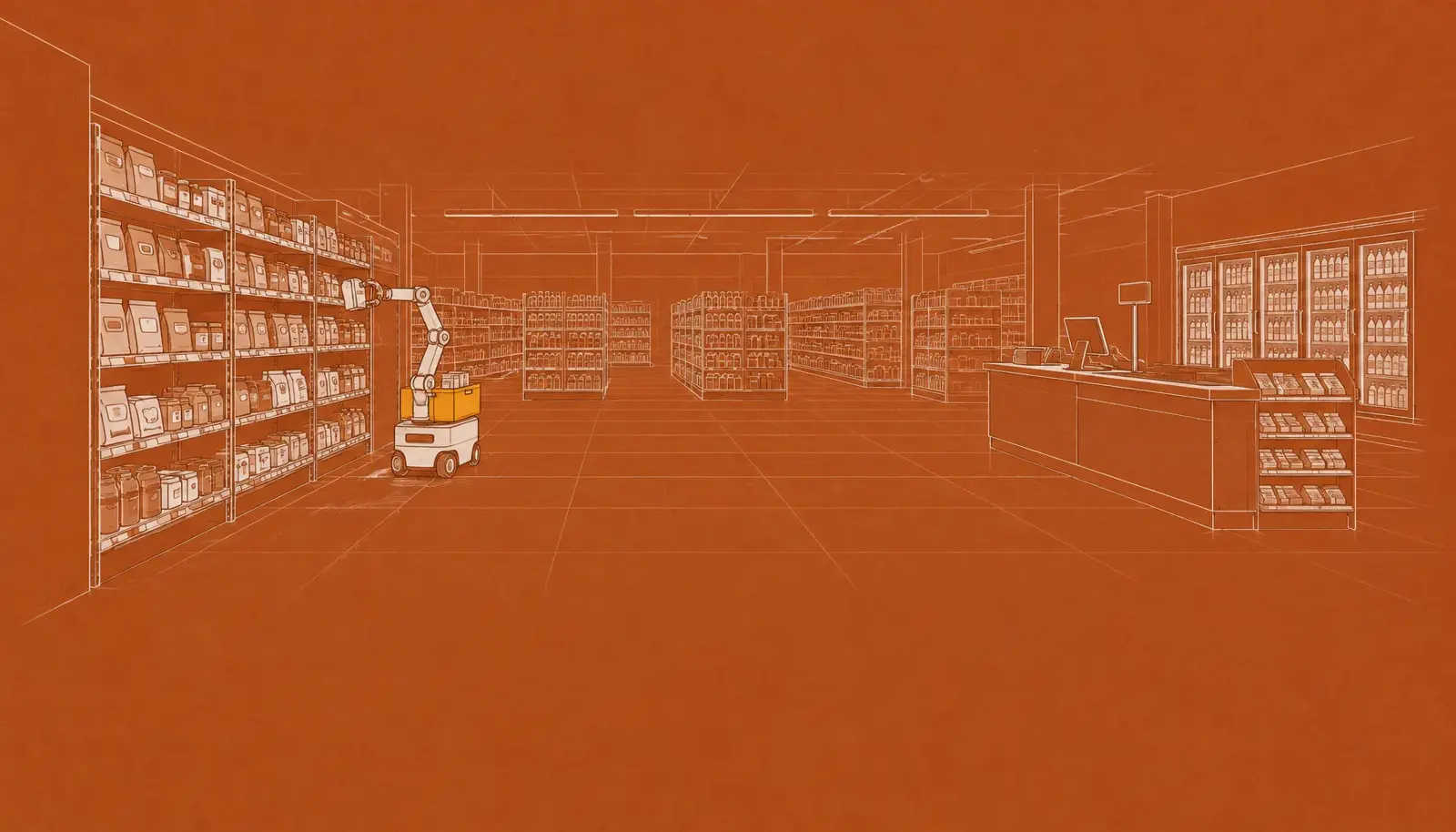
At its October 29 Innovation Day in Shanghai, AgiBot presented a deployment result that shifts attention from a robot’s first attempt to how its performance changed on the job. A G2 robot working in a convenience store with the company’s Genie Master agent framework raised its reported full-task workflow success rate from 28.6% on day one to 85.7%, where it stabilized after the fifth day, according to EET China’s account of the event.
The work included packing deli food, picking up items and restocking. Sina Finance also reported the 28.6%-to-85.7% result after the event.
The figures are company-reported, not an independent assessment. The public event accounts do not specify how many attempts went into each rate, how the full workflow was defined, or whether the same tasks and conditions were used across all five days. Those omissions make it difficult to judge how much the result depends on the task mix or whether it would carry over to another store.
GO-3 connects prediction to action
AgiBot introduced GO-3 Preview at the same event as an embodied foundation model built around WRAM, or World Reasoning Action Model. The company describes WRAM as a framework that combines reasoning about a task, predicting what may happen next and generating actions. Genie Master handles the deployed robot’s task progress and execution feedback, according to EET China’s event report. The reported store result concerns a G2 running Genie Master; the reports do not identify GO-3 as part of that deployment.
In its official announcement, AgiBot says GO-3 is designed to help robots “anticipate the consequences of their actions, adapt to changing environments and generalize beyond previously learned task sequences.”
AgiBot also reported leading results on three simulated or structured evaluation suites: it said GO-3 ranked first in task success rate and process score on RoboDojo, had the highest overall score on RoboTwin, and ranked first overall on RoboColiseum. Those rankings, like the convenience-store rate, were presented by the company; the announcement does not supply an independent evaluation of the deployment result.
The score needs operating context
The reported increase is a specific claim about a particular robot, framework and store workflow—not evidence that success rates generally climb with time in service. A stronger comparison would need the number of trials, a breakdown of task types, the failure criteria and records showing what the robot changed between attempts. The company’s public accounts provide none of those details.
At the event, AgiBot also introduced Worken, a proposed way to measure useful robot work through active robot count, autonomous working hours and output efficiency.
Peng Zhihui, AGIBOT’s co-founder, president and CTO, said:
“We want to move beyond measuring how many robots are built or delivered and begin measuring how effectively they can perform useful work, autonomously and consistently, in the real world.”
The 85.7% figure puts a task-completion rate on that ambition, but the reported deployment window is the only one specified in the public coverage.
Sources
- Original source EET China eet-china.com
Other pages read
- AGIBOT agibot.com
- Sina Finance finance.sina.com.cn
Related stories
- AGIBOT Debuts GO-3 Preview, 40-Kg G2 Max and Link-U OS 1.0
- AgiBot’s Rollback Rewinds Robot Policies to Test Better Actions
- AgiBot’s 110 Robots Set Guinness Dance Record in Jinan, Dagu Wen Hui Reports
- Genie Sim Scores Correlate 96.7% With Real Robots, AgiBot Says
- VICTR Preprint Reports 23.8% Success on Unseen Out-of-Domain Real-World Robot Tasks