The Floor
ALFRED logs 528 forest traversals in year-long survey
ALFRED completed 528 traversals across 29 collection days in a year-long forest survey, with no scheduled collection missed. The open-source mobile manipulator’s reported reach gains came alongside a degraded battery, weather limits and operator-steered forest runs.
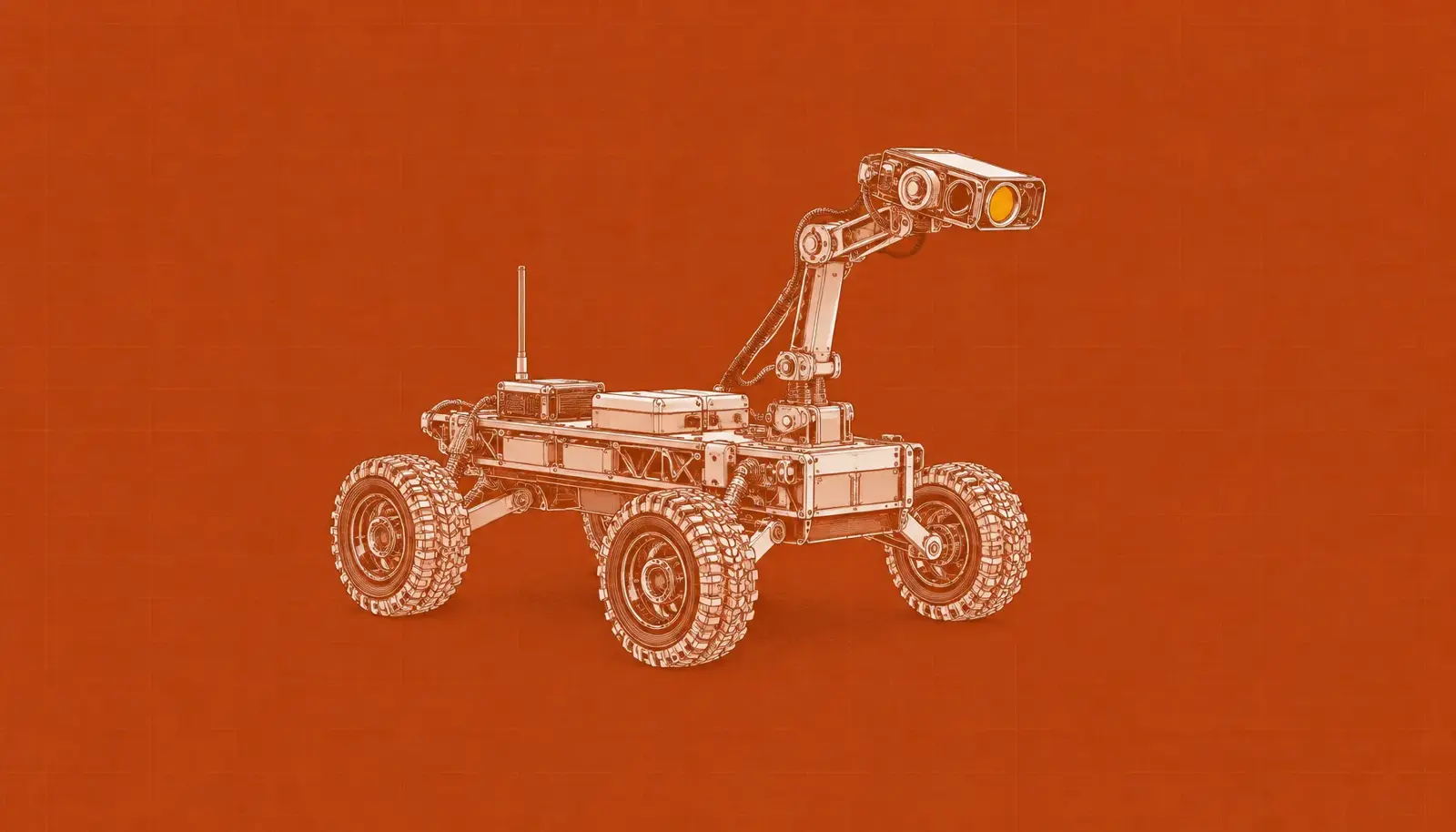
ALFRED completed 528 forest traversals over 29 collection days without missing a scheduled survey, according to a paper submitted to arXiv on October 1. The mobile manipulator gathered 4.9 terabytes of sensor data from June 2025 to May 2026 in a forest beside Heriot-Watt University’s Edinburgh campus. The authors used the site as a stand-in for farmland, where repeated close-range observations could help track plant growth.
528 traversals, with an operator steering
The survey was a sustained field deployment, but not an autonomous forest mission. An operator followed the Ackermann-steered base and directed its movement; the six-degree-of-freedom arm swept autonomously between fixed joint configurations. The robot recorded 31.68 hours of data across the campaign, including scans from LiDAR mounted on both the base and the arm.
That distinction matters because the paper also describes ALFRED 2.0, a separate configuration built for crop-row work. Its base could navigate pre-validated routes autonomously, but the online planner intended to select new sensor viewpoints was not brought into service. Nor did the team run learning-based perception onboard. For the forest results, the evidence is repeat collection with a human steering the base, not end-to-end autonomous monitoring.
Rebuilding raised reach to 66.1%
The authors developed four builds against six requirements: durability, modularity, repairability, sensing reach, endurance and reproducibility. In model-based comparisons of the last three builds, the usable share of the arm’s reachable poses rose from 34.0% to 60.0%, then 66.1%. The same analysis found that only the final build left the frame-mounted LiDAR’s horizontal view clear both forward and backward.
Those measures expose a design trade-off: adding structure and hardware can improve mounting options while restricting arm movement or blocking a sensor. The LiDAR analysis also changed with the arm’s posture. On ALFRED, the share of the horizontal beam with a clear view increased from 74.80% with the arm in its zero posture to 88.96% in its drive posture. The calculations use robot models, not field measurements of sensing accuracy, and the authors note that omitted details such as cable routing make their collision models slightly optimistic.
“The deployment also showed that mechanical modularity is only as dependable as the robot description that tracks it.”
Ciarán Miceal Johnson, Christopher Quail, Garry Ellard, Alistair McConnell, Steve Tonneau and Fernando Auat Cheein, “ALFRED: Requirement-driven development of an open-source mobile manipulator for long-term plant monitoring”
Battery degradation stretched a survey to three days
The campaign kept its schedule despite a battery problem that slowed collection. Around December 2025, one battery degraded enough that a charge lasted about 30 minutes—roughly five of the 33 traversals in a complete survey window. A collection window that had taken one day then took three. The team restored endurance partway through the campaign with a replacement battery and a portable generator.
Reconfiguration added another operational test. The platform was changed for a separate payload study, and the team repeatedly switched between the forest robot and ALFRED 2.0 as the crop-row build developed. Each complete change took about six hours, in part because the two builds needed matching robot descriptions, collision settings and sensor frames. The paper’s account treats those software models as part of the machine: the wrong description could let the system run while misrepresenting its physical setup.
Open build files, bounded field conditions
The authors release CAD files for custom parts, robot descriptions, collision configurations, operating code, Docker containers, an assembly guide and a bill of materials. They present those materials alongside the robot’s progression so other teams can inspect or reproduce the builds and run comparable reach and visibility analyses. The report also records practical repairs: a damaged sensor mount was replaced the next day without disrupting data collection.
The field record has limits. The Hunter 2.0 base is not waterproof and should not run in rain or snow, so the team did not attempt collections in wet conditions. The paper also notes that the arm’s relative encoders can leave joint offsets that may affect sensor measurements. The next test is whether the extra viewpoints from an arm-mounted sensor measurably improve the plant traits extracted from repeated surveys.
Sources
- Original source · Preprint ALFRED: Requirement-driven development of an open-source mobile manipulator for long-term plant monitoring arXiv:2610.01477