The Floor
ALOHA Lightning preprint targets faster learned manipulation
A Stanford-affiliated preprint describes a two-arm robot system trained from hands-on demonstrations and designed to perform manipulation tasks at near-human speed. Its authors report fast task completion, while a detailed comparison table records a 50% success rate for toss-and-catch.
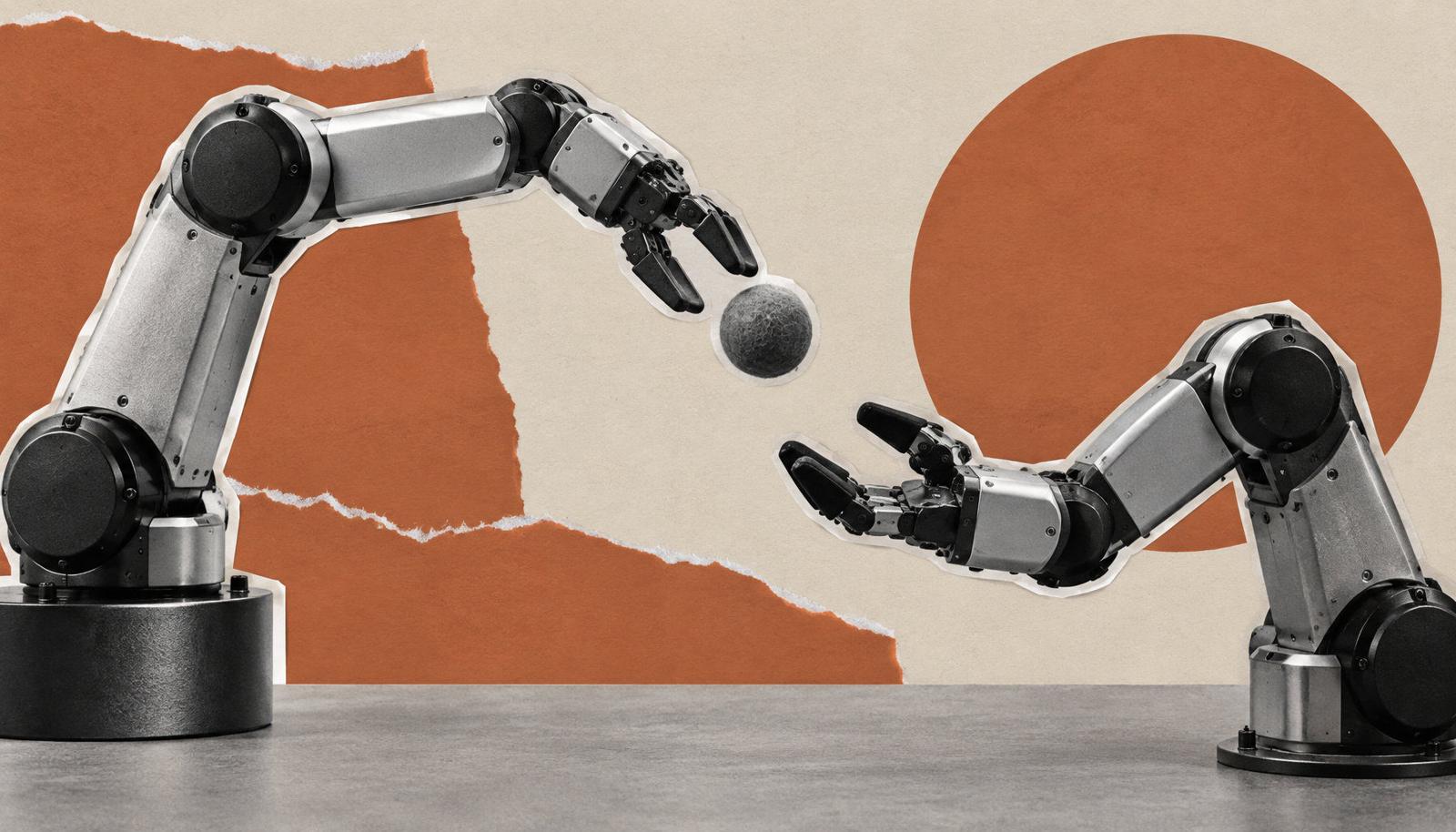
Hands-on teaching, faster execution
A bimanual robot-learning system described in a new preprint aims to make learned manipulation faster by collecting demonstrations through direct physical guidance, then smoothing the robot’s actions during execution. The paper, ALOHA Lightning: Learning Fast and Precise Manipulation, was submitted to arXiv on November 16, 2026, by researchers affiliated with Stanford University.
The setup pairs two robot arms, each with a parallel-jaw gripper. For demonstrations, an operator holds handles attached to the grippers and guides the arms through tasks; the paper calls this kinesthetic teaching. The authors say real-time gravity compensation reduces the effort needed to move the arms. Unlike teleoperation, this method lets the operator handle the robot directly, with visual, haptic and sound feedback, the paper says.
The system records images from three RGB cameras at 50Hz, along with the robot joints’ positions and velocities. Two cameras are mounted at the wrists, facing the space between the gripper jaws, while a third looks down over the work area. To address the difference between demonstrations, when a person’s hands are in view, and robot execution without the operator, the authors’ learning pipeline masks regions showing hands and arms.
Policy methods and task results
The paper describes a second method to smooth transitions between action chunks, the sequences of target joint positions predicted by the policy. The authors say this test-time processing helps reduce jerky movements at high speed. They use an imitation-learning policy to predict future joint positions from camera images and the robot’s current state.
Tasks include unstacking cups, inserting a battery into a remote control, bussing dining ware into a tray, folding shorts and tossing a ball between the arms. For each task, the team collected 50 demonstrations, according to the paper. Its abstract says the system completed bimanual tasks with success rates above 80% while moving close to human speed.
The detailed results vary by task. In the speed-comparison table, the system records whole-task success rates of 90% for unstacking cups, 85% for battery insertion and 100% for bussing a table. But for toss-and-catch, the table reports a 50% whole-task success rate, with a completion time of 1.85 seconds. The abstract’s broader success-rate statement therefore sits alongside a lower result for that specific task.
Comparisons and user study
The researchers compared their method with teleoperated puppeteering, including versions that doubled controller frequency or skipped actions. They report that speeding up demonstrations collected through puppeteering caused sharp performance drops. For example, the table gives battery insertion a 55% whole-task success rate with puppeteering, 15% when its controller frequency was doubled, and 30% when actions were skipped, compared with 85% for ALOHA Lightning.
A user study involved seven volunteers with little or no teleoperation experience. Each practiced, watched an expert demonstration and then attempted ten timed battery-insertion trials using both setups. The authors report that participants learned to operate their system quickly and achieved speeds of up to three times those with puppeteering. The paper is an arXiv preprint.
Sources
- Original source · Preprint ALOHA Lightning: Learning Fast and Precise Manipulation arXiv:2611.21919