The Floor
ASTRA preprint details a wave-aware simulator for surface-vehicle autonomy
A University of Michigan research team has presented ASTRA, an Isaac Sim environment for developing autonomy software for marine surface vehicles. The preprint reports tests of simulated waves and existing BlueBoat software, while noting that several vessel motions have not been calibrated against real-world measurements.
A simulator built around a surface vehicle
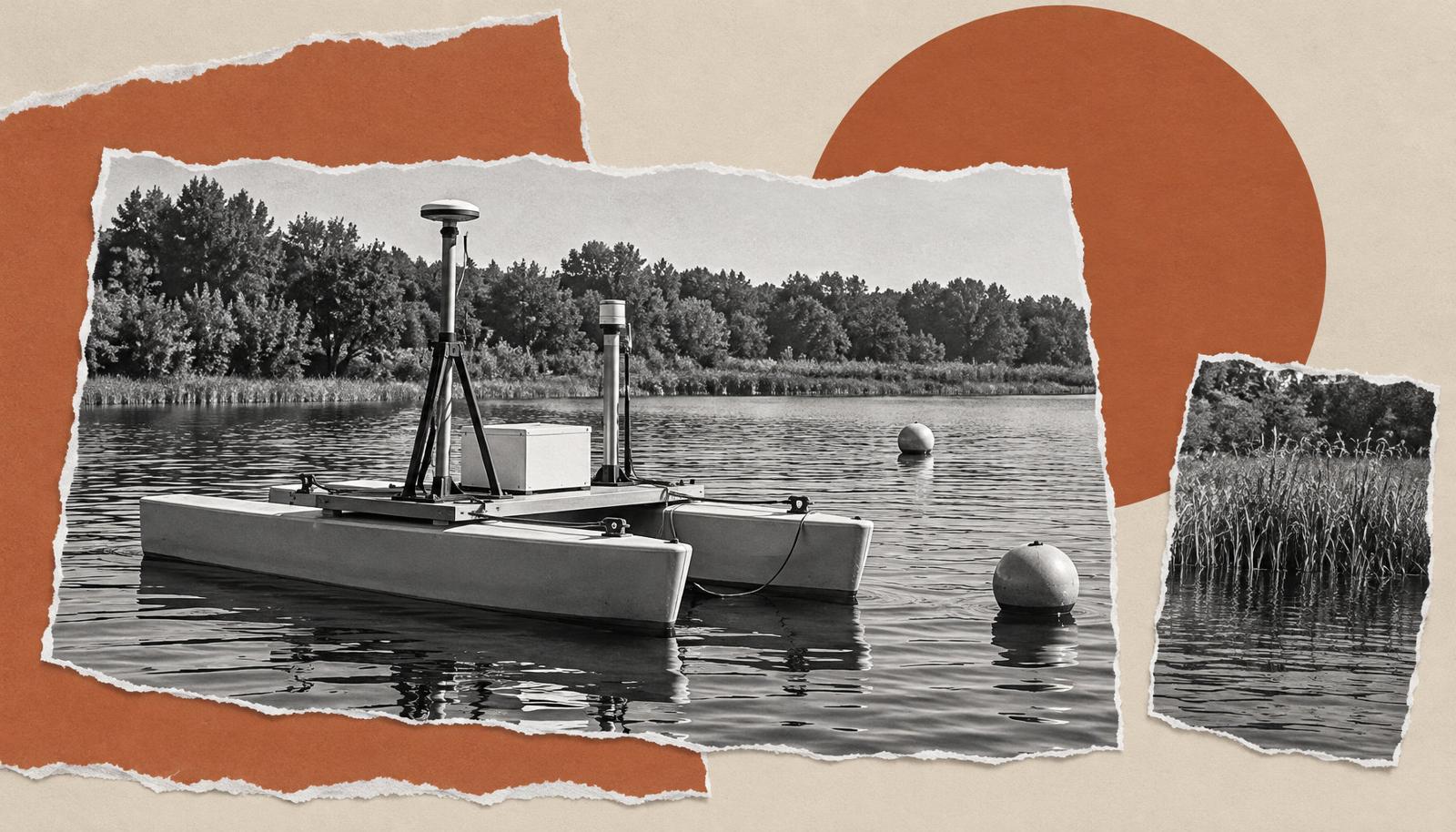
A University of Michigan research team’s arXiv preprint presents ASTRA, a marine surface-vehicle simulator that combines boat dynamics, sensor simulation and software interfaces intended to match a physical testbed. Submitted on November 16, 2026, the paper describes the system as a way to develop and test marine autonomy software without relying only on field trials, which the authors say can be costly and difficult to reproduce.
The paper describes ASTRA as an environment built in NVIDIA Isaac Sim. Its model combines Fossen-style marine dynamics, geometry-based buoyancy and programmable waves, alongside a rendering and sensing setup connected to Robot Operating System 2 (ROS 2). The simulated platform reproduces the sensor configuration of a physical BlueBoat testbed, including GPS, an inertial measurement unit, LiDAR and RGB-D sensing. That configuration is intended to let localization, perception, planning and control software use interfaces consistent with the boat.
Wave and software tests
The researchers say they used field data from the BlueBoat to identify planar surge and yaw damping, then ran zero-propulsion tests in Isaac Sim to examine the coupling between the water surface, buoyancy and vessel motion. In still-water roll tests, two trials released from plus or minus 8 degrees returned upright without overshoot. The authors describe this as an internal consistency check, not a quantitative validation of the real boat’s roll dynamics.
For wave tests, the paper reports sampling the simulated surface for 600 seconds at a fixed point across three sea states. At the dominant wave frequency, the simulated heave response had a reported coherence of 0.996 and a response-amplitude operator of 1.02 meters per meter in the mild condition. In the strong condition, the paper reports coherence of 0.992 and a response-amplitude operator of 1.00 meters per meter. The team also reports that a still-water control run showed no measurable heave.
The researchers ported existing BlueBoat ROS 2 localization and perception modules into ASTRA without changing their interfaces. One localization module fused GPS and inertial data and, against Isaac Sim ground truth over a 189-meter trajectory, achieved a position root-mean-square error of less than 3 centimeters. A semantic-mapping pipeline using LiDAR, RGB-D and pose estimates published map updates at 2.2 hertz; the team also ran the same pipeline on recorded real-world BlueBoat sensor data and described the resulting map as qualitatively consistent with the simulated scene.
Results remain simulation-based
With the full sensor suite, buoyancy solver and autonomy stack active, the pond scene ran at approximately 35 frames per second on a single NVIDIA RTX 4090 GPU, according to the paper. The authors present that rate as sufficient for interactive development, but the reported tests do not establish that the simulated vessel dynamics match real-world behavior across all motions and sea conditions.
The paper notes that only planar surge and yaw damping have been informed by field data. Heave, roll and pitch have not been calibrated against physical measurements, and the roll test used a placeholder inertia. The authors also say the semantic-mapping transfer is qualitative because labeled ground truth for the real pond is not available; they describe the wave model as a repeatable disturbance generator, not a field-validated seakeeping prediction or calibrated sea state.
The preprint says ASTRA is intended as an open-source testbed for marine autonomy development, simulation-based benchmarking and sim-to-real experimentation.
Sources
- Original source · Preprint arXiv arXiv:2611.21789
Related stories
- Preprint presents FlowRRT planner for monoped hopping
- Preprint puts robot control policies inside 3D route planning
- Preprint finds 61 checker defects in robot simulation benchmarks
- Preprint models how imitation policies discount noisy object readings
- BeyondEgo raises humanoid task success in simulation, preprint says