The Floor
DataBeyond Puts PICKINGMAN on a Live Waste-Sorting Line
DataBeyond livestreamed its dual-arm PICKINGMAN robot sorting mixed municipal waste at an operating facility in Dongguan, China. The full line processes 50 metric tons in four hours, according to the company, which also acknowledges that the robot still needs improvement.
“During the livestream, we identified areas where the robot still needs improvement.”
Mo Zhuoya, DataBeyond
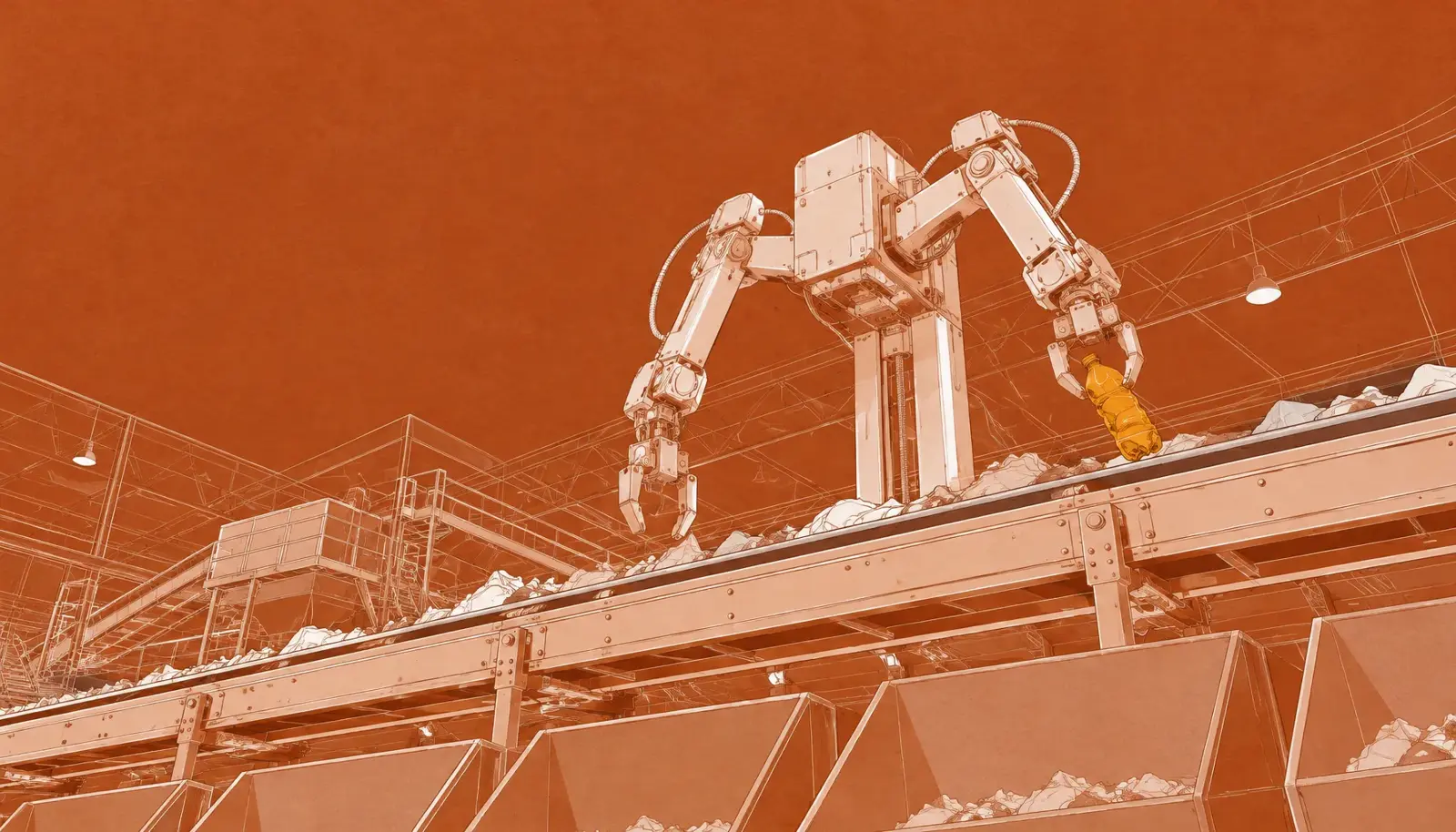
DataBeyond put its PICKINGMAN waste-sorting robot on camera during a global livestream from an operating facility in Dongguan, China, on October 22. The broadcast showed the dual-arm machine working on a live line at the Liaobu Municipal Solid Waste Integrated Treatment Center, the company’s October 23 announcement says. PICKINGMAN had begun operating there on September 22. The demonstration offered a view of the system in a working plant, not just a staged product presentation.
Fourteen degrees of freedom on a moving conveyor
PICKINGMAN has two arms with a combined 14 degrees of freedom, an IP65 dust-and-water protection rating and a stated maximum rate of 3,600 picks per hour. The robot identifies targets on a moving conveyor and coordinates perception, decision-making and motion control to pick them. Its listed targets include PET bottles and trays, polypropylene containers, polyethylene items, aluminum cans and glass. The company designed it to support continuous operation around the clock.
The published rate is a maximum, not a reported count from the livestream. DataBeyond’s announcement does not give a measured picking rate for the broadcast or say how many items the robot successfully sorted during it. That distinction matters when comparing a machine’s rated capacity with performance on mixed waste moving through an active facility.
The line’s results are not the robot’s alone
DataBeyond and Guangdong Dongshi Environment jointly developed the Liaobu project, which combines robotic picking with AI optical sorting and other processing equipment. According to project data cited by DataBeyond, the complete line handles 50 metric tons of mixed municipal solid waste in four hours, with about 35% waste reduction and 25% resource recovery. Those figures describe the integrated line, not PICKINGMAN by itself.
The company compares that throughput with earlier sorting of recyclables from the same volume, which it says required four skilled workers for eight hours. The line separates recyclables for downstream recovery; residual waste is compressed and sent for further treatment. The project aims to reduce workers’ direct contact with waste and shift staff toward equipment inspection and production coordination.
PICKINGMAN still needs improvement
Zhuoya’s assessment came with a qualification: the livestream exposed areas for improvement. The company plans to accelerate product iteration and hold longer global livestreams, but it did not identify the specific problems seen during the broadcast or provide a schedule for the next one.
PICKINGMAN entered service at Liaobu on September 22, alongside the commissioning of an AI-powered sorting line. Its account of the site also describes an agreement with Dongshi Environment covering 100 embodied robots. The livestream therefore presented the robot after deployment had begun, while the company’s own remarks kept the immediate technical conclusion modest: the machine is operating, and its developers still see work to do.
Sources
- Original source · Press release PR Newswire prnewswire.com
Other pages read
- DataBeyond databeyond.com