The Floor
DEEP Robotics Outlines Five Research Tracks for Embodied AI
Five research efforts support DEEP Robotics’ DEEPRobotics-Brain architecture, spanning world models, navigation, manipulation, policy optimization and robot-data evaluation. The announcement reports results from simulations and real-robot tests, alongside a dataset collected with the LYNX M20.
“We introduce EvolvingNav, which turns timestamped 3D histories into a persistence–relocation belief over the current world.”
The authors of EvolvingNav write
That method feeds one of five research advances DEEP Robotics announced on October 24 in support of DEEPRobotics-Brain, which the company calls “its embodied intelligence architecture for real-world robot operation.” Its DR-Agent, the release says, “draws on EvolvingNav,” so that “memory and location beliefs” can be “updated as the environment changes.” The program includes a world model, a vision-language-action model, a policy-optimization method, an embodied agent and a robot-data benchmark. The work addresses how robots predict the effects of actions, turn instructions into movement and adapt when their surroundings change, the company says.
The announcement presents the efforts as research supporting an architecture, not as a newly available commercial product. It describes collaborations with researchers at MIT, UC San Diego, the University of Illinois Urbana-Champaign, Tsinghua University, Zhejiang University, Hong Kong University of Science and Technology and Beijing Institute of Technology. The related preprints are available through the company’s developer center.
DR-WM-1.0 adds terrain physics to prediction
DR-WM-1.0 aims to predict whether a robot’s planned movement is physically workable, rather than generate a scene that merely looks plausible. The model combines reconstructed scene geometry with estimates of friction, roughness and stiffness, calibrated against real robot action-and-response data. Its dual-ControlNet setup conditions video generation on geometry and camera motion associated with simulated robot movement.
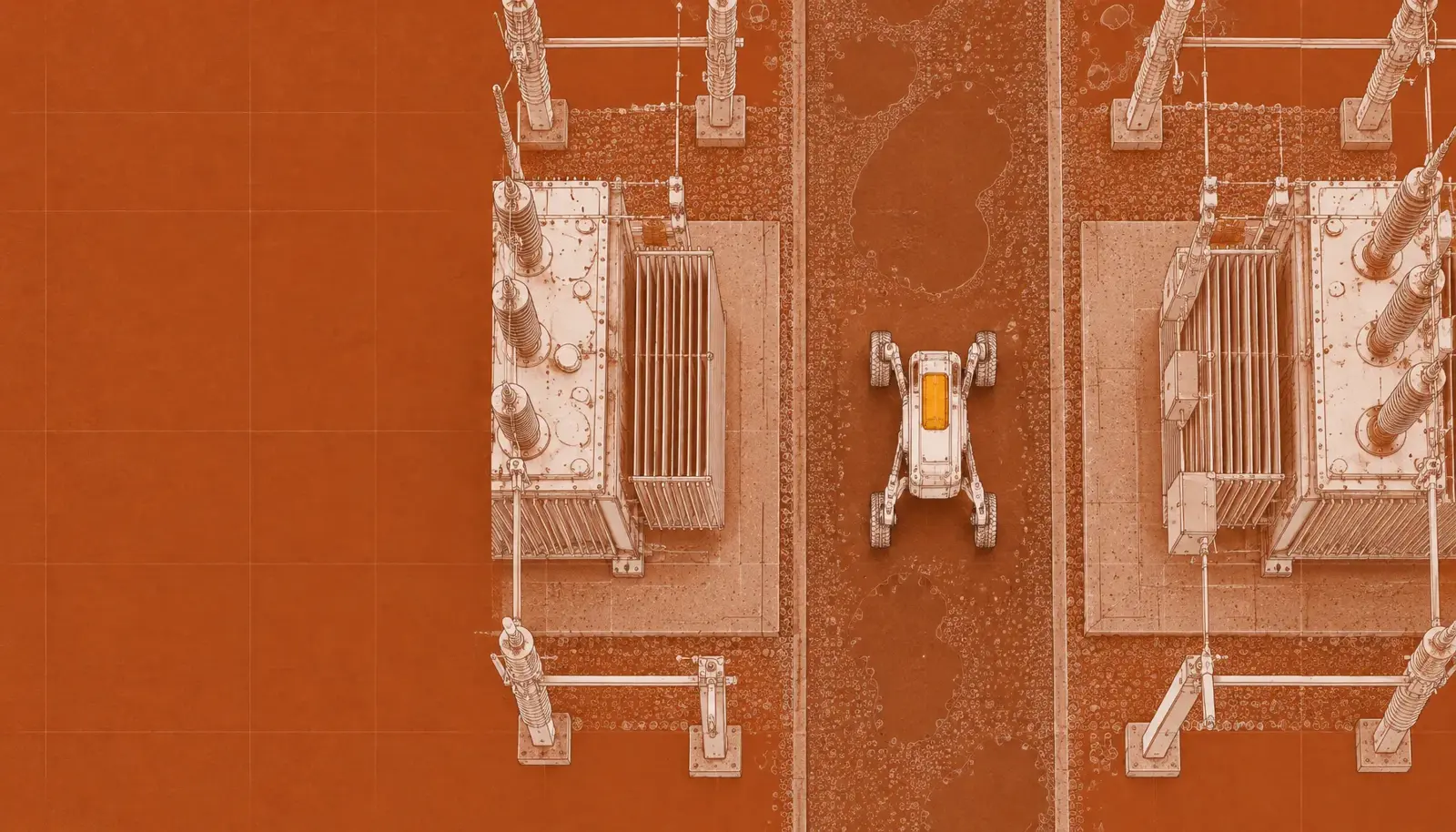
The work draws on 2.58 million image-mask pairs and more than 100,000 real-robot clips. It describes substation inspection after rain or snow as a possible use: a robot could compare a slippery shortcut with a longer route before committing to either. The release does not present that scenario as a deployed application.
DR-VLA and AMC target instruction-to-motion gaps
DR-VLA-2.0 combines action-free learning from human, first-person web video with robot demonstrations. Its EgoLynx training collection includes 10,000 hours of curated video and 2,000 teleoperated robot-navigation clips, according to the announcement. The aim is to transfer cues such as yielding or going around obstacles while using robot data to teach the system executable actions.
On a held-out EgoLynx-Robot test split, DR-VLA raised its Quadruped Navigation Score by about 5% against the strongest competing result for that measure and cut open-loop final heading error by 14.6% against the best result on that measure, DEEP Robotics reports. The score combines safety, instruction compliance, comfort and progress. The company also describes AMC, a separate manipulation framework that uses 13 motion commands per arm: positive and negative translations on three axes, positive and negative rotations on three axes, and a hold command.
AMC is designed to make language instructions steer movement and let force feedback adjust contact tasks such as insertion or wiping. The research page reports 92.5% separation for single opposing motion prompts and 83.1% for pairs of prompts in offline tests. In real-robot trials, the team reports 87.8% normalized progress for fruit sorting with unseen object and target placements; adding force adaptation raised reported progress to 78.5% for the combined drawer-retrieval and plug-insertion task, and 75.2% for vase wiping.
DR-APO gains on simulation and the LYNX M20
DR-APO, developed with Zhejiang University, is intended to apply one policy-optimization approach across Gaussian, diffusion and flow-matching policies. The method supports both continuous-control learning from scratch and post-training navigation models. In tests across five MuJoCo-v5 tasks, it reports the strongest results in nine of ten diffusion-policy comparisons and all ten flow-policy comparisons included in the study.
For post-training the NavDP navigation model, the release reports simulated success rising from 70.33% to 89.55%. In real-world navigation tests on DEEP Robotics’ LYNX M20 wheel-legged robot, the reported success rate rises from 25% to 65%. Those figures are results attributed to the company’s evaluations; the announcement does not describe independent replication.
LynxScenes links several tasks to one robot dataset
The fifth effort, DR-Benchmark, centers on LynxScenes, a real-world dataset collected with the LYNX M20. The company reports 833.6 hours and 3,294.7 kilometers of operation, yielding about 100,000 navigation clips and 3 million annotated frames. Its labels cover 27 object categories, four road-structure categories and 20 navigation instructions organized into three levels.
LynxScenes supports four tasks on the same data: instruction-conditioned trajectory prediction, bird’s-eye-view perception of objects and road structures, future-scene prediction and multi-view reconstruction. The study evaluates 25 models on the benchmark. Taken together, the five tracks span prediction, navigation and manipulation, policy updates, changing spatial memory and evaluation; the release’s clearest evidence of progress remains the test results and dataset scale it reports, rather than a claim of broad field deployment.
Sources
- Original source · Press release DEEP Robotics globenewswire.com
Other pages read
- The Manila Times (GlobeNewswire copy of the release) manilatimes.net
- DEEP Robotics Developer Center · page 1 developer.deeprobotics.cn
- arXiv arxiv.org
- DEEP Robotics Developer Center · Amc web handoff developer.deeprobotics.cn