The Floor
Researchers derive force-closure test for cooperative pushing
A paper sets out a geometric condition for four frictionless contacts to achieve planar force closure on a rectangular object. Simulations compared tracking performance with and without a force-closure configuration.
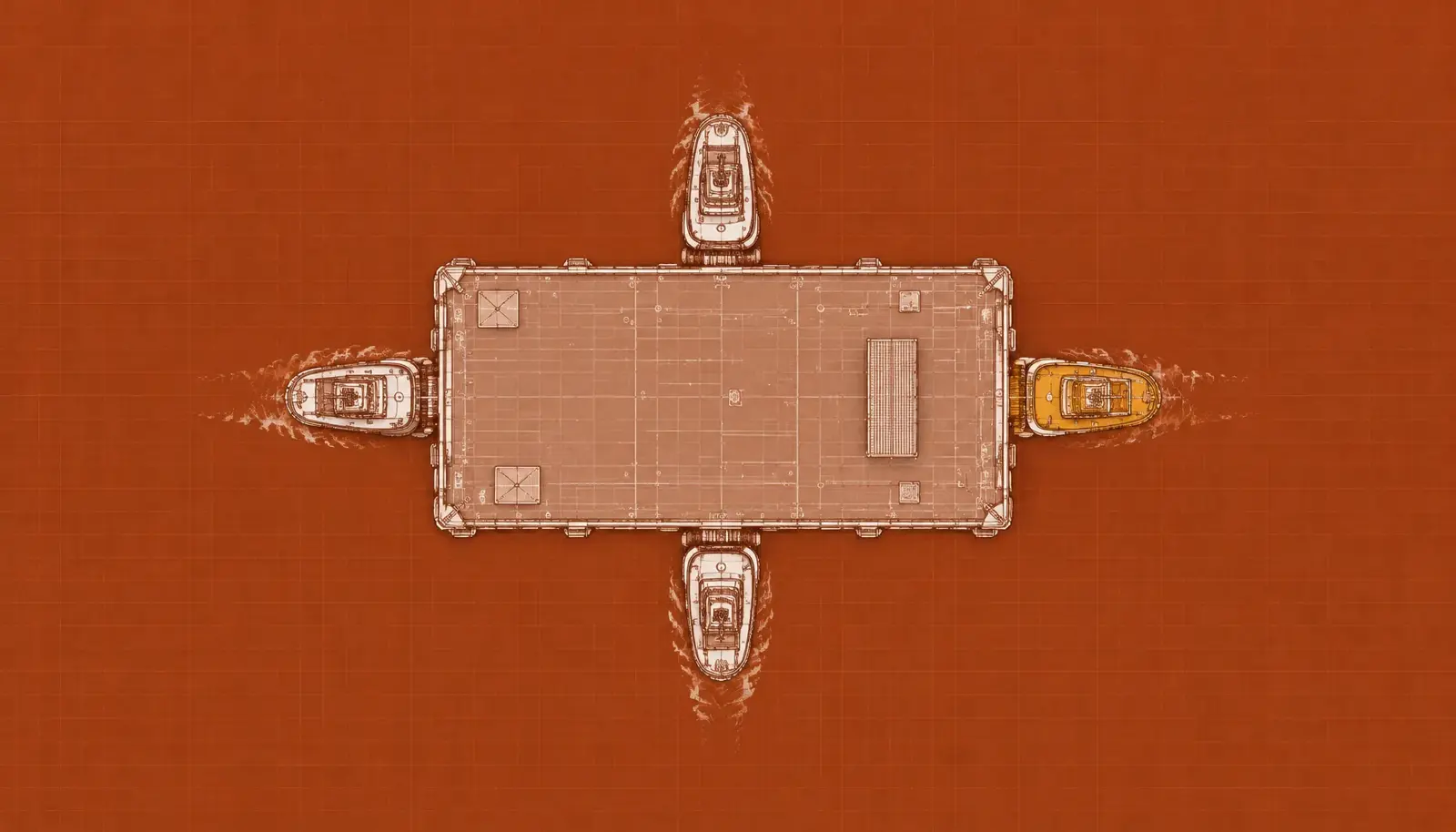
A mathematical condition for placing four pushing contacts can determine whether they achieve planar force closure on a rectangular object, according to a paper by Duy Anh Nguyen and Trung Dung Ngo. The researchers tested the condition in simulations of a floating body, comparing configurations with and without force closure.
Source arxiv.org
The paper was submitted to arXiv on November 9. It was also published in the 2026 IEEE Canadian Atlantic Ocean Symposium. Nguyen and Ngo work at the More-Than-One Robotics Laboratory at the University of Prince Edward Island.
Checking contact geometry
The result applies to a rectangular object with four unilateral, frictionless pushing contacts, one on each edge. Under the paper’s model, each contact can push only along the inward normal of its edge. Force closure means the contacts can generate arbitrary planar combinations of force and moment on the object.
The paper derives an inequality using the rectangle’s length, width and the locations of the edge contacts. The authors state that force closure is achieved if and only if the product of the two calculated factors is less than zero. In this geometry, the two factors represent relative offsets for opposing contact pairs; the required arrangement gives those offsets opposite signs.
The condition does not depend on the object’s center of mass or desired trajectory. It can be checked before allocating contact forces, so that the contact geometry is assessed before the tracking controller’s commanded force and moment are assigned to the pushers.
Adjusting the pushers
If the condition is not met, the authors’ adjustment rule selects the opposing contact pair associated with the smaller absolute factor and shifts that pair to reverse its sign. The paper describes the rule as a way to restore feasibility before force allocation, rather than as an optimal planner.
The researchers put the check into a trajectory-tracking framework for a floating rectangular object. The framework checks the geometry, adjusts it if needed, and then allocates nonnegative pushing forces for the commanded motion.
The simulations used a rectangular floating-body model with a length of 83 m and a width of 18 m. The pushing robots were represented as ideal unilateral actuators producing normal forces at their contact points, an arrangement intended to isolate the effect of contact geometry.
Simulation comparisons
The researchers compared three contact configurations: one missing coverage on an edge, one with a contact on each edge but without force closure, and an adjusted configuration satisfying the condition. In static tests, the configurations were asked to produce representative planar forces, yaw moments and combined force-and-moment commands.
The authors report that the force-closure configuration produced negligible residuals for all the tested commands. The configuration with a contact on every edge but without force closure could produce only a restricted subset of those commands.
In a separate narrow-passage simulation, the researchers compared the configurations with and without force closure using the same controller and contact-force allocation. The force-closure configuration followed the desired path through the passage, while the other deviated and violated the passage boundary, according to the paper.
For position in x and y and unwrapped yaw, the paper reports root-mean-square tracking errors of 12.05 m, 18.11 m and 535.96 degrees without force closure, compared with 2.24 m, 2.66 m and 2.69 degrees, respectively, with force closure. The comparison is for the simulated floating-body maneuver.
Sources
- Original source · Preprint arXiv arXiv:2611.13268
Related stories
- Researchers test learning-enhanced control on aerial manipulator
- Researchers present low-cost TAG testbed for coupled robot control
- Oxford researchers report agent-designed soft robots in preprint
- Preprint: FORGE combines humanoid walking, foot placement and contact control
- Preprint Finds VLA Reactivity Depends on Execution Strategy