The Floor
FRED Lifts Human-to-Robot Skill Transfer to 50%
FRED scored 50.0% on human-to-robot skill-transfer tasks, compared with 19.4% for the best competing world action model. The paper also reports 97.2% instruction following and describes human-to-robot transfer as implicit, without explicit alignment across embodiments.
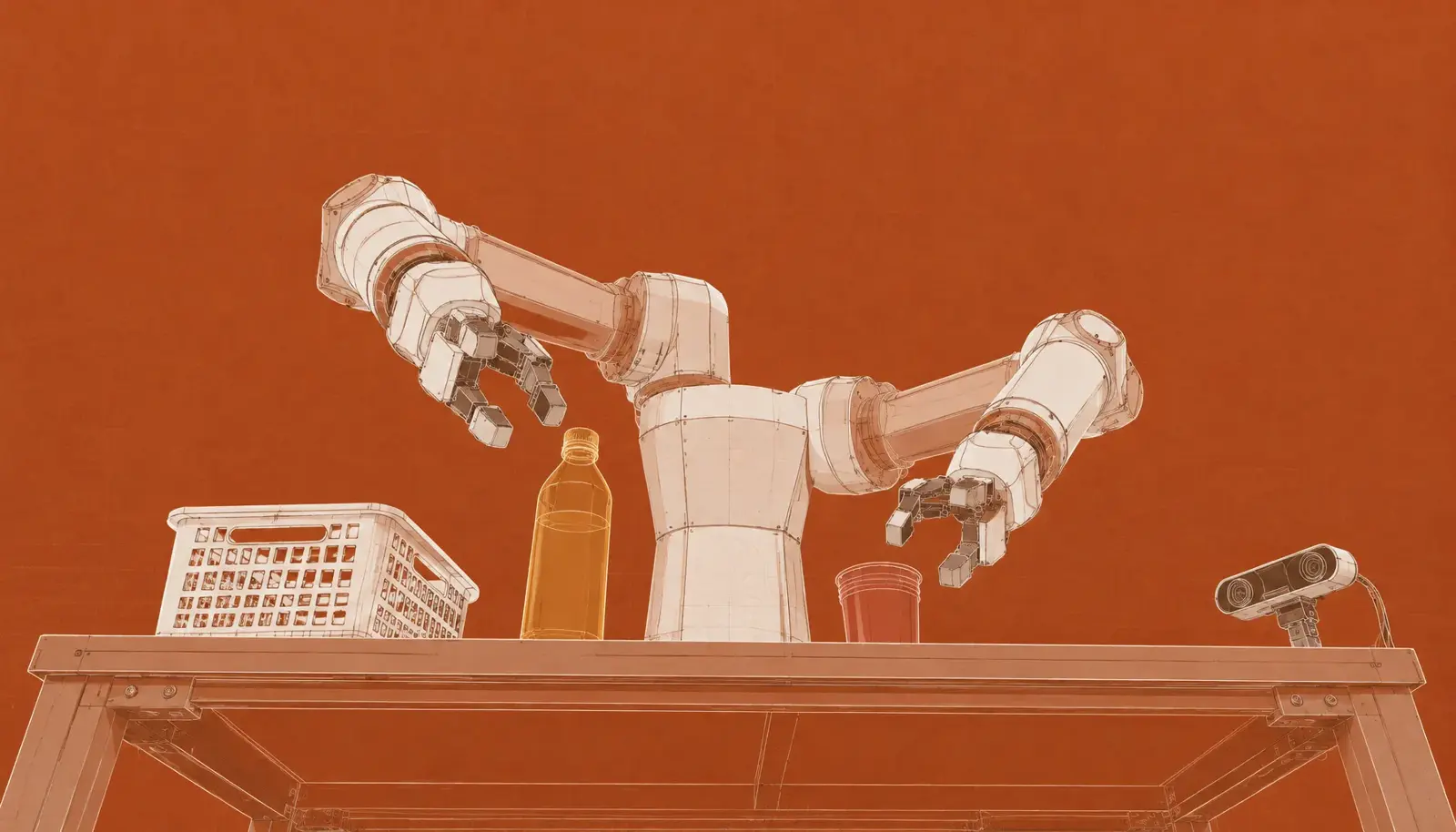
FRED achieved 50% task success on robot skills demonstrated only in human videos, up from 19.4% for the strongest competing world action model, according to a paper submitted to arXiv on October 21. The result comes from tests with an OpenArm humanoid and tasks absent from its robot training data. Its average task-success score was 50%, with partial credit for incomplete attempts, and it followed task instructions at a 97.2% rate.
How FRED turns video predictions into actions
FRED, short for Future Representation learning via self-Distillation with temporal context, is a training framework for world action models. Those models use video diffusion systems to predict future visual states and condition a separate decoder that generates robot actions. Rather than repeatedly denoising a video at inference, the model extracts intermediate features from a single pass and uses them to guide the action decoder.
The KAIST and RLWRLD authors train FRED to make those features more informative. A student model predicts representations of future video from noise; an exponential-moving-average teacher supplies target representations derived from future observations. FRED also conditions the video model on a short history of observations, giving it recent movement as context for predicting what happens next.
“Without human-video co-training, FRED and the baselines achieve near-zero task success.”
The authors—Huiwon Jang, Suhyeok Jang, Hyeonmo Kang, Seungku Kim, Jinwoo Shin and Sihyun Yu—write in “Self-Distilling Future Video Representations for World Action Models.”
Three transfer tasks test more than object pickup
The human-to-robot tests cover placing a bottle on a basket, placing unfamiliar objects into a container, and pouring coffee from a bottle into a cup. The paper says the relevant placements, objects or behaviors appear in human videos rather than in the robot’s training demonstrations. The OpenArm evaluation uses 12 trials per task and reports mean scores as percentages, including partial credit for incomplete attempts.
For human-video co-training, the researchers collected 1,187 egocentric videos, totaling 321,000 frames, across seven skills and seven object categories. The robot training set contained 553 teleoperated demonstrations and 192,000 frames, covering 53 language instructions, four skills and six object categories. The comparison in the paper’s table shows FRED at 50% task success and 97.2% instruction following; DiT4DiT, the strongest competing world action model on task success, scored 19.4% and 55.6%, respectively.
Instruction following outpaces task completion
The gap between those two measures matters: a policy can respond to the requested task without completing it. The paper reports that several competing models often performed familiar robot-training behaviors instead of the skill shown in the human video. FRED’s high instruction-following score suggests it more often selected the requested behavior, while its lower task-success score shows that executing that behavior remains difficult.
The authors also report that FRED without human-video co-training scored 0% on both instruction following and task success for these transfer tasks. They describe transfer as implicit: human and robot videos train the video model together, but the method does not explicitly align representations across human and robot embodiments. Their stated next research target is that cross-embodiment alignment; the measured result for now is 50% task success on the tested OpenArm transfer benchmark.
Sources
- Original source · Preprint Self-Distilling Future Video Representations for World Action Models arXiv:2610.30320