The Floor
Global factory robot density hits 152 per 10,000 workers, IFR says
The International Federation of Robotics says global manufacturing robot density reached a new peak of 152 units per 10,000 employees. South Korea, Singapore and Germany headed its 2025 country ranking.
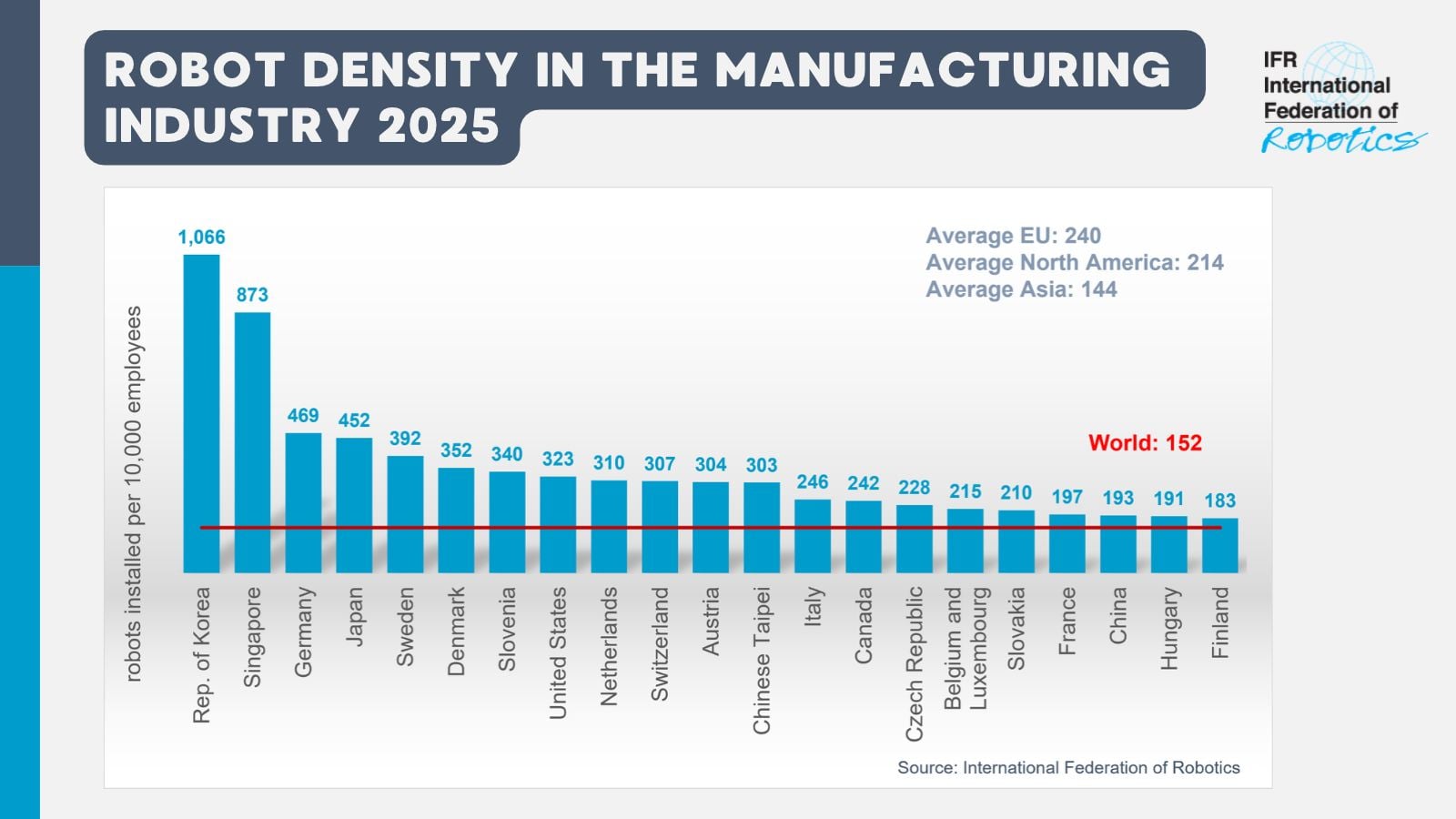
The global manufacturing industry reached a record 152 industrial robots per 10,000 employees, according to new data from the International Federation of Robotics. South Korea led the 2025 ranking with 1,066 robots per 10,000 manufacturing employees. Singapore followed with 873 and Germany placed third with 469.
The measure relates operational industrial robots to the number of employees and can be applied to manufacturing as a whole or to particular branches. Jane Heffner, the federation’s president, said the measure adjusts robot counts against manufacturing employment to provide a common basis for global analysis.
The federation reported a global average of 132 robots per 10,000 manufacturing employees for 2024 in an April statement. Its new country chart identifies the latest density figures as covering 2025.
Country rankings
Japan ranked fourth in the latest data, with 452 robots per 10,000 manufacturing employees. Sweden, Denmark and Slovenia followed with respective densities of 392, 352 and 340, according to the federation’s chart.
The Netherlands recorded 310 and Switzerland 307. The chart also put Austria at 304 and Chinese Taipei at 303 robots per 10,000 manufacturing employees.
China ranked 19th globally, with 193 robots per 10,000 manufacturing employees, according to the federation. Its density rose 147% from 2020 through 2025. The Chinese figure uses employment data from the National Economic Census conducted by China’s National Bureau of Statistics.
For 2024, IFR had reported China’s density at 166 robots per 10,000 employees and placed it 22nd worldwide. That calculation was based on updated labor-market data issued by the national statistics bureau.
Regional changes
The European Union reached 240 robots per 10,000 manufacturing employees, an increase of around 35% over the five years from 2020 to 2025, the federation said. Germany, Sweden, Denmark, Slovenia and the Netherlands were the five EU members among the ten highest-ranked economies.
North America’s density reached 214 robots per 10,000 employees, up around 24% over the same period. The United States remained eighth worldwide, at 323 per 10,000 manufacturing employees. Canada had 242 and Mexico 64.
Asia’s density reached 144 robots per 10,000 manufacturing employees, following an increase of about 47% from 2020 to 2025, according to the federation.
Robots in operation and new installations
In a September 24 release, IFR reported that the global operational stock of industrial robots rose 9% to a record 5 million units in 2025. Factories installed more than 600,000 new units during the year, an 11% increase in annual installations.
China accounted for 59% of global deployments, with 354,000 industrial robots installed in 2025, the federation reported. The United States installed almost 38,500 units, up 12%. Japan installed 36,219, a decrease of 19%.
Sources
- Original source International Federation of Robotics · Service robots record ifr.org
Other pages read
Related stories
- A3 Reports Q3 Robot Orders in North America Up 24.8% to 10,989 Units Worth $723.5M
- FANUC Raises Forecast as First-Half Sales Climb 16.2%
- ASUS says Gallop completes factory task-learning loop
- FCC reports $6 billion in U.S. drone manufacturing investment
- GXO and Apptronik plan up to 1,000 Apollo robots, subject to results