The Floor
Heave-Ho paper reports humanoid teams carrying loads without network links
A new preprint describes a decentralized system for humanoids to coordinate shared-object tasks using local observations and spoken commands rather than robot-to-robot network messages. Its authors report real-world trials with mixed robot-and-human teams and simulations scaling the controller to ten humanoids.
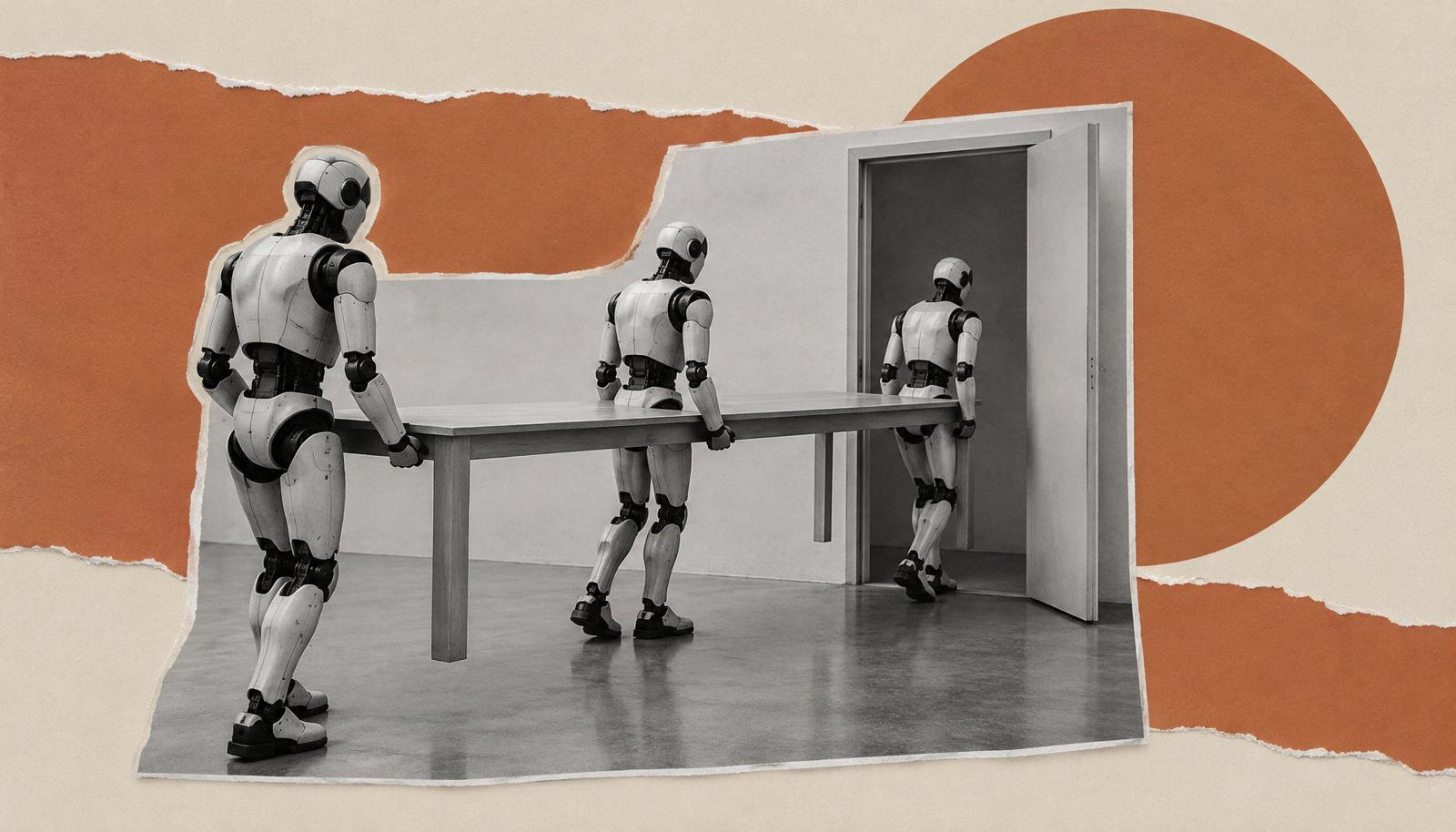
Robots coordinate through the shared load
A new preprint describes a decentralized system for humanoids to coordinate shared-object tasks using local observations and spoken commands rather than robot-to-robot network messages. The paper, posted to arXiv on Nov. 17, presents Heave-Ho as a framework for teams carrying, pushing, handing over and positioning objects together.
Each robot runs a shared low-level controller based on its own observations; the robots do not exchange network messages during a task. At a higher level, a vision-language planner selects the next team skill from the leader robot’s camera view. The leader speaks the skill, and followers recognize the command through onboard microphones and use a shared schedule to start together, according to the paper.
The controller handles movements such as lifting, putting down, stepping and turning. The paper says these skills start and end in common team configurations so that they can be chained into longer sequences. A human can also follow the spoken commands or take the leader role.
Benchmark spans 12 task types
The researchers introduce HH-Bench, a benchmark of 12 collaborative tasks for teams of two to ten humanoids. Tasks include carrying a table, moving through a narrow doorway or an L-shaped corridor, carrying on the shoulders, pushing, pulling, precise placement and handing a box to a partner. The benchmark covers both simulated and real-world evaluations, but the paper cautions that their success rates are not directly comparable: simulation starts from a wider range of positions, while real-world trials use a nominal setup with small perturbations.
In real-world experiments across several team configurations and tasks, the authors report 92 successful trials out of 100. The evaluated scenarios include two-robot doorway and corridor tasks, a box handover and placement, a person carrying with a G1 humanoid, and teams carrying a table. Stair carrying had the lowest reported result among those tests, at seven successes in ten trials.
Planner and controller results
The team evaluated the vision-language planner over five long-horizon tasks, with ten trials per task: two in the real world and three in simulation. The authors report an average success rate of 86% for Heave-Ho, compared with 98% for an operator manually selecting skills. The planner completed six of ten narrow-door trials and seven of ten L-shaped-corridor trials; it completed all ten trials in each of the three simulated tasks.
For low-level control, the paper reports a 94.41% average success rate across simulated HH-Bench episodes, compared with no more than 28.56% for the other tested controllers. Those results average over the 12 tasks, three simulation seeds and 512 teams per seed. The result is a simulation benchmark, distinct from the paper’s real-world trial totals.
Two-robot training, larger teams
The G1 controller was trained with two identical robots. In simulation, the authors ran the same policy, without retraining, on teams of four, eight and ten G1 humanoids carrying a table. In real-world tests, four G1s carried a table, as did mixed teams involving people and an EngineAI PM01 humanoid; the authors report 37 successful trials out of 40 across these scale-up and mixed-team tests.
The paper identifies limits in the coordination method: followers must hear the leader, so synchronization depends on a reasonably quiet environment and reliable sound pickup. It also says that training the planner for a new task requires demonstrations gathered manually through teleoperation.
Sources
- Original source · Preprint arXiv arXiv:2611.22275
Related stories
- LAGR preprint reports 93% success in tabletop grasp trials
- ReRead adds a cache-reading corrector to frozen robot policies
- Preprint Adds Human Avoidance to Humanoid Motion Tracking
- ReLoco preprint joins humanoid walking and fall recovery in one policy
- Virtual-joint method reuses humanoid locomotion training across three robots