The Floor
HermiteTwin models robot grasps separately from sheet deformation
A research preprint describes a digital twin that reconstructs thin deformable objects from robot-manipulation video. In tests on recorded cloth and foam interactions, the authors report lower average reconstruction error than two comparison methods.
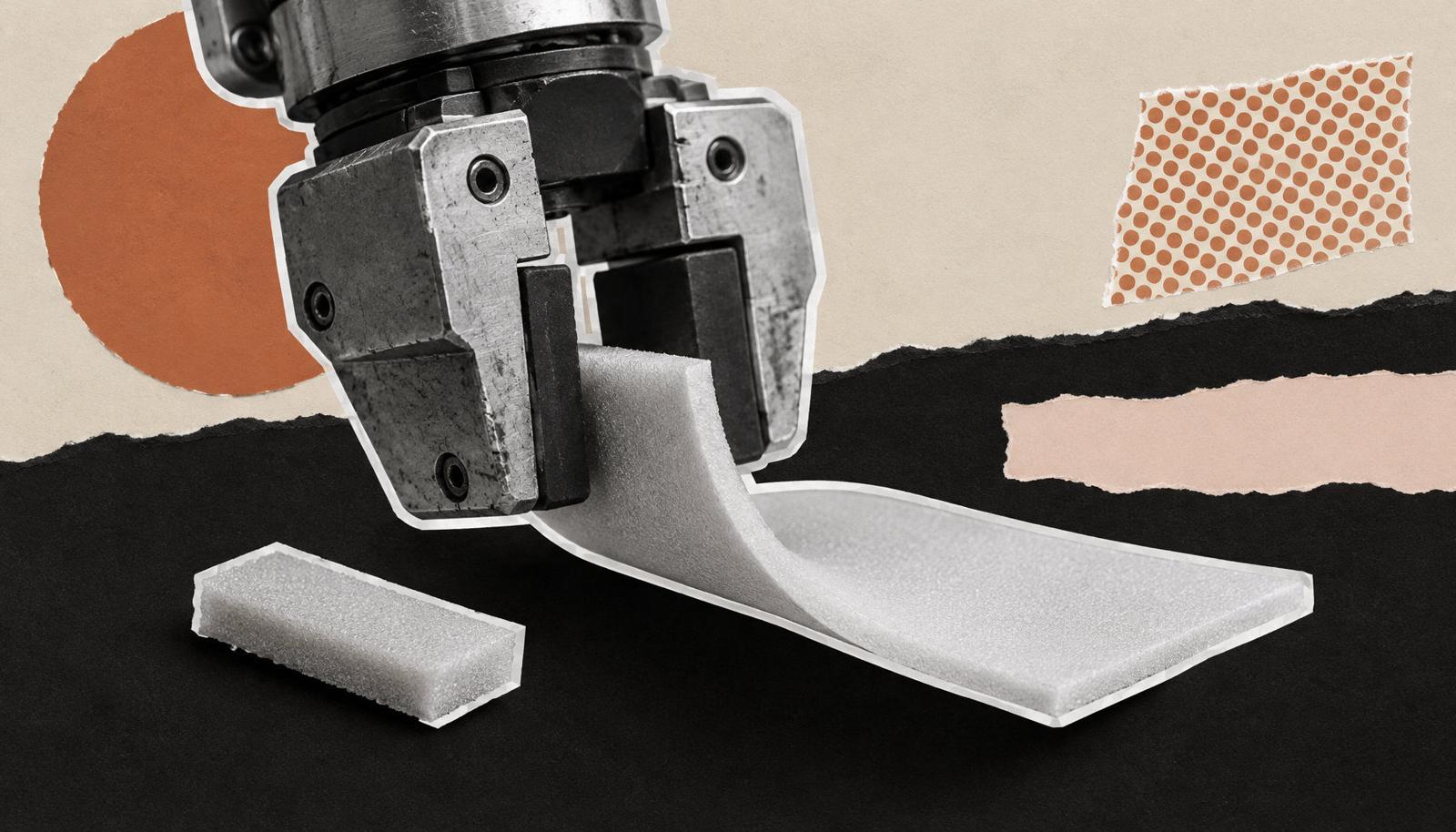
Researchers have built HermiteTwin, a digital-twin framework that models how a robot grips a thin, deformable object separately from how the object bends. In a preprint posted to arXiv, the authors report that the method reproduced recorded cloth and foam manipulation more accurately than two comparison methods in their tests.
The framework reconstructs a simulated object from multiview video of a robot manipulating it. Its authors are Kangrui Zhang, Mu Huang, Xing Shen, Tiantian Liu and Bo Ren.
Separating grasp and shape
HermiteTwin represents the object with a coarse bicubic Hermite shell: a grid whose nodes describe a smooth surface and its bending. Rather than using the same grid to resolve every detail of a grasp, it uses denser samples associated with positions on the material.
As the simulated gripper moves, samples can be captured, clamped and released. Their attachment forces are transferred to the shell, allowing the grasp to be represented at a finer resolution than the physical state of the object.
The inputs include calibrated multiview video, the gripper trajectory and its clamp-and-release schedule. The method reconstructs the rest surface and a Gaussian appearance model from the first frame, then estimates effective material and contact parameters by comparing simulated motion with tracked object points.
The parameter search uses CMA-ES followed by refinement with adjoint gradients. The appearance model moves with the simulated surface; image loss is not used to identify the physical parameters.
Tests against two methods
The team evaluated the method on ten recorded interactions from the Deform360 robot-manipulation dataset: eight involving red cloth and two involving a white foam sheet. Tactile signals supplied contact, clamp and release timing before fitting.
The comparisons were with PhysTwin, a spring-mass digital twin, and GS-Dynamics, a learned point-based simulator. All methods used the same observations within each interaction and carried the same Gaussian appearance model.
Across the fitting frames of the ten interactions, the researchers report an average 3D error of 42.05 mm² for HermiteTwin, compared with 61.89 mm² for PhysTwin and 116.95 mm² for GS-Dynamics. The reported metric was Chamfer distance, averaged with equal weight across interactions; lower was better.
For future prediction, the models were fitted on the first 300 frames of the eight red-cloth interactions and evaluated on the remaining recorded frames. HermiteTwin's reported average 3D error was 67.75 mm², against 120.40 mm² for PhysTwin and 552.40 mm² for GS-Dynamics. The recorded future robot motion and contact events were supplied to the models, so the test predicted the cloth's continuation under known control rather than the robot's actions.
Limits on new actions
The authors also transferred their grasp model to PhysTwin in a diagnostic cloth interaction. They report that the grasp engaged but did not recover the observed fold, suggesting that the shell representation, not just the grasp model, contributed to the difference.
Simulated new actions included draping cloth over a book, lowering it into a box and lifting cloth with a bottle resting on it. The new-action scenes were qualitative and had no real counterparts for comparison.
Each twin was identified from a single recorded interaction, and its parameters were inferred without force measurements. The authors say the method also depends on tracked points from calibrated multiview capture, while its appearance model does not reproduce effects such as view-dependent shading on wrinkles or surfaces newly exposed by folding.
Sources
- Original source · Preprint arXiv arXiv:2611.27282