The Floor
PACE estimates disturbances to improve quadruped tracking in tests
A new locomotion framework feeds disturbance estimates into a quadruped robot’s policy and joint-level controller. Researchers report lower velocity-tracking error in simulation and tested the method on a physical robot carrying an 11.5 kg payload.
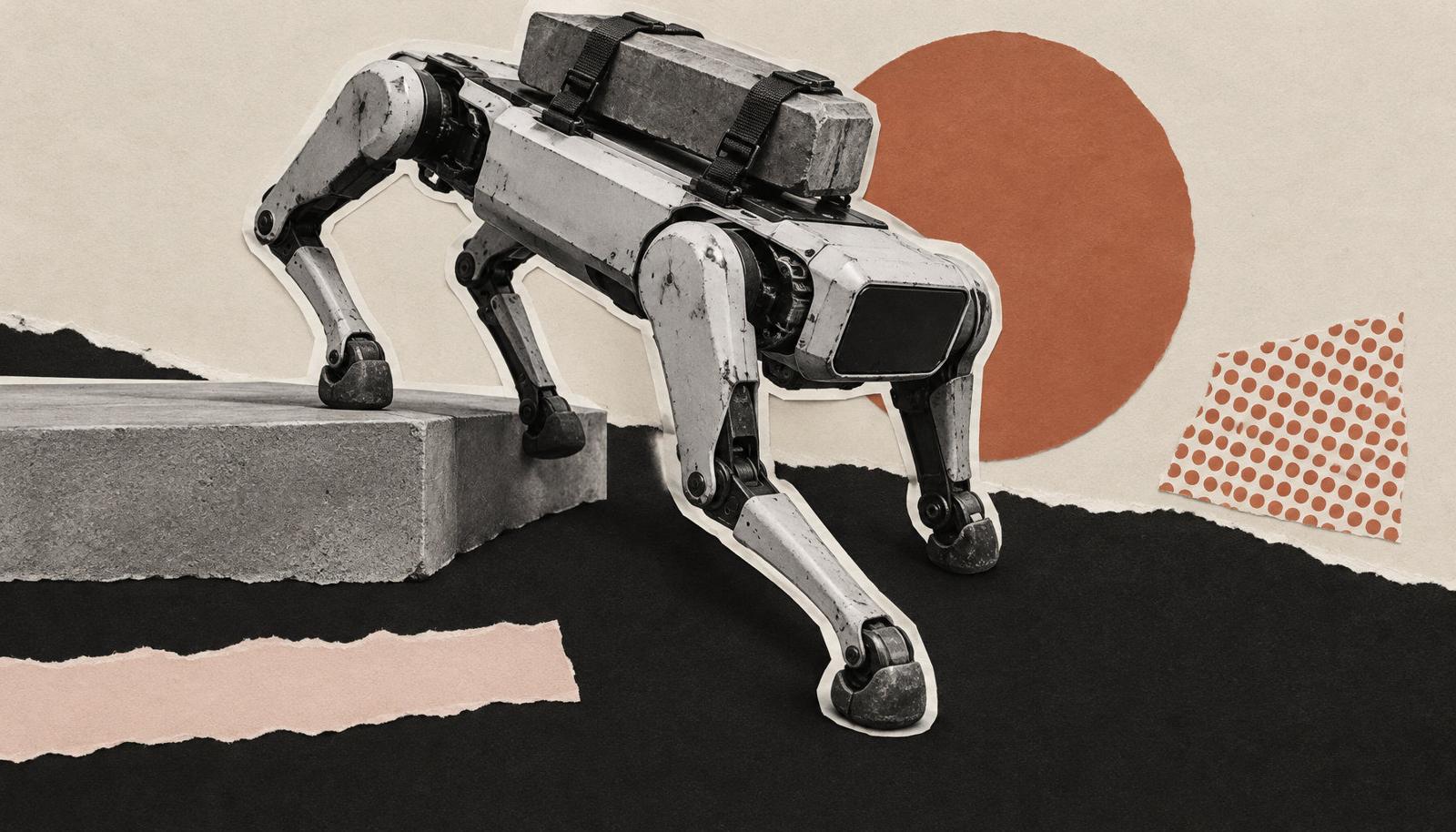
A quadruped locomotion method that estimates disturbances as a robot moves reduced velocity-tracking error by 18.1% to 57.0% against comparison methods across eleven simulated dynamics conditions, researchers report in a new preprint. Called PACE, the framework uses the estimate both to adjust joint-level torque and to inform the robot’s learned policy.
In physical tests, a DeepRobotics Lite3 running the method carried an 11.5 kg payload and descended a 16 cm step it had not encountered during training, according to the paper. The policy had been trained only on flat ground in simulation, with at most 3 kg of added mass.
Estimating the disturbance
PACE stands for Policy Augmentation and Compensation with Explicit disturbance estimation. The preprint was submitted on November 20 by a team including researchers from Beihang University and Nanyang Technological University.
The method combines effects including payload changes, shifts in the robot’s center of mass, actuator degradation and external forces into a joint-space disturbance. A nonlinear observer estimates that disturbance during operation without requiring joint acceleration measurements.
The estimate enters the controller through feedforward torque compensation and is also supplied as an observation to the policy generating the robot’s actions. Both pathways are present during training and retained when the policy is used on the robot.
The researchers also developed a contact-force estimator that uses joint and inertial measurements rather than dedicated force sensors. In simulation, the paper reports that the reconstructed vertical force tracked the simulator reference with a 2.7 N root-mean-square error.
Simulation comparisons
All four methods were evaluated in simulation; the physical robot tests covered BASELINE and the two PACE configurations.
Averaged across eleven simulated conditions involving payloads, center-of-mass shifts and actuator degradation, PACE had 57.0% lower velocity-tracking error than BASELINE, 18.1% lower than HIMLOCO and 32.8% lower than the feedforward-only variant, the authors report. The comparison used a fixed commanded horizontal velocity and yaw rate.
The paper also describes an out-of-distribution command test: during training, commanded linear velocities were sampled from −1 to 1 m/s, while evaluation included a 2 m/s forward command. The authors report that PACE maintained stable locomotion under that unseen command while BASELINE initially fell repeatedly.
Payload and terrain trials
In the physical payload test, the load attached to the robot’s base was increased until it could no longer complete the prescribed locomotion trial without falling. PACE maintained stable forward locomotion with 11.5 kg, nearly equal to the robot’s own 11.6025 kg mass; tests with greater payloads were unsuccessful, the paper says.
For step-down tests, platform heights ranged from 8 cm to 16 cm in 2 cm increments, with five trials per method at each height. The authors report that PACE completed all trials at 16 cm; tests at greater heights were unsuccessful for all methods.
The team tested five unseen outdoor terrains: flagstone, lawn, sand, gravel road and large rocks. Each method had five traversal trials on each terrain, with success defined as crossing the test segment without falling.
PACE recorded 100% success on the first four terrains and 60% on large rocks. The feedforward-only variant recorded 80% on large rocks, a result the authors say suggests that the benefit of adding the estimate to policy observations can vary under highly irregular contact conditions.
Sources
- Original source · Preprint PACE: Policy Augmentation and Compensation With Explicit Disturbance Estimation for Robust Locomotion arXiv:2611.27061
Related stories
- Ai2 releases RoboTrack benchmark and point-tracking models
- ManipScope preprint finds weak instruction following in robot tests
- MomentMem improves robot memory tests in simulation and on hardware
- PonderPounce-WM tests future prediction in robot control
- FORTH preprint pairs robot learning losses with force measurements