The Floor
Preprint reports faster planning with SI-MPPI in map simulations
A preprint introduces SI-MPPI, a planner that combines Monte Carlo tree search with GPU-batched trajectory optimization. Its authors report shorter planning times than two RRT*-based baselines across four simulated maps, while noting that the tests used static, known environments.
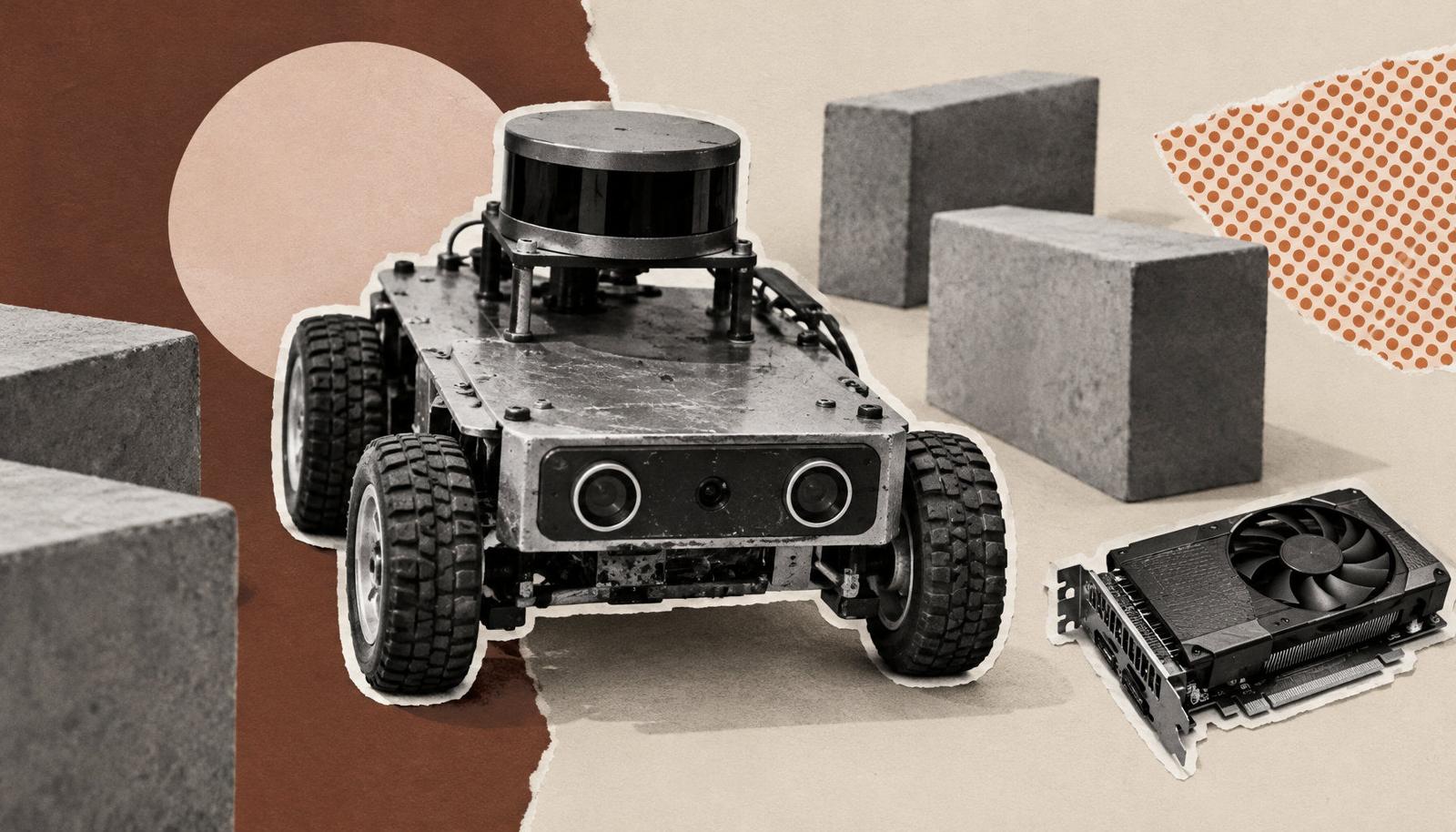
A planner built around tree expansion
A preprint posted on November 19 introduces Search-Informed MPPI (SI-MPPI), a planner that combines Monte Carlo tree search with Model Predictive Path Integral optimization. The authors report that it planned faster on average than two RRT*-based methods in simulations across four cluttered maps, while keeping path lengths broadly comparable.
Source arxiv.org
The method uses tree search to select which alternatives to explore over longer routes, then runs MPPI to optimize short motion segments toward intermediate targets the paper calls “baits.” It checks candidate segments for collisions and progress, and adds the lowest-cost accepted candidates to the search tree. The process uses GPU-batched trajectory rollouts and adapts later searches using results from earlier expansions.
Four maps, three comparisons
The evaluation used four 100-by-100-meter occupancy-grid maps and compared SI-MPPI with kinodynamic Monte Carlo tree search, LQR-RRT*, and Informed Kinodynamic RRT*. Each planner ran five trials on each map. All four planners succeeded in every reported benchmark trial.
Across the maps, the authors report that SI-MPPI reduced average planning time by 26.8 times compared with LQR-RRT* and 9.7 times compared with Informed Kinodynamic RRT*. Its average path length was 14.7% shorter than LQR-RRT*’s and 2.7% longer than Informed Kinodynamic RRT*’s. Against kinodynamic Monte Carlo tree search, SI-MPPI reduced average search-tree size from 8,032.90 nodes to 521.35 and average path length by 21.8%, but took 8.38 seconds on average to plan, compared with 5.97 seconds for that baseline.
Benchmark conditions and limits
The comparisons ran on a system equipped with an NVIDIA GeForce GTX 1660 Ti laptop GPU. SI-MPPI used the GPU for trajectory rollouts; tree management and the three baseline planners ran on the CPU. The paper says all methods were implemented in Python and evaluated with a shared occupancy-grid representation, rectangular robot footprint, and logging pipeline.
The authors describe the work as offline planning for static, known maps and say the method does not guarantee the shortest route. They also note that its planned trajectories had relatively low speeds; a separate receding-horizon MPPI controller can track the resulting waypoints, as illustrated in supplementary video. The reported results are simulations, not tests of a robot navigating a physical environment.
Sources
- Original source · Preprint arXiv arXiv:2611.26763
Related stories
- Preprint Sets Deadlines for Robots Awaiting Language-Model Plans
- Preprint puts robot control policies inside 3D route planning
- Preprint finds hand-written planners beat UniAD in some tests
- Preprint presents FlowRRT planner for monoped hopping
- Robot memory model cuts planning latency in tests, researchers say