The Floor
PRISM preprint proposes a way to retain VLA skills in composite tasks
A preprint accepted at NeurIPS 2026 describes PRISM, a method that stores robot-manipulation skills as separate adapters and routes among them as a task progresses. On RoboCasa365, the authors report higher atomic-skill success than a two-stage fine-tuning baseline, alongside a smaller gain on long-horizon composite tasks.
Retaining skills while combining them
A preprint whose authors say it was accepted at NeurIPS 2026 introduces PRISM, a method for retaining previously learned manipulation skills while combining them in longer tasks. The paper was submitted to arXiv on November 6, 2026. Its authors are Jiachen Tao, Gengyu Zhang, Haoxuan Wang, Bing Liu and Yan Yan.
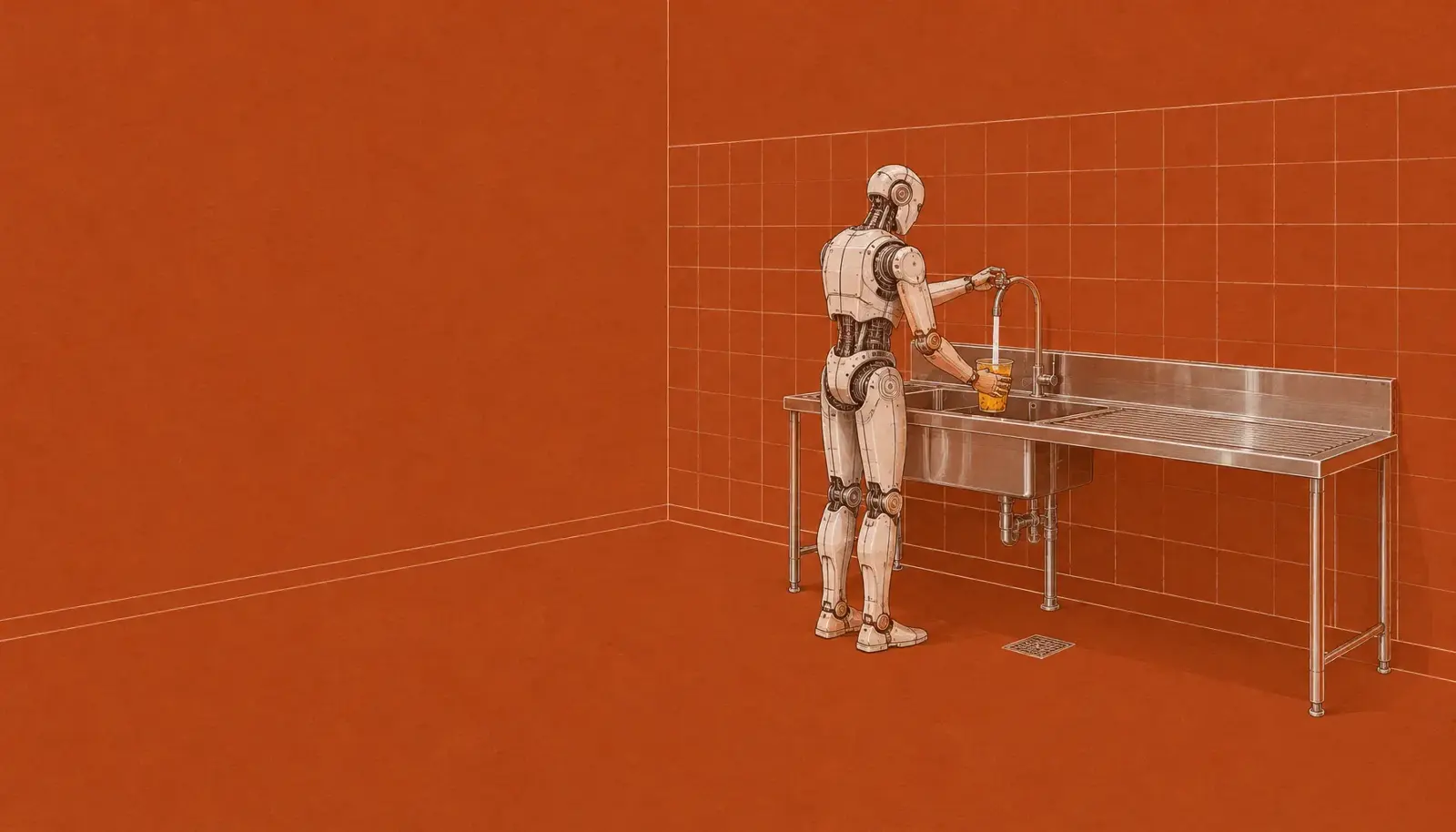
Vision-language-action (VLA) models are intended to support multiple language-directed manipulation behaviors, but the authors identify skill retention and long-horizon composition as additional requirements. They describe a common problem with adapting a policy to new tasks: each task is absorbed into a shared update, with no parameter-level location for reusable skills and no mechanism to call those skills at different points in a task. Sequential fine-tuning can also degrade previously acquired behaviors. A composite task, such as washing an object by turning on a water source and then moving the object through the stream, may instead be trained end to end even though it combines skills the policy has already learned.
From skill updates to a primitive bank
The authors report that low-rank updates trained for separate skill families occupy a distinguishable, low-dimensional subspace of the action-expert parameters. Their analysis says this structure recurs across independently trained checkpoints. They also find that a composite-task LoRA places roughly half of its Frobenius energy in the subspace, compared with a near-zero result in a matched random-rotation control. The paper describes this as evidence that composite behavior can partly be expressed through existing skill updates.
PRISM turns those updates into parameter-level primitives. It stores each skill family as a dedicated low-rank action-expert adapter in a primitive bank, then augments the primitives with skill-specific low-rank residuals for composite-task training. The base primitives are held frozen during that training. The authors call the loss of separately addressable skill-specific directions during shared sequential training “primitive collapse”; their design aims to preserve those directions while enabling later adaptation.
Routing as a task progresses
The method uses a router to select or mix primitive branches at inference. It makes a decision for each action chunk, using a prefix representation that combines the current instruction and visual state. Because the instruction remains fixed while the sub-goal changes, the authors condition routing on that prefix so the selected mixture can change across phases of a long-horizon task.
A deterministic, task-conditioned, action-derived oracle supplies per-chunk labels to supervise the router. During composite training, PRISM updates the vision encoder, language LoRA, skill residuals, router, shared action projections and time MLP, while leaving every primitive adapter frozen. The paper says this preserves the base per-skill action-expert adapters by construction.
Reported results
On RoboCasa365, PRISM achieved 56.43% atomic-skill success and 20.00% success on long-horizon composite tasks. The comparison standard two-stage π0.5-LoRA fine-tune reached 17.86% atomic-skill success and 17.50% composite-task success. The authors also report validating PRISM on an AgileX PIPER real-robot setup.
Sources
- Original source · Preprint arXiv arXiv:2611.08917
Related stories
- VICTR Preprint Reports 23.8% Success on Unseen Out-of-Domain Real-World Robot Tasks
- Preprint finds retrieval rivals some VLAs on simulated robot tasks
- ActPrune Uses Predicted Robot Motion to Prune VLA Tokens
- Preprint reports up to 3.75× robot capacity for VLA serving
- RoboColosseum Tests Robot Policies in 5,699 Comparisons at 124 Sites