The Floor
RESONATE Tests Social Navigation in 320 Physical Trials
RESONATE evaluates eight robot-navigation controller configurations in eight scenarios involving people, with five repetitions per scenario. The paper reports different strengths across controllers, including a 100 percent success rate for one configuration and failures for another in a narrow-turn test.
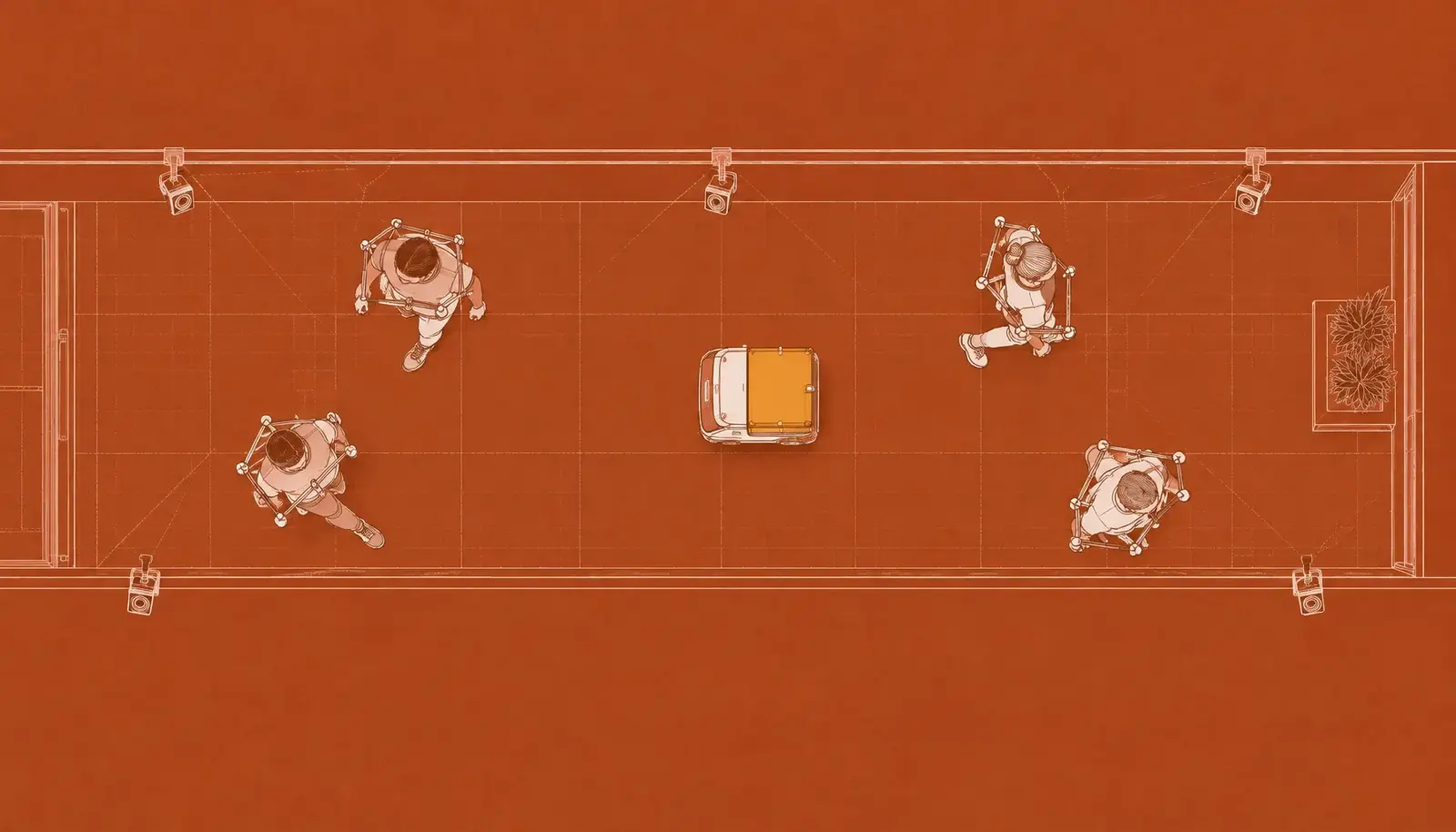
In one RESONATE trial, a person tracks a mobile robot and actively tries to block its path while keeping about 50 centimeters away. The test is one of eight structured encounters in a physical benchmark introduced in a paper submitted to arXiv on November 2, 2026.
Results reveal scenario-dependent trade-offs among the tested methods.
Stefano Trepella, Andrea Ostuni, Mauro Martini, Irene Borgini and Marcello Chiaberge, paper authors
A Jackal, motion capture and real pedestrians
RESONATE uses a Clearpath Jackal mobile robot, running a ROS 2 and Nav2 software stack, to compare local navigation controllers in closed-loop tests with human participants. Ten VICON cameras track the robot and people, providing position ground truth with millimetric error. The experiments take place in a 4.0-by-5.0-meter area, with the robot’s speed capped at 0.6 meters per second.
The benchmark covers passing, overtaking, three crossing patterns, a narrow turn, a mixed encounter and the curious-person test. That last scenario asks a person to follow the robot’s position and interfere with its route, while the first seven use people who walk around the robot and change course to avoid potential collisions.
The study compares eight controller configurations: variants of the Dynamic Window Approach (DWA) and Model Predictive Path Integral (MPPI) planners, plus standalone Optimal Reciprocal Collision Avoidance (ORCA) and Social Force Model (SFM) controllers. DWA and MPPI are each tested with a basic obstacle-only setup, a Gaussian social costmap, and an SFM-based social-cost method. Each controller runs five times in every scenario, for 320 physical experiments.
Efficiency is only part of the score
The evaluation combines navigation measures—including success rate, path length and time to goal—with social measures such as distance from people and time spent in different proxemic zones. Human participants also rate safety, friendliness, naturalness and the robot’s ability to anticipate avoidance needs.
Thirty people took part, and each participant received a survey at the end of the experiment. The paper reports 278 successful runs and 42 failures across the benchmark: seven collisions with a person, eight collisions with the environment, 24 timeouts and three navigation failures.
Different controllers lead in different situations
The DWA configuration with a Gaussian social costmap achieved a 100 percent success rate across all eight scenarios, making it the benchmark’s most reliable implementation. The authors identify SFM-MPPI—the MPPI planner paired with an SFM-based social cost—as the best overall balance of reliability, navigation efficiency and social acceptance.
Those findings are not a universal ranking: the paper reports scenario-dependent results, and the authors caution that five repetitions per controller-scenario combination limit statistical power. After statistical correction, significant differences appeared for some, but not all, measured outcomes and scenarios. The narrow-turn test exposed a particular weakness for SFM-DWA, which failed in four of its five runs; SFM-MPPI succeeded in all five.
Trajectories and software are available
The paper says the benchmark releases the recorded trajectories with motion-capture ground truth, anonymized participant ratings, ROS 2 and Nav2 plugins, maps, configuration files and an evaluation pipeline. The results offer a shared physical protocol for comparing navigation methods, while the trial outcomes show why performance on a passing route cannot stand in for performance in a tight turn or an obstructed crossing.
Sources
- Original source · Preprint arXiv arXiv:2611.02937
Related stories
- Preprint tests simulated planner for humanoid groups around people
- RobotWorld Finds the Top Agent Finishes 19% of Robot Tasks
- ROS 2 simulation study reports faster, repeatable tests
- Arduino introduces RouterBridge_ROS for bringing board I/O into ROS 2
- StrataSLAM is released for multi-floor mapping in ROS 2