The Floor
Russia sends Teledroid robot toward space station for tests
A Progress cargo spacecraft launched with a two-armed humanoid robot for an experiment aboard the International Space Station. Roscosmos plans tests in a simulator, inside the station and on its exterior.
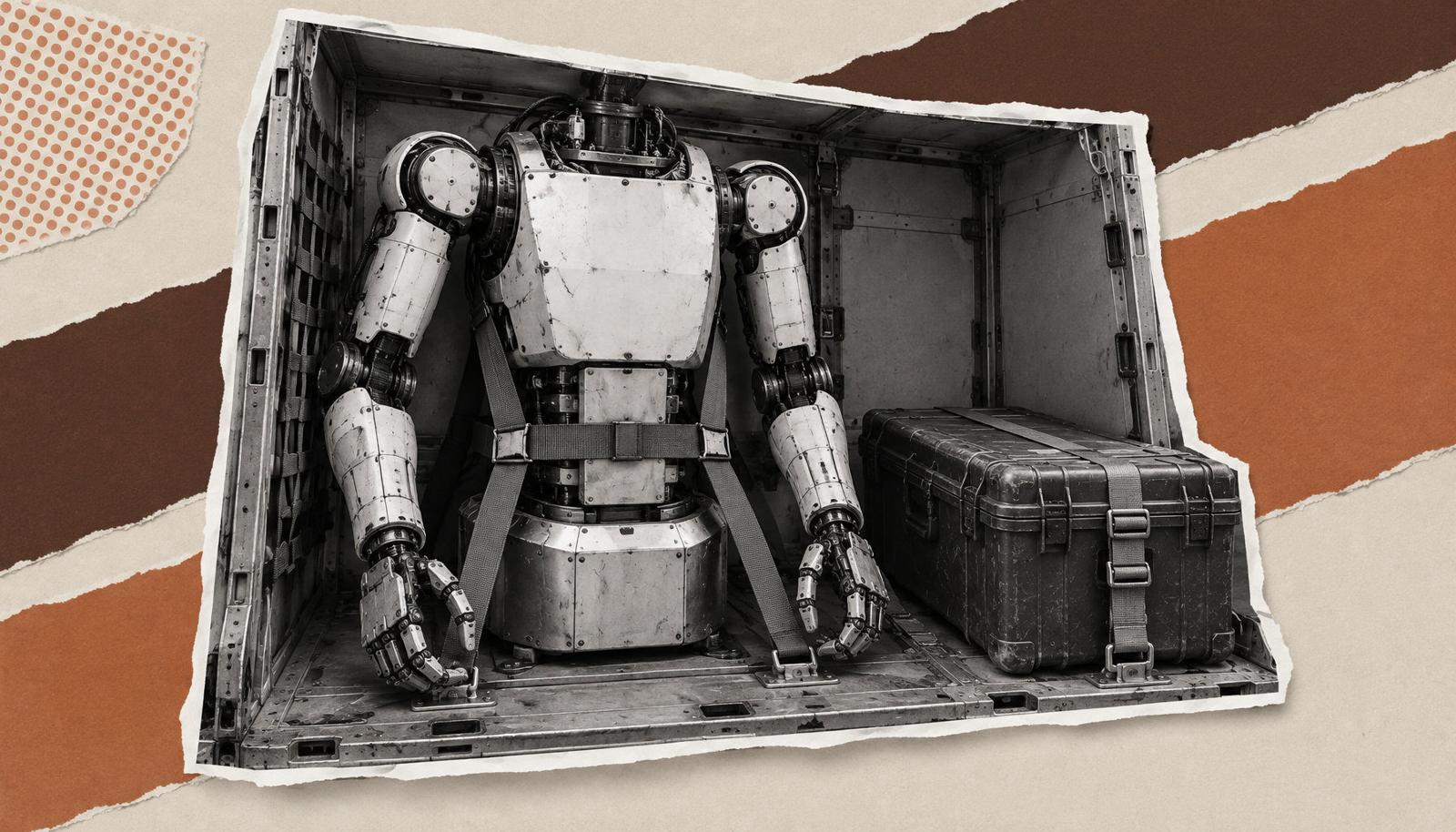
A two-armed humanoid robot is on its way to the International Space Station aboard a Russian cargo spacecraft for a planned experiment inside and outside the station. Roscosmos said the robot, called Teledroid, was carried on Progress MS-36 when it launched from Baikonur on November 24.
The Soyuz-2.1b rocket lifted off at 13:17 Moscow time, according to TsENKI, the ground-based space infrastructure operator. The spacecraft reached its intended orbit, separated from the rocket's third stage and deployed its antennas and solar panels.
Robot headed for station tests
Teledroid is a torso-type manipulator with two arms and 30 degrees of movement. Roscosmos says the robot is designed to withstand vacuum, radiation and extreme temperature changes and will be able to use tools familiar to cosmonauts, including a hammer, ratchet wrench and carabiner.
The agency describes three operating modes. In copying mode, a cosmonaut controls the robot's movements through an exoskeleton with force feedback. In supervisory mode, an operator assigns a task for the robot to perform using machine vision; an automatic mode would use preset scenarios.
Work inside and outside
The experiment is planned for 40 sessions: 20 on a virtual simulator, 12 inside the station's Russian segment and eight on its exterior. Cosmonauts Pyotr Dubrov and Anna Kikina are to operate the robot.
Roscosmos says the experiment is intended to test a robot that could take on routine and potentially dangerous operations for crews. The planned sessions are tests, not an operational deployment.
Supplies on board
Roscosmos expects the spacecraft to dock with the station's small research module on November 26 at 15:10 Moscow time. Progress MS-36 is carrying more than 2,400 kg of cargo, including equipment and supplies for Teledroid and the Aseptik, Kaskad and Orbita-MG experiments.
Its cargo includes 750 kg of fuel for refueling the station, 420 kg of water for Roscosmos cosmonauts, 51 kg of oxygen and 261 kg of food, including fresh produce. The manifest also lists 657 kg of equipment and consumables for station operations and crew science, 247 kg of sanitary equipment and hygiene supplies, and 41 kg of medicines and supplies for counteracting the effects of weightlessness.
Sources
- Original source TsENKI “С Байконура стартовала ракета-носитель «Союз-2.1б» с кораблём «Прогресс МС-36»” russian.space
Other pages read
- Roscosmos “Роскосмос” t.me
Related stories
- Researchers report safe robot planning without retraining
- HumanoidPose preprint targets 3D robot pose from monocular video
- NIOSH seeks input on humanoid robot workplace safety
- Preprint tests simulated planner for humanoid groups around people
- XPeng puts 76-degree-of-freedom Iron on stage for live questions