The Floor
A New Self-Labeling Method Carries Robot Preferences Across Tasks
A study submitted to arXiv on October 27, 2026, tests a method for carrying robot movement preferences from one manipulation task to another without target-task preference labels. In simulation and two real-robot transfers, the method improved preference following while maintaining similar task success to naive fine-tuning.
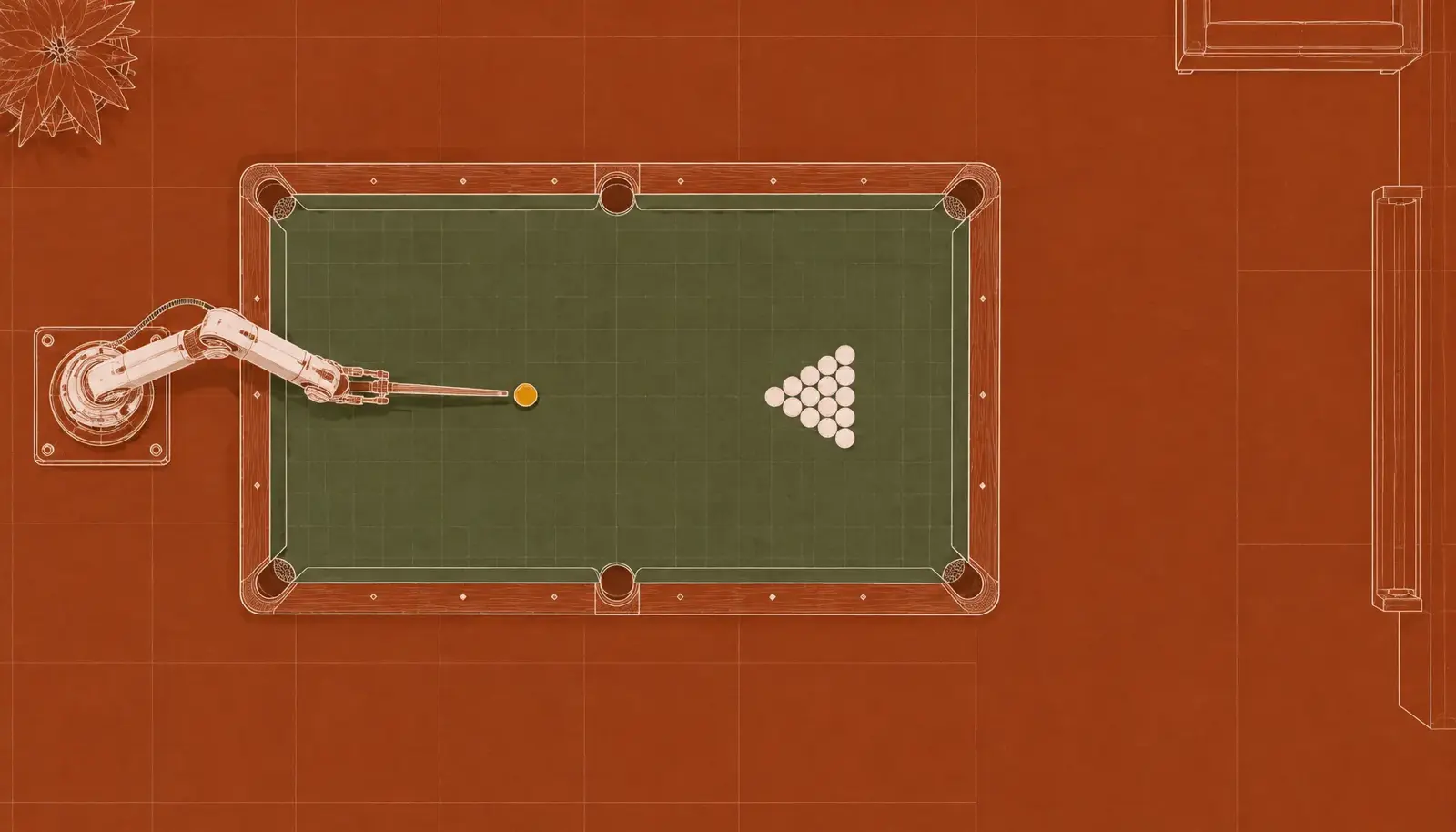
The robot transfers preferences between task types
A UR5e arm carries learned movement preferences from one kind of manipulation to another in a study submitted to arXiv on October 27, 2026. Researchers transfer clearance preferences from pick-and-place around an obstacle to pushing a bowl, and strike strategies from air hockey to billiards, where the robot uses a direct or bank shot.
The paper, “Self-Labeled Preference Transfer for Steerable Robot Manipulation,” targets a gap in vision-language-action (VLA) policies: a new task may come with demonstrations, but not with labels explaining how each demonstration was performed. Fine-tuning on target demonstrations without preference labels can improve task success while weakening preference control, the authors report. Execution preferences include “grasp low” or a “wide detour.”
The recognizer labels target demonstrations
The method, called Self-Labeled Preference Transfer (SPT), has two stages. First, a shared vision-language backbone learns from labeled source demonstrations both to perform a requested preference and to recognize that preference in a short demonstration. Then a frozen copy of the recognizer labels demonstrations for a target task; a trainable policy uses those inferred labels while adapting to the new task.
Target demonstrations still matter: they must show the relevant behaviors, even though researchers withhold their preference labels during adaptation. The method also uses a predefined preference vocabulary. At deployment, only the action policy runs; the recognizer is not called again.
“We study whether learned preference control can transfer to new tasks whose demonstrations contain the desired behaviors but lack preference annotations.” The authors write.
Simulation gains preference control without losing task success
In RoboTwin 2.0 simulations, the researchers test five binary preference types: grasp contact height, release height, obstacle clearance, grasp orientation and placement location. The recognizer labels target demonstrations with 96.4% average accuracy. Across the five axes, the results table reports that SPT follows the requested preference in 83.8% of rollouts, compared with 59.4% for naive fine-tuning; average task success is 89.2% and 88.0%, respectively.
The authors also test two simultaneous preferences in simulation: SPT follows both in 93.8% of rollouts, against 42.5% for fine-tuning from the same initialization without self-labeling.
Two real-robot transfers, 40 trials
For the real-robot tests, the team uses a UR5e and two transfers between task types. SPT follows the requested preference in 37 of 40 trials, compared with 21 of 40 for naive fine-tuning. Task success is 38 of 40 for SPT and 36 of 40 for the baseline.
The results cover bowl pushing with near- or far-path preferences and billiards with direct- or bank-shot strategies. Each target task has 20 trials across its two preference commands. The experiment supports transfer across these tested tasks; it does not show that the method can infer an unrepresented behavior or handle an open-ended preference vocabulary. The authors identify continuous and open-vocabulary preferences, unseen preference combinations and recognition that can abstain on unfamiliar behaviors as future work.
Sources
- Original source · Preprint arXiv arXiv:2610.38000
Related stories
- VICTR Preprint Reports 23.8% Success on Unseen Out-of-Domain Real-World Robot Tasks
- Preprint finds retrieval rivals some VLAs on simulated robot tasks
- ThinkWorld Trains Robot Policies by Scoring Imagined Futures
- RoboColosseum Tests Robot Policies in 5,699 Comparisons at 124 Sites
- ActPrune Uses Predicted Robot Motion to Prune VLA Tokens