The Floor
SemPhys trains humanoid motions against simulated execution
An arXiv preprint presents SemPhys, a framework that scores a humanoid’s executed motion against the instruction that generated it. The authors report higher instruction-retrieval accuracy than the methods they evaluated on the BONES-SEED benchmark.
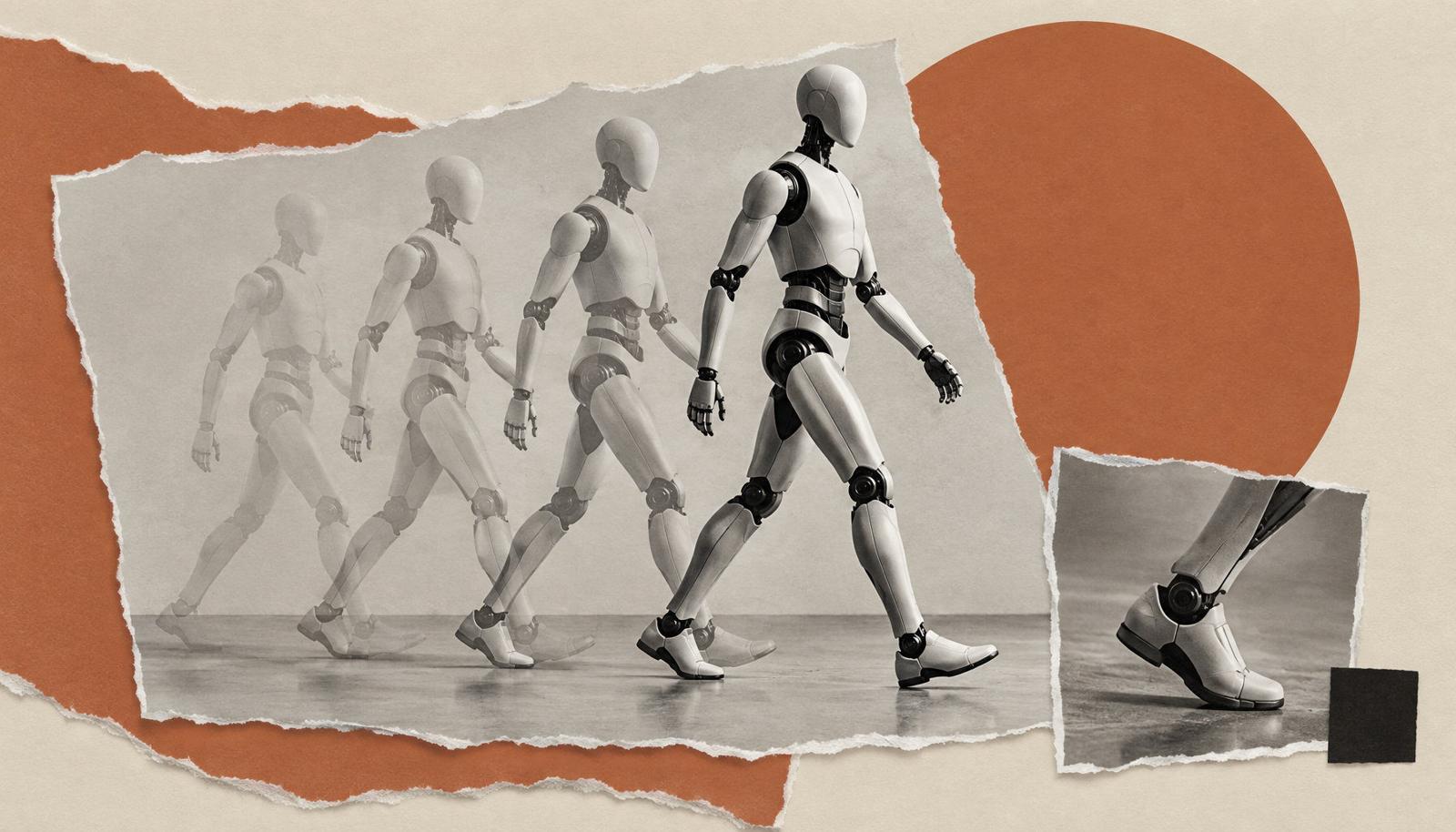
A humanoid motion generator trained to account for how a tracking controller changes its movements matched language instructions in 79.62% of executed test clips, versus 60.10% for the strongest baseline, the authors of an arXiv preprint report. The system, called SemPhys, evaluates the robot’s executed motion—not just its generated reference—against the instruction.
Learning from the executed motion
The paper, dated November 18, 2026, addresses a gap between a motion generator’s output and what a humanoid actually does. A generator can produce a kinematic reference for an instruction, then a tracking controller can alter that movement while maintaining balance under contact constraints. The authors say those corrections can change the action conveyed by the motion.
SemPhys combines a text-conditioned motion generator with a fixed tracking controller and a differentiable world model. During training, the controller and model predict a short segment of a simulated execution. The system inserts that segment into its original position in the larger trajectory, scores the complete motion against the instruction, and sends gradients back through the predicted segment to update the generator.
The paper says the full episode provides context for interpreting a local movement. In an example involving a turn followed by a walk, the motion before the predicted segment establishes whether the turn came first, while the later motion shows what followed. A paired anchoring loss also keeps each updated reference close to the initial generator’s output for the same instruction and noise input.
Benchmark results
The researchers evaluated SemPhys on the processed BONES-SEED benchmark. Its test split contains 13,302 motion clips, including 13,082 upright tasks used to measure sustained physical failure. For the comparison, the same frozen tracking controller executed each method’s generated references on a simulated Unitree G1.
SemPhys achieved 79.62% rank-one instruction retrieval on executed clips, compared with 60.10% for MDM, the strongest baseline on that measure. The paper reports a mean sustained-failure rate of 0.25 per thousand upright tasks for SemPhys. These results are from the benchmark evaluation under the shared controller; the paper separately reports that its retrieval measure tests the correct instruction against pools of 32 candidates.
A blind perception study covered 50 instructions rated by 10 respondents. The authors report average scores of 2.44 out of 3 for motion naturalness and 2.68 out of 3 for semantic alignment. In a separate robustness evaluation, the method averaged 78.89% executed rank-one retrieval and 0.70 failures per thousand upright tasks across 16 simulated conditions that varied body mass, actuator strength, ground friction and joint damping.
Hardware demonstration
The paper also describes a real-world demonstration on a Unitree G1: the robot turned and then took forward steps in the new direction. The researchers say they deployed the generator and tracking controller without hardware fine-tuning.
At deployment, the generator produces a reference from an instruction and an event plan, and the tracking controller follows it using robot feedback. The world model and semantic matcher are used during training, not for online rollouts or scoring during execution.
Sources
- Original source · Preprint SemPhys: Semantic-Physical Co-Learning for Humanoid Motion Generation via Differentiable World Models arXiv:2611.24074
Related stories
- Paper reports 75% success for WEVO humanoid learning
- Verify2Act checks robot plans in imagined scenes before execution
- ReLoco preprint joins humanoid walking and fall recovery in one policy
- JEPA Dots separates language goals from robot world prediction
- NIOSH seeks input on humanoid robot workplace safety