The Floor
SomaAlign Pairs 74,914 Multimodal Samples With Soft-Grasp Learning
A new dataset for soft-robot grasping combines 74,914 multimodal samples from 1,000 trajectories involving 100 objects. SomaAlign, the paper’s representation-learning method, reports 90.66% average Recall@10 across 30 directed cross-modal retrieval tasks.
74,914 samples target a gap in soft grasping
A new dataset for soft-robot grasping brings together 74,914 multimodal samples from 1,000 continuous grasping trajectories involving 100 objects. The work, posted to arXiv on November 2, introduces Soma alongside SomaAlign, a representation-learning method designed to account for noisy, mismatched sensor streams during contact.
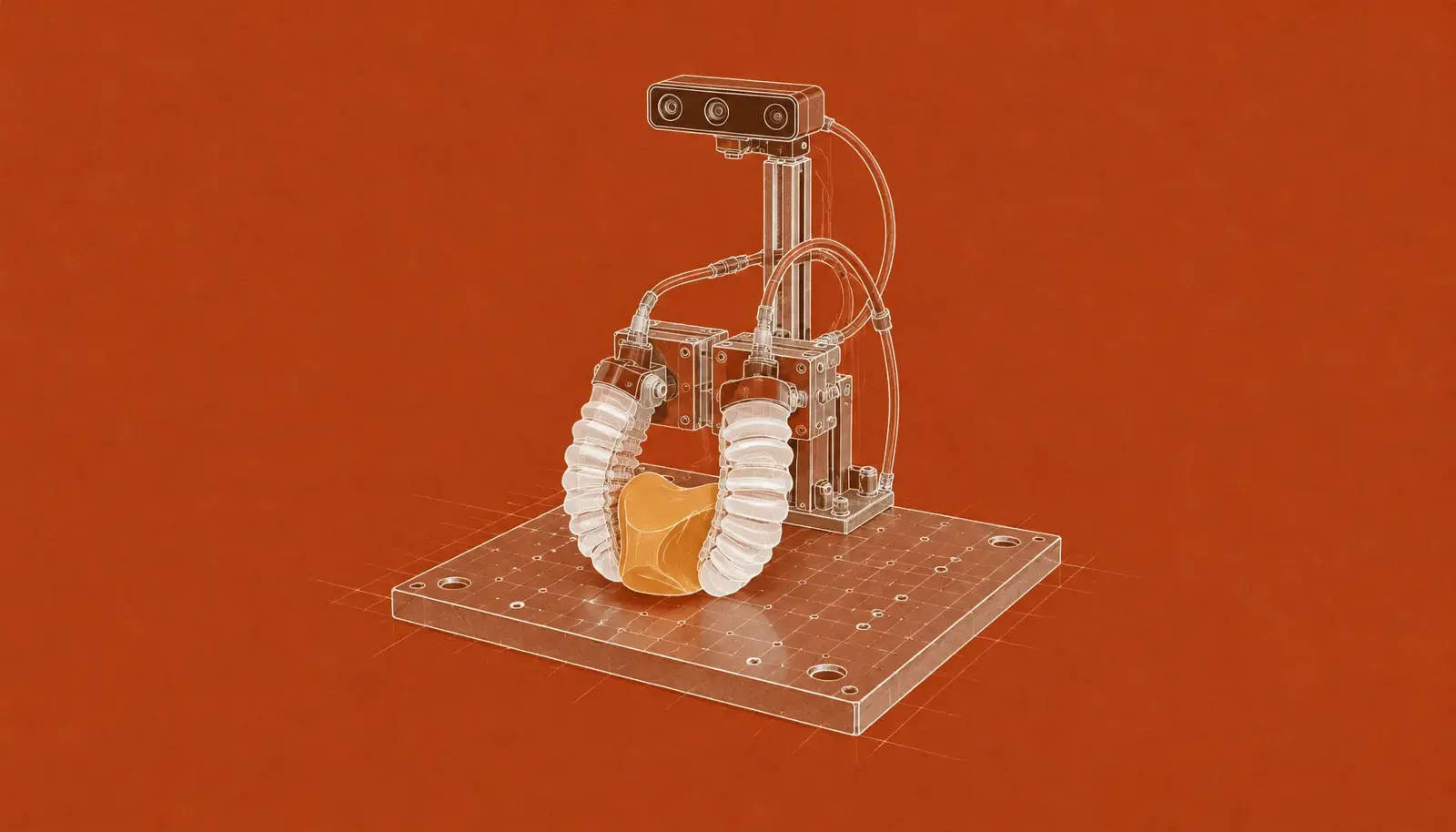
Each cycle-aligned sample combines remote and hand-mounted RGB images, depth, tactile pressure, inertial measurements and structured text. The authors collected the data using two- and three-finger pneumatic soft grippers, with annotations covering stationary and sliding grasp states. They argue that soft grippers’ deformation and changing contact conditions make it harder to interpret sensor signals than in more rigid setups.
Reliability estimates shape how sensors align
SomaAlign trains representations in three stages. Masked reconstruction estimates the relative reliability of each modality; a contrastive-learning stage adjusts alignment strength for each sensor pair; then conflict-aware constraints bring inconsistent signals from the same sample into better agreement while preserving the embedding’s broader geometry.
“SomaAlign achieves an average Recall@10 of 90.66% across 30 directed cross-modal retrieval tasks.”
Haoyuan Wang, Shuai Peng, Yongkai Liao, Yuxiao Sun, Wei Luo, Xinxing Chen and Jian Huang, authors of “SomaAlign: Reliability-Aware Multimodal Representation Learning for Soft Robotic Grasping”
For each query, Recall@10 counts a success when at least one valid positive appears among the ten highest-ranked gallery entries. The paper uses the paired observation from the same time window as the positive for sensory-to-sensory retrieval; for text-to-sensory retrieval, all observations sharing the queried structured description are valid positives. The paper also tests physical-attribute recognition, multimodal question answering and cross-modal generation, but its central practical test asks whether representations learned on Soma transfer to grasp-outcome prediction.
Post-grasp accuracy tops 94%; early results are less strong
For that test, the team collected a separate set of 1,000 grasp trials across 100 objects; quality control left 998, with 600 successful and 398 failed grasps. SomaAlign’s encoders stayed frozen while lightweight classifiers were trained and evaluated through five-fold cross-validation grouped by object, so trials involving the same object did not cross between training and test folds.
Using observations from before, during and after a grasp, a two-layer classifier reached 94.59% accuracy with SomaAlign features, the highest post-hoc result among the representations compared. Early prediction uses only pre-grasp and mid-grasp observations: there, SomaAlign’s two-layer classifier reached 84.07%, below the 86.48% recorded by the Hub Alignment baseline. The paper therefore shows a stronger result for classifying an outcome after the lift than for predicting success before the robot has completed it.
The paper stops short of closed-loop grasp control
The authors say the SomaAlign implementation code is publicly available.
The study also uses supervised probes for the independent outcome task, rather than demonstrating zero-shot transfer, and its authors call for broader tests across platforms and sensor configurations. Their evaluation measures representations and predictions; it does not show a gripper changing its actions in response to SomaAlign during a live grasp.
Sources
- Original source · Preprint arXiv arXiv:2611.02794
Related stories
- Oxford researchers report agent-designed soft robots in preprint
- Hsu and Stone Introduce ELA Preprint for Learning Robot Policies from Video Demonstrations
- Researchers Present Multi-Agent Reinforcement Learning for Planar Tangram Assembly
- FMC³ shows factory-worker data system for robot learning
- RoboColosseum Tests Robot Policies in 5,699 Comparisons at 124 Sites