The Floor
STAR Raises VLA Success Rates Without Changing Model Weights
A paper introduces STAR, an inference-time method that adjusts late-layer representations in vision-language-action models without changing their weights. Across the reported benchmarks, the method increases average task success by 4.0 percentage points, though results vary by model and test condition.
The paper, submitted to arXiv on October 29, introduces STAR, an inference-time method aimed at a specific weakness in vision-language-action (VLA) models: visual information about a task’s target can fade from the model’s internal action representations near the point where it produces a movement. The method steers those representations without changing the pretrained model’s weights. Across the benchmarks reported in the paper, the authors say STAR raises average task success by 4.0 percentage points.
STAR targets a late-layer grounding gap
VLAs turn a visual observation and a language instruction into robot actions. The paper’s authors probe how strongly those actions depend on the relevant object by masking its pixels in an image and measuring how much the model’s action representation changes. In their test with the π0.5 model, that object-awareness measure rises through early and middle layers, then falls in later layers.
STAR addresses the decline by applying an exponential moving average to residual updates across late layers. In effect, it carries update directions associated with object-aware representations forward, closer to the action output. The method also adjusts the strength of that mixing using recent robot-state information: it applies the intervention more conservatively during rapid changes such as end-effector rotation or fine adjustments, and more strongly during steadier motion.
“Experiments on robot manipulation benchmarks show that STAR improves late-layer object awareness and increases average task success rates by 4.0 percentage points.”
The paper’s authors write
Benchmark gains differ by model and task
The researchers evaluate STAR on SimplerEnv, which tests tabletop tasks including drawer interactions and object picking, and LIBERO-PRO, which tests longer manipulation tasks under changes to language, objects, object placement, task goals and visual context. On SimplerEnv, the reported average success rate for GR00T-N1.5 rises from 41.0% with native inference to 46.3% with STAR. For OpenVLA, it rises from 30.3% to 36.0% across the tasks available for that model.
On LIBERO-PRO, GR00T-N1.5’s average increases from 40.3% to 43.2%, while π0.5 rises from 48.2% to 50.1%. The gains are not uniform across conditions. For π0.5, task-split success goes from 6.8% to 18.8%. Its scores also rise on the object split, from 66.2% to 67.0%, while falling on the language split, from 92.8% to 92.6%; the swap split, from 9.2% to 7.2%; and the environment split, from 65.8% to 65.0%.
A small real-robot gain, with a training caveat
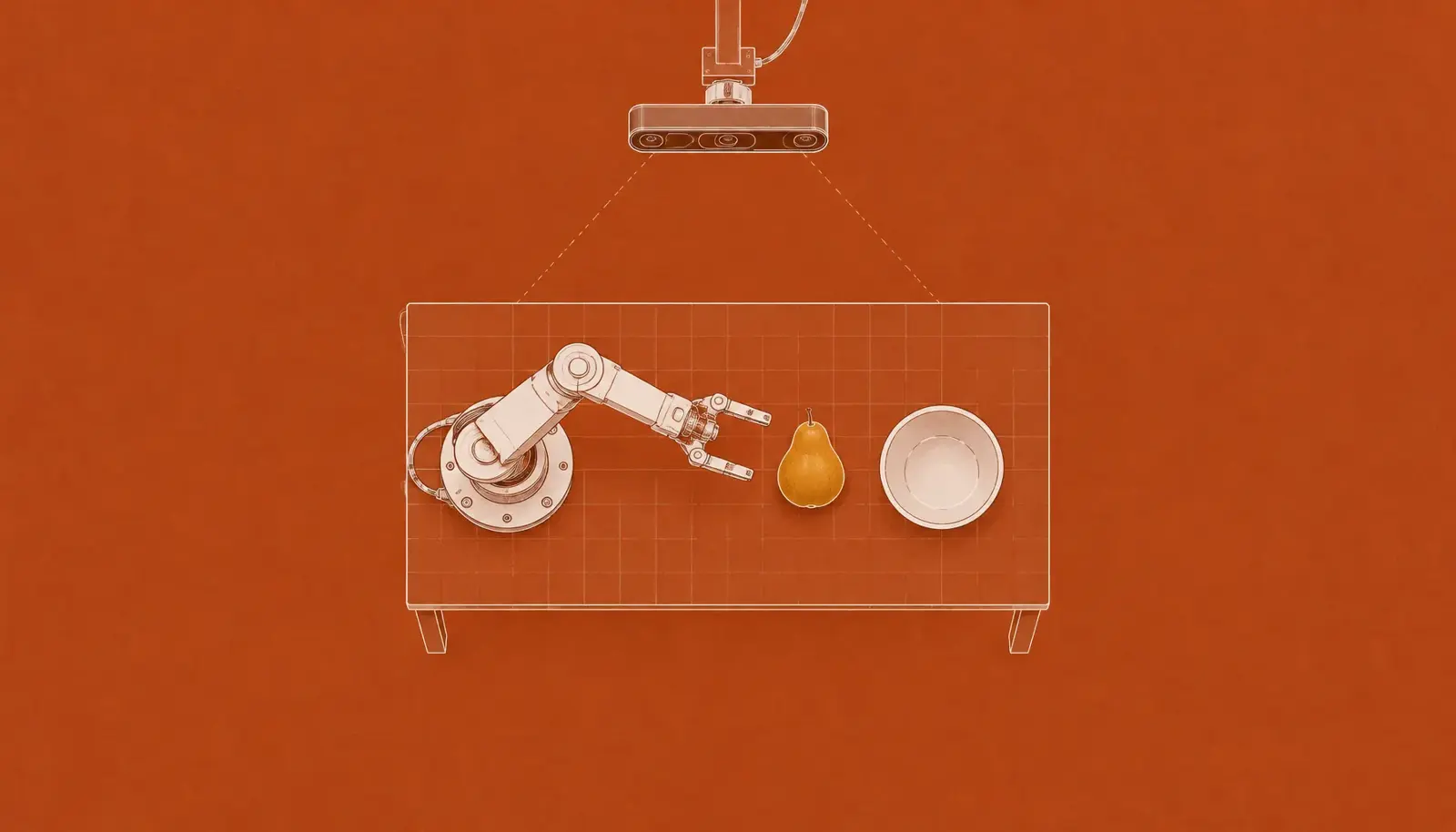
The paper also reports a physical robot test: picking up a pear and placing it in a bowl. STAR succeeds in 19 of 40 trials, compared with 17 of 40 for native inference, or 47.5% versus 42.5%. The comparison uses the same π0.5 checkpoint for both methods, but that checkpoint was fine-tuned for the task for 15,000 steps before evaluation. The “without retraining” claim therefore describes STAR’s inference-time intervention, not a claim that the underlying policy required no task-specific training.
On the test system, which uses one NVIDIA RTX 3090, the authors measure 3.3% additional inference latency relative to native inference. STAR also differs from the paper’s training-free comparison method, DTP: DTP uses an extra forward pass to identify visual tokens to prune, while STAR makes its change within single-pass inference. Those results make the method’s appeal concrete, but they do not establish that every VLA or robot task will benefit.
Intermediate states limit where STAR can run
STAR requires access to intermediate Transformer hidden states, so it cannot directly wrap a black-box policy that exposes only its action outputs. The authors also say their proprioception-based design mainly fits single-end-effector manipulation and may offer limited benefit on models that do not show the late-layer grounding decline they measured. The reported findings are evidence for a targeted adjustment to specific model internals—not a general fix for VLA failures.
Sources
- Original source · Preprint arXiv arXiv:2610.41009
Related stories
- ActPrune Uses Predicted Robot Motion to Prune VLA Tokens
- VICTR Preprint Reports 23.8% Success on Unseen Out-of-Domain Real-World Robot Tasks
- RoboColosseum Tests Robot Policies in 5,699 Comparisons at 124 Sites
- ThinkWorld Trains Robot Policies by Scoring Imagined Futures
- Preprint finds retrieval rivals some VLAs on simulated robot tasks