The Floor
Study Finds Coding Agents Fall Short for Robot Engineers
A study at German automation company AKE Technologies found that a coding agent did not make robot engineers more productive across most tested tasks. The four-engineer trial found its clearest benefit in generating repetitive robot-movement code.
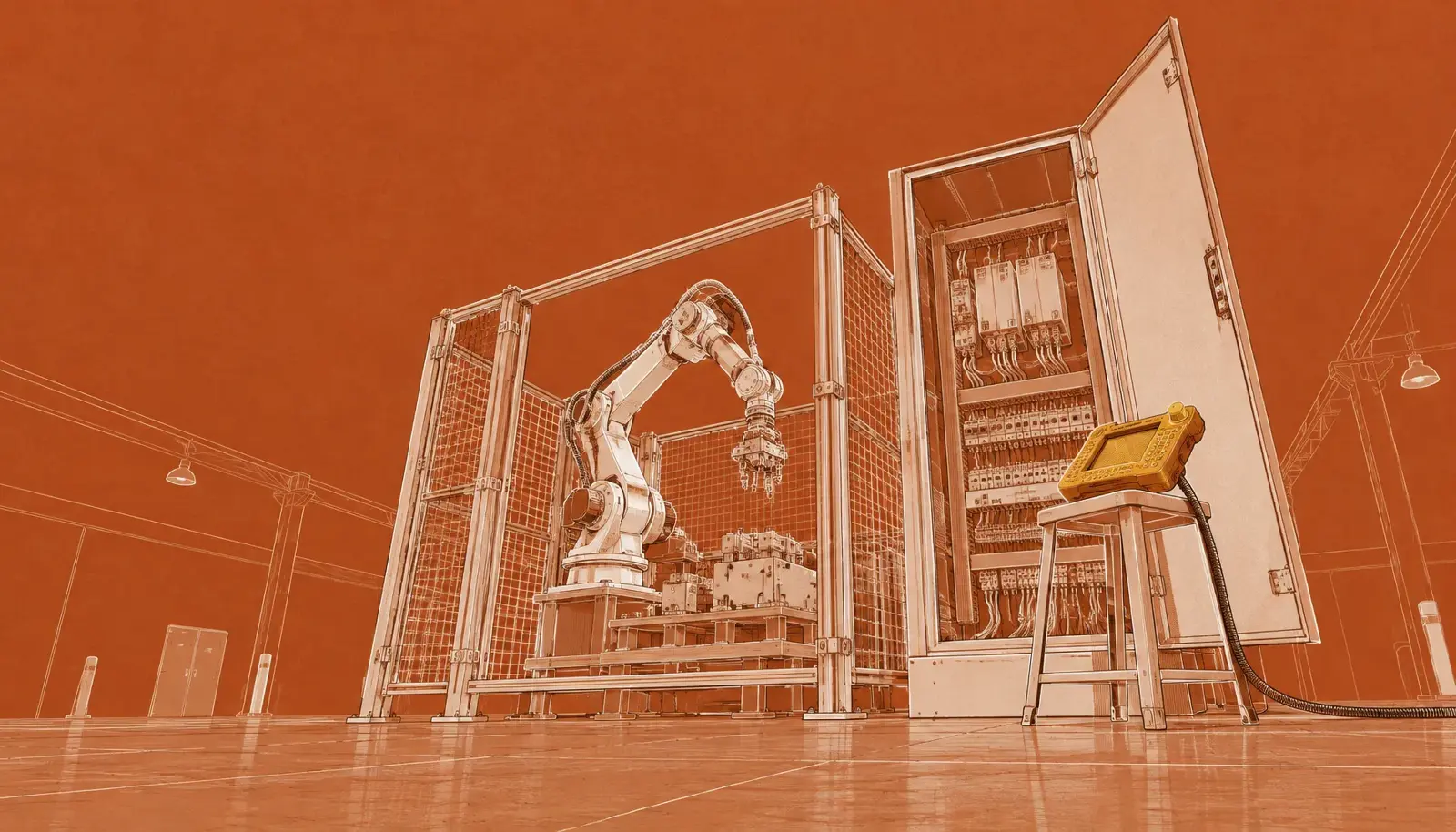
A coding agent did not make industrial robot engineers faster or produce better results on most of six tested tasks, according to a study conducted with automation company AKE Technologies. The exception was a repetitive code-generation task, where engineers needed to build movement trajectories between given positions. The paper, submitted to arXiv on October 23, reports two focus days with four engineers and cautions that its small case study cannot support statistical generalization.
Four engineers, six ABB RAPID tasks
The engineers at AKE program ABB industrial robots in RAPID, a vendor-specific language, and check their work in RobotStudio simulations before deployment. Researchers Salim Fares and Steffen Herbold tested tasks drawn from that work: modifying existing programs, documenting code, finding injected bugs, reversing robot paths, generating movement trajectories and programming a 3D stacking task. Each task was estimated to take 30 to 60 minutes.
The agent ran Claude Code with the open-weight GPT-OSS 120B model on AKE’s own server, which used a single H100 GPU. The company barred cloud-based language models because customer code and data are confidential. Researchers split the engineers into groups that alternated between using the agent and working without AI, then changed the agent’s setup before the second focus day to supply the RAPID manual and project instructions automatically.
The agent’s clearest win was repetitive code
“Our results show that the agent did not make the engineers more productive, with the exception of a task that required the generation of highly repetitive code,” write Salim Fares and Steffen Herbold of the University of Passau.
Trajectory generation was the one task where agent-assisted work matched or beat unaided work on both focus days. Once engineers knew the required paths, the agent could help produce the many similar routines. Across the other tasks, the researchers found no general speed or quality advantage: averaged across tasks, functionality scores were 1.7 with the agent and 2.3 without it, while code-quality scores were 1.8 and 2.5, respectively.
The study’s automated check also counted 25 programming-standard violations in agent-assisted solutions, compared with 11 in solutions written without AI. After the researchers added the reference manual and project context, the agent’s adherence improved: five of eight checked solutions had no violations, up from two of ten on the first day. That change did not improve task completion rates, which remained low for agent-assisted work.
RobotStudio’s missing view limited the agent
The agent could inspect and edit code, but it could not see the simulated robot cell. Engineers rely on that visual feedback to judge whether a programmed movement makes sense in space, and the paper identifies the gap as a likely contributor to weak functionality. The researchers suggest that connecting the agent to RobotStudio could help it account for the cell rather than treating the program as text alone.
How engineers used the tool also mattered. They often delegated even trivial edits and continued long conversations after the agent had moved away from a correct intermediate result. Fares and Herbold found that prior experience using AI mattered more to success with the agent than robotics-engineering experience, pointing to a need for training and a learning period rather than assuming skilled robot programmers can adopt an agent immediately.
Two focus days leave the longer-term result open
The researchers stress that the trial involved one small-to-medium-sized company, four engineers and two days of observation; one engineer missed the second day. The team also knew which solutions used the agent when assessing them. The results therefore describe this particular setup, not a definitive verdict on coding agents across robot engineering.
The paper’s concrete boundary is narrower: an agent configured with domain references helped with repetitive, well-specified code, but struggled on work that depended on understanding robot behavior in a simulated cell. Whether longer training and direct access to simulation can close that gap remains unanswered by the two-day study.
Sources
- Original source · Preprint Can AI Agents Help Robotic Engineers? Lessons from Two Focus Days in Industry arXiv:2610.32636
Related stories
- Coding Agents Find a Faster Warehouse-Routing Algorithm in Simulation
- A3 Reports Q3 Robot Orders in North America Up 24.8% to 10,989 Units Worth $723.5M
- Panasonic Targets Humanoid Robot Production by 2029; Results Remain Undisclosed
- FMC³ shows factory-worker data system for robot learning
- RobCo Tops $1B Valuation as CEO Moves to the US