The Floor
Stanford and Amazon Authors Target Humanoid Fall States With Active Learning
A research team developed an active-learning monitor that estimates whether a Unitree G1 humanoid can recover its balance, using simulations to test its predictions under disturbances. The paper reports fewer simulated falls when the monitor switches to a balancing policy, and describes a qualitative zero-shot demonstration on physical hardware.
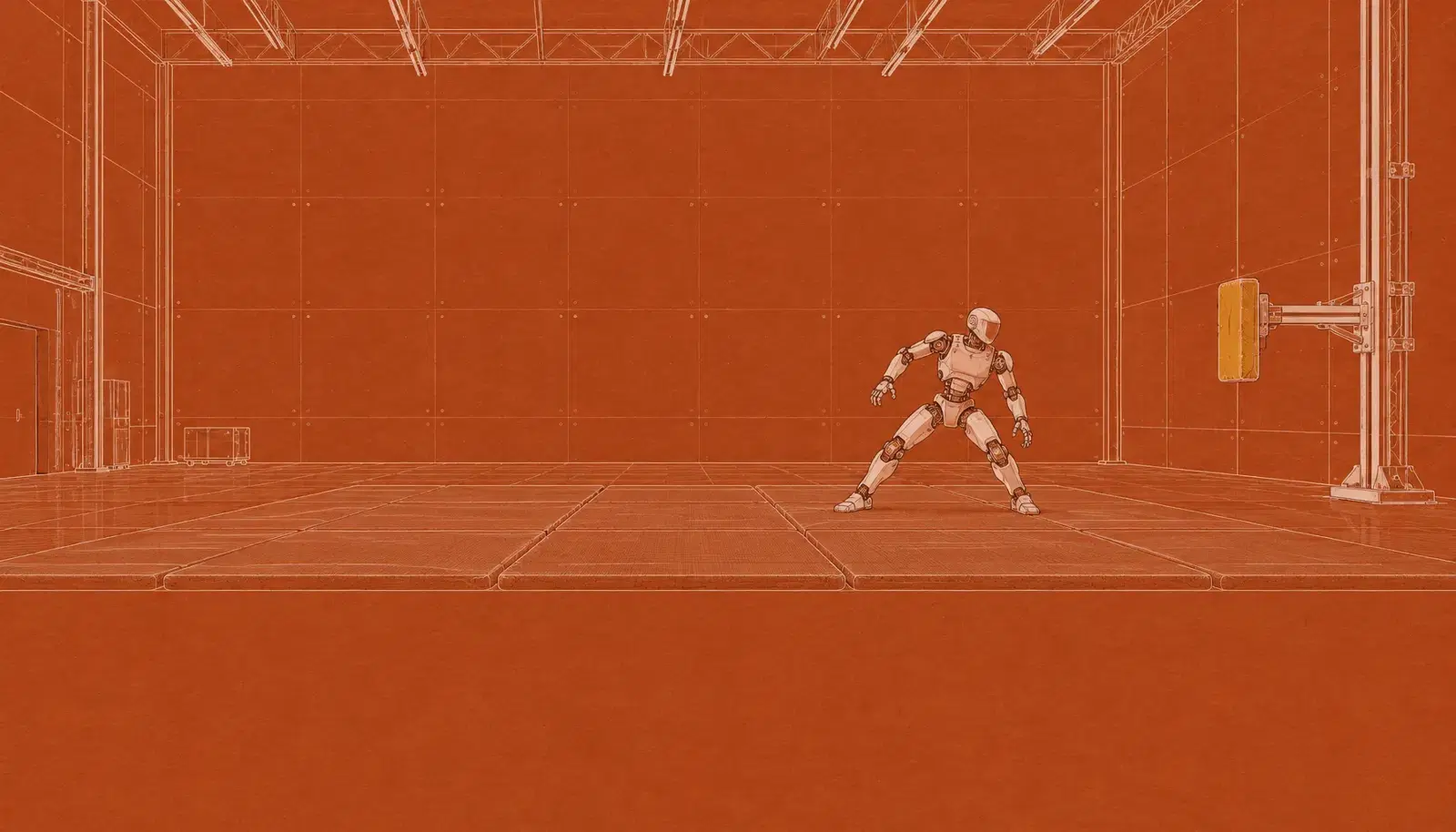
“The framework alternates between accurately learning the liveness value of known states and actively discovering novel states at the fringe of the policy’s capabilities.”
The authors write: Zeyuan Feng, Baljeet Singh, Sarthak Ranjeet Kaingade, Somil Bansal and Bryan Trinh, authors of “Active Reachability Learning for Humanoid Recoverability Monitoring.”
Finding the edge of a G1’s balance
A paper posted to arXiv on October 23 by researchers affiliated with Stanford University and Amazon proposes a way to identify the states in which a humanoid can still recover its balance—and to focus training on states the robot has not yet encountered. The work, “Active Reachability Learning for Humanoid Recoverability Monitoring,” treats fall prevention as a monitoring problem: estimate when a task-running robot is approaching a state where its fallback balancing policy may no longer save it.
The monitor learns a “liveness” value for the robot’s current state, estimating whether the fallback controller can return it to a stationary upright posture within a set time. When the predicted value or the model’s uncertainty crosses a threshold, the system switches from the task policy to the balancing policy. The aim is to make that switch before the robot reaches an unrecoverable state, rather than to teach the task policy every possible recovery maneuver.
Exploration seeks uncertain states, not certain failure
Training such a monitor is difficult because humanoid dynamics depend on physical contact. The paper notes that two states that look nearly identical at foot contact can lead to very different outcomes if one foot slips and the other holds. Uniformly sampling the robot’s high-dimensional state space can also create physically invalid simulator states, so the authors collect data through rollouts instead.
Their method alternates between learning recoverability from collected data and training an explorer to seek states with high model uncertainty. A reach-avoid objective directs the explorer toward those unfamiliar states while keeping it away from regions the monitor already judges confidently unrecoverable. The fallback policy then runs from newly found states to generate additional training examples. That distinction matters: the explorer searches for informative territory, not for a fall to stage on hardware.
Simulation gains, with a six-hour training run
The team evaluates its approach on a Unitree G1 model with 29 degrees of freedom and a 69-dimensional state representation. In the paper’s simulation, 30 active-learning rounds took about six hours. The learned value monitor reached an F1 score of 0.957 on validation data and 0.918 on an out-of-distribution push test; its reported coverage on those sets was 0.944 and 0.815, respectively.
Active exploration also improved recall on the unfamiliar push data: the value monitor’s overall out-of-distribution recall rose from 0.672 to 0.893. In the hardest disturbance bin, it increased from 0.425 to 0.871. During simulated walking trials, the monitor reduced falls for both a nominal walking policy and a degraded policy with severe observation noise and sensor blackouts. Under the strongest tested disturbance, the paper reports a fall-rate reduction from 12.21% to 8.94% for the nominal policy, and from 47.75% to 20.75% for the degraded one.
Hardware evidence remains qualitative
The authors also report a zero-shot demonstration on a physical G1, but the performance figures discussed in the paper come from simulation. In the most severe simulated disturbance band, the monitor predicted all eventual falls in advance, with an average lead time of 0.58 seconds before torso-ground contact. That interval may give a fallback controller time to reduce impact, but it is not a guarantee that a real robot will avoid every fall.
The paper identifies three limits: the monitor reacts to uncertain or risky states rather than proactively preventing entry into them; its learned estimates are not calibrated; and its coverage depends on what the explorer’s action space can reach. The method therefore maps a useful boundary for a particular fallback policy, not a universal safe zone for humanoids. Its practical value will depend on whether the prediction remains dependable outside the randomized simulation conditions used to train and test it.
Sources
- Original source · Preprint arXiv arXiv:2610.33317
Related stories
- Humanoid Controller Uses Its Torso to Reposition Objects in 45 of 50 Trials
- WholeBodyMem Lifts Unitree G1 Memory-Task Success to 88.3%
- Preprint tests simulated planner for humanoid groups around people
- Researchers test latent steering for safer robot path planning
- Starship Plans Software Changes After Tallinn Bus Crash