The Floor
Amazon Prime Air tests drone avoidance choices in simulation
A simulated drone maneuver that accounted for uncertainty produced fewer collision events than a geometric alternative in one set of tests. The ordering reversed when the researchers restricted the drone’s vertical maneuvering space.
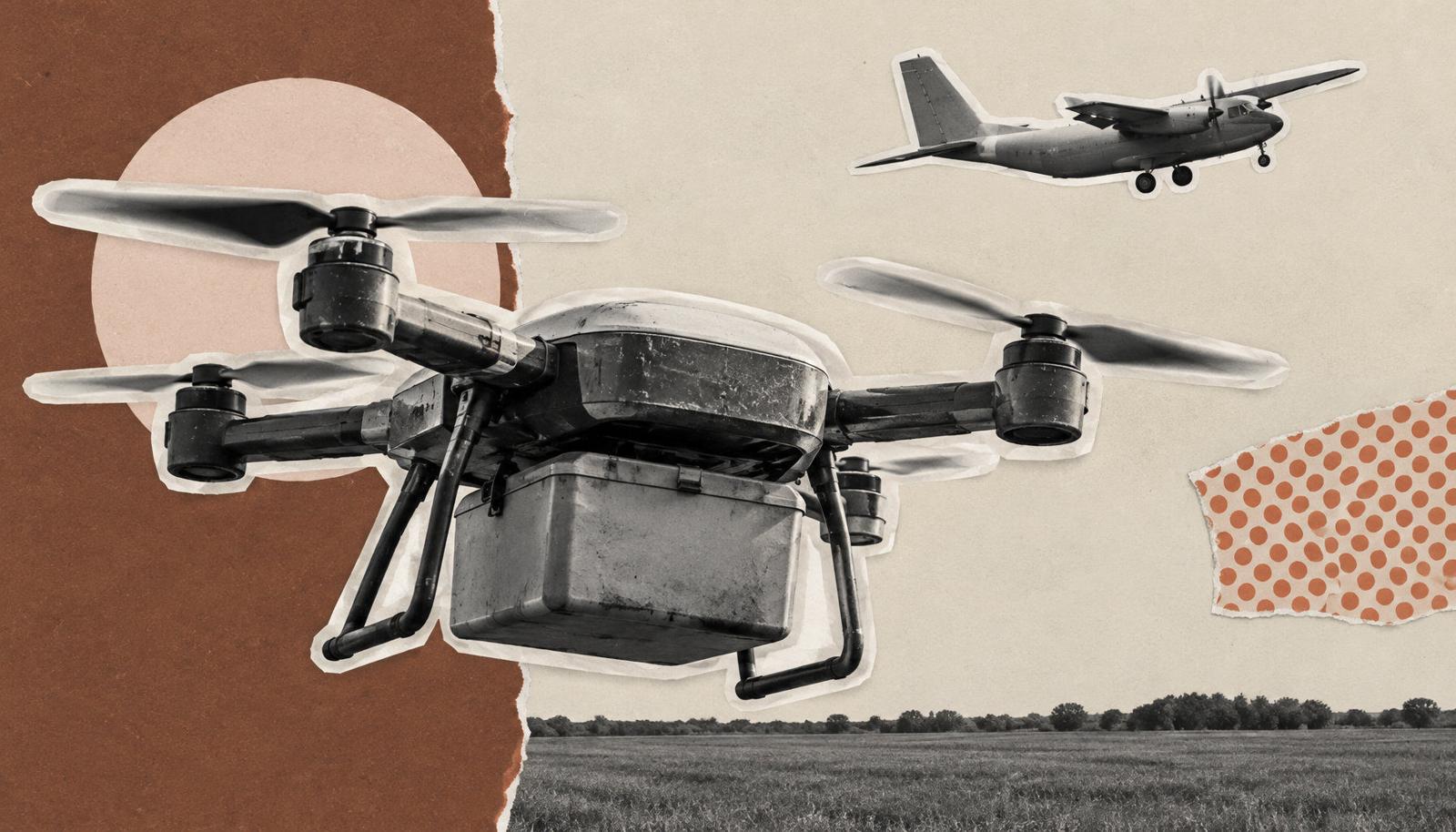
A maneuver that accounts for uncertainty in another aircraft’s position produced 34 simulated collision events, compared with 81 for a geometric avoidance method, in a test of delivery-drone maneuver selection. Amazon Prime Air researchers report the result in a preprint, while noting that the ranking reversed when the drone’s available vertical maneuvering space was reduced.
Source arxiv.org
The comparison used 10,000 pairs of simulated encounters between a delivery drone and crewed aircraft. The preprint was submitted to arXiv on November 24 and has been accepted for publication at the AIAA SciTech Forum 2027.
Choosing a direction
The study examines a last-resort detect-and-avoid decision: where a drone should steer after a collision risk is detected. The authors describe limited onboard sensing, short decision times and uncertainty about the predicted closest point of approach as constraints on that choice.
One policy, called away from closest point of approach, or ACPA, steers away from the predicted position of the other aircraft at that point. The other, away from plane of danger, or APD, accounts for uncertainty in the aircraft’s location and steers away from a plane where its possible positions are expected to cluster.
The second approach addresses a case in which errors in estimating the other aircraft’s distance dominate its position estimate. Both policies use the estimated track available at alert time and neglect changes in the predicted time and location of closest approach caused by the avoidance maneuver itself.
How the encounters were scored
The simulated aircraft included helicopters, fixed-wing aircraft, ultralights and hot-air balloons. Each encounter pair shared the same other-aircraft trajectory and planned drone mission path; one used no avoidance maneuver and the other used the policy being evaluated.
The researchers used a model of the flight controller of Amazon Prime Air’s MK30 delivery drone and a model of its onboard threat detection software. In the circular-space experiments, both policies operated within a maneuver space with a 30-meter radius; the simulated drone returned to its mission path 20 seconds after initiating an avoidance maneuver.
The study counted a collision event for a helicopter, fixed-wing aircraft or ultralight entering a vertical cylinder centered on the drone, with a 7-meter radius and 7-meter full height. For balloons, the criterion was entry into a sphere centered on the drone with a 17.5-meter radius.
Results depend on maneuver space
With the circular maneuver space, the researchers recorded 980 collision events under the no-maneuver policy, 81 under ACPA and 34 under APD. The corresponding risk ratios, comparing each active policy’s count with the no-maneuver count, were 8.27% for ACPA and 3.47% for APD.
The paper reports that APD performed better for each non-balloon aircraft type in that test. For balloon encounters, the policies had identical results. The encounter counts were not weighted to reflect the expected frequency of each aircraft type in airspace.
The result changed when the same encounters were tested with an elliptical maneuver space having a 30-meter lateral semi-axis and a 15-meter vertical semi-axis. In that setting, ACPA had an 8.8% risk ratio and APD had a 12.7% risk ratio.
The authors attribute the reversal to APD choosing a mostly vertical direction in the large majority of those encounters, leaving it with less displacement when the vertical extent was reduced. They identify the effect of maneuver kinematics on the predicted closest approach as a subject for future work.
Sources
- Original source · Preprint DAA for an Autonomous Delivery Drone: Maneuver Selection Policies for Near-Collision Risk Avoidance arXiv:2611.31729
Related stories
- Amazon Needs State Certificate for Westborough Drone Pad, MassDOT Says
- Police operator adds DJI M300 arm checks after drone crash
- Researchers report new humanoid behaviors in simulation
- Qvyon launches sensor-based simulation platform with $8 million
- Berkeley and NVIDIA pair robot coding agents with a new benchmark