The Floor
Amazon researchers report faster planning for 1,125 robots
Researchers used a Schrödinger bridge to reduce planning time on a 1,125-robot grid from 478 seconds to 67 seconds. The resulting trajectories stayed within 6.5% of the optimum, according to an Amazon Science post.
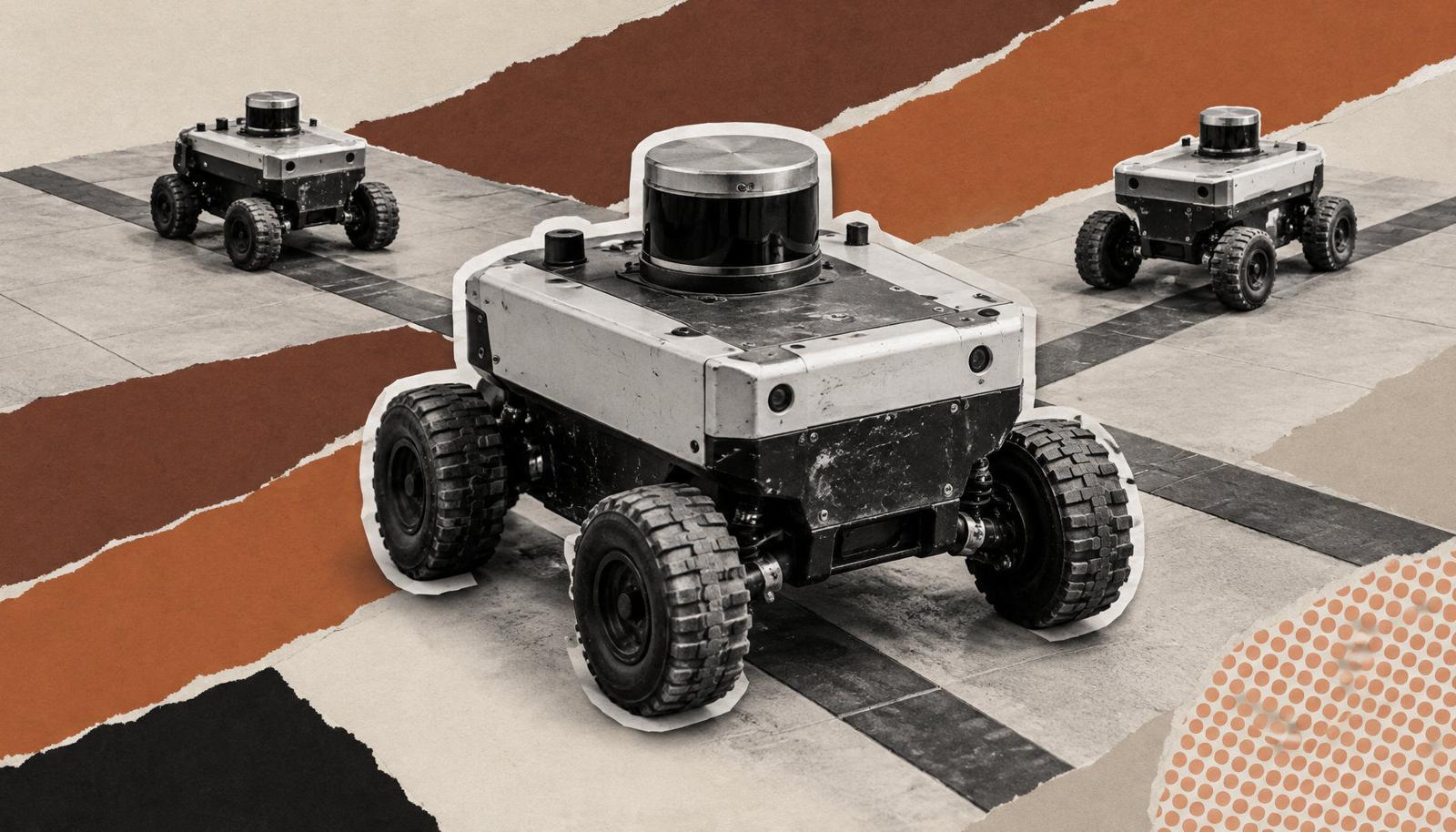
A planning method using a Schrödinger bridge reduced computation time from 478 seconds to 67 seconds for a grid with 1,125 robots, according to Amazon Science. The resulting trajectories stayed within 6.5% of the optimal trajectories, Amazon Scholar Usman Khan reported in a post on November 24.
The comparison used a 150-by-150 grid with a planning horizon of 30 time steps and 3.4 million decision variables. It describes a grid-planning result, rather than a deployment of the method in a warehouse.
Trading optimality for speed
The work addresses multi-agent pathfinding: coordinating robots moving toward destinations without collisions. In the grid formulation described by Khan, a robot can move north, east, west or south, or wait at each time step.
The research focuses on an anonymous version of the problem, in which any robot can reach any destination. Khan and Joey Durham presented a paper on the approach at the International Conference on Machine Learning in 2026.
The researchers first formulated the problem as multi-marginal optimal transport, or MMOT. That formulation represents robot positions at intermediate times as well as at the start and end, allowing the plan to account for movement through space and time.
Khan reported that the direct MMOT solver produced optimal trajectories for the 1,125-robot grid in 478 seconds. By contrast, he wrote, a non-total-unimodular, NP-hard formulation often failed to find even one feasible solution in 12 hours.
From a shadow to paths
The direct solver preserves a property called total unimodularity. According to Khan, that lets a linear program produce integer solutions: a plan does not assign a fraction of a robot to one route and the remainder to another.
The faster approach uses a Schrödinger bridge to approximate the optimal-transport solution. Rather than immediately selecting individual paths, it calculates a probabilistic “shadow” of how robot mass is likely to move between starting and final configurations.
That shadow cannot itself be executed because it splits robot mass across possible locations and destinations. The researchers use it to identify important corridors, then remove decision variables associated with small amounts of mass or less likely travel and recover integer trajectories.
The bridge uses an entropic relaxation of the MMOT problem and an iterative method called Sinkhorn iterations. In the paper, the authors describe the shadow as a template for a reduced linear program.
Scope of the research
Khan said the Schrödinger pipeline, including the shadow and the step that recovers integer trajectories, scaled nearly linearly in practice. He contrasted that with the direct solver's reported practical runtime scaling, while noting that the direct method could take too long for real-time deployment.
The researchers are developing extensions for labeled pathfinding, where each robot has a fixed destination, and lifelong pathfinding, where robots handle continuous streams of tasks. Khan is a professor of computer science at Boston College as well as an Amazon Scholar.
Sources
- Original source · Blog post Amazon Science “Lazy gas, hot gas, and a thousand robots” amazon.science
Other pages read
- Amazon Science “Optimal and scalable MAPF via multi-marginal optimal transport and Schrödinger bridges” amazon.science
Related stories
- Coding Agents Find a Faster Warehouse-Routing Algorithm in Simulation
- Preprint reports faster planning with SI-MPPI in map simulations
- Robot memory model cuts planning latency in tests, researchers say
- Preprint Sets Deadlines for Robots Awaiting Language-Model Plans
- Preprint puts robot control policies inside 3D route planning