The Floor
Researchers publish open three-arm surgical robot platform
A preprint documents ARTS, an open-source three-arm platform for minimally invasive surgery research, with a priced bill of materials totaling USD 137,320. Tests on real robot arms measured pose repeatability of 0.14 mm to 0.25 mm; the platform has not yet been independently rebuilt or installed.
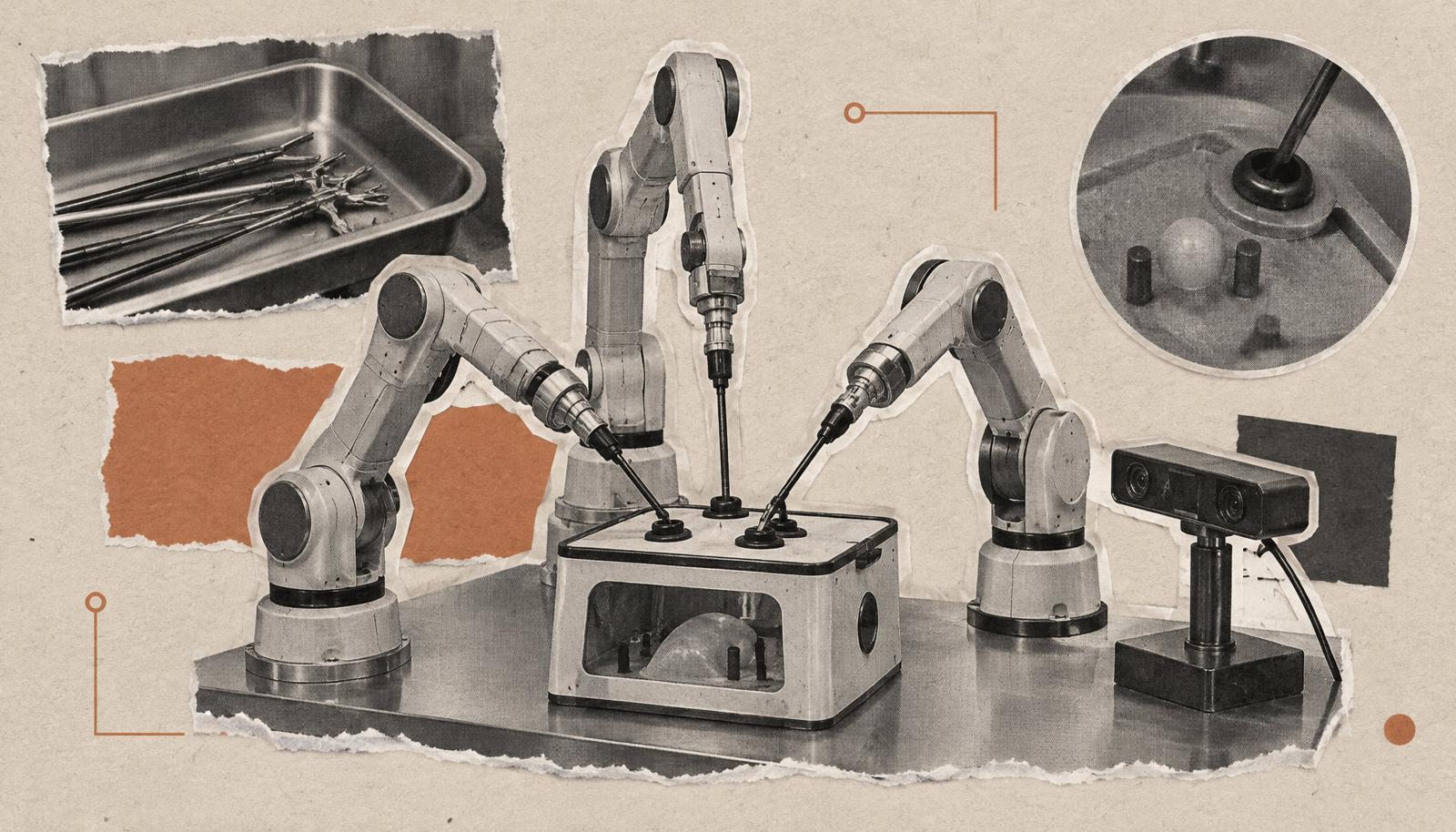
A research platform built from purchasable parts
Researchers have published an open-source design for a three-arm surgical robotics platform, with a priced bill of materials totaling USD 137,320. The November 11 arXiv preprint presents the Autonomous Robotic Translational System, or ARTS, for autonomy research in minimally invasive surgery; its authors say the platform is assembled entirely from purchasable parts.
ARTS uses two UR5e arms to operate wristed da Vinci X/Xi instruments, while a UR5 arm carries a stereo endoscope. Two FLIR cameras capture the endoscope’s optical channels. The setup also includes a console with haptic handles, foot pedals and a stereo viewer, plus a supervisor station with a hardware stop wired to all three arm controllers.
Control, recording and safety
The researchers released the hardware designs, firmware and software under the Apache 2.0 license. The ROS 2 software pins its dependencies and uses the same installation scripts for bare-metal and container setups. Each arm runs its own controller: the instrument arms operate at 500 Hz and the endoscope arm at 125 Hz.
A synchronization board records the two cameras’ exposure timing in hardware, while the software records stereo images and robot-state data. In a 30.5-minute recording test, the cameras captured 54,827 frames each, and the measured mean left-right skew was 2.7 ± 3.2 microseconds, with a worst case of 11 microseconds. The paper reports hand-to-arm lag of 58 ms and 54 ms in two usable teleoperation tests, and camera-to-monitor latency of 68 ms; it did not measure the head-mounted display’s video path.
The separate hardware stop brings all three arms to a controlled stop while keeping their motors powered, so they hold their positions until a reset. The paper describes this as a Category 2 stop. Its software collision monitor is configured to stop all arms if modeled components come within 20 mm of one another.
Tests on real arms
For pose-repeatability measurements, the team followed ISO 9283:1998 and used an optical tracker while one instrument arm visited five taught poses 30 times each. The paper reports repeatability ranging from 0.14 mm to 0.25 mm across those poses. It also compared the result with a da Vinci Research Kit Classic arm tested under the same protocol: that arm’s reported range was 0.09 mm to 1.24 mm across the five poses.
The team also measured physical remote-center-of-motion error during three five-minute trials of randomized pivoting and instrument roll. The reported mean error across those trials ranged from 0.34 mm to 0.37 mm.
Teleoperated task demonstrations
Three expert and three novice operators performed the Fundamentals of Laparoscopic Surgery peg-transfer task through a laparoscopic trainer box, after five minutes of practice. The task involved passing six triangles between needle drivers and placing them on pegs, with a 300-second limit. All three experts completed it in 93.2 to 144.8 seconds; two novices completed it in 162.1 and 219.1 seconds, while the third transferred five of six triangles before time ran out. One expert also performed bimanual suturing on a suture pad as a qualitative demonstration.
The paper presents these as platform tests and demonstrations, not clinical procedures. It says ARTS has not yet been rebuilt or installed by an independent group; a second installation at a partner site is planned to test the bill of materials, documentation and installation process.
Sources
- Original source · Preprint ARTS: An Open-Source, Reproducible Three-Arm Platform for Autonomy Research in Minimally Invasive Surgery arXiv:2611.15135
Related stories
- FDA clears Medtronic’s Hugo robot for specified general surgeries
- Continuum grasper combines traction and cutting in one endoscope channel
- ExRL learns when to replan robot actions, researchers report
- Researchers test latent steering for safer robot path planning
- Robot memory model cuts planning latency in tests, researchers say