The Floor
Continuum grasper combines traction and cutting in one endoscope channel
A two-segment robotic grasper routes an electrosurgical knife through a slot in its body, letting both tools work through one 3.7 mm colonoscope channel. In an ex vivo chicken-tissue demonstration, the team completed a tissue-removal workflow in 15 minutes; the work has not been tested in people.
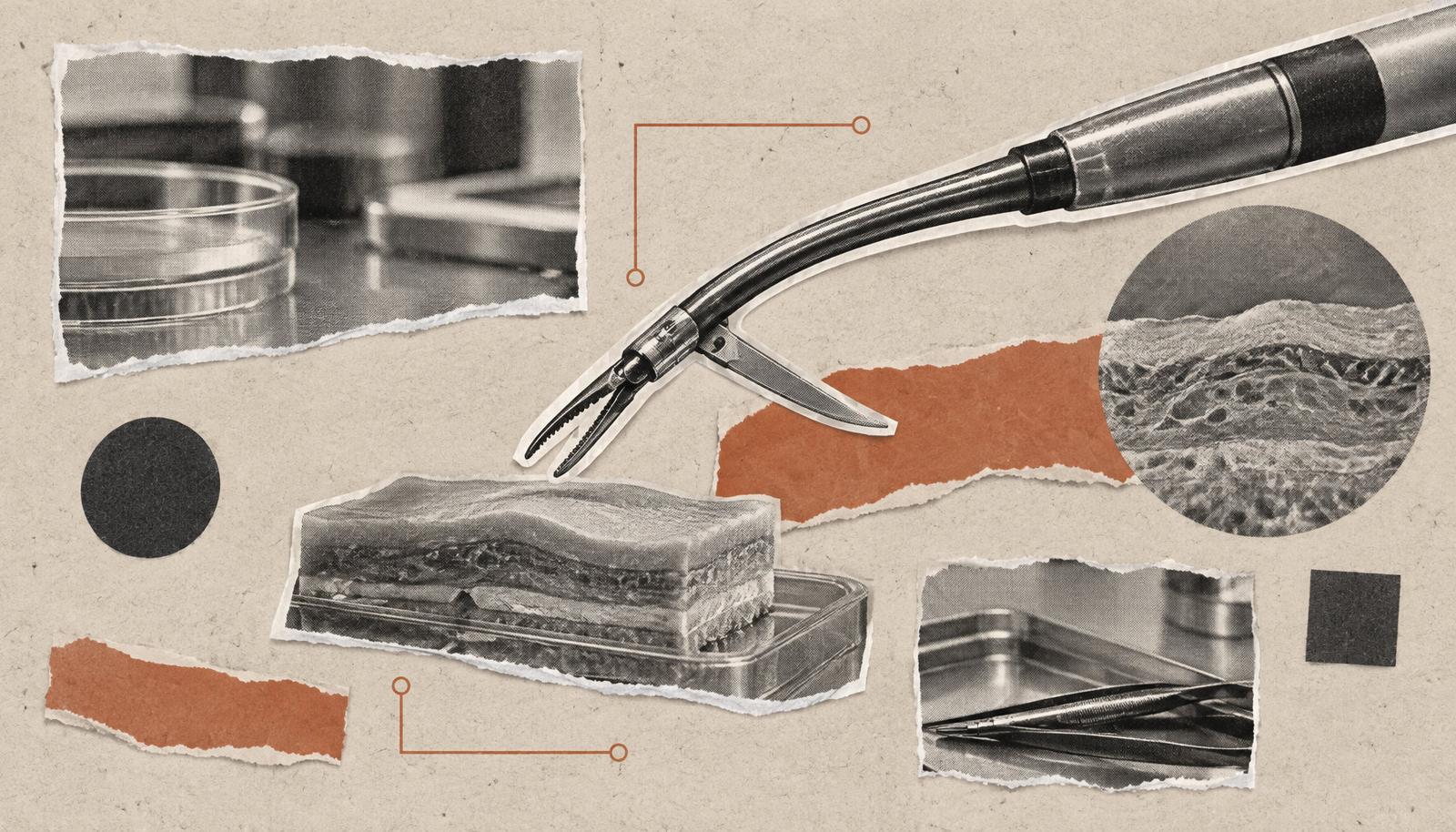
A grasper and knife share one channel
A two-segment robotic grasper is designed to provide tissue traction while an electrosurgical knife cuts through the same 3.7 mm colonoscope channel. The paper, posted on November 11, describes an ex vivo demonstration of tissue removal using the combined instrument.
Source arxiv.org
Researchers Bendavid Maimon, Thompson Wong, Aedan Mangan, Sukjun Kim, Michael C. Yip and Tania K. Morimoto describe the device as a two-degree-of-freedom continuum grasper. The instrument is intended for endoscopic submucosal dissection, or ESD, in which a physician cuts around and beneath a lesion to remove it in one piece.
A slot lets the knife emerge
The device uses a hollow Nitinol tube with two bending segments and a grasper at its tip. A slot in the proximal segment allows the knife to pass out through the tube, while the grasper holds and lifts tissue to expose the dissection plane.
The tool and knife are designed to fit within a standard single-channel colonoscope’s 3.7 mm working channel, according to the paper. Four independently driven linear motion units control the proximal and distal tendons, knife movement and grasper operation. Load cells on the tendon units measure tension during articulation.
Model and traction tests
The team tracked the instrument’s tip during separate proximal- and distal-segment movements, then compared the measured positions with predictions from its kinematic model. The paper reports normalized root mean square error of 33.9% for the proximal segment and 9.10% for the distal segment.
The authors say the model overestimated tip travel. They point to tendon stretch, compliance in the actuation system and friction—factors that can reduce or unevenly distribute bending—as limitations not captured by the model.
For traction tests, the researchers used an 18 mm silicone polyp phantom attached to a force sensor. Across the tested phantom heights, they report a mean resultant force of 0.33 ± 0.02 N and a mean force lifting the phantom of 0.27 ± 0.04 N. The measurements came from three trials at each height, with tendon tension set to 9 N.
Ex vivo removal, not a clinical trial
The researchers then mounted the grasper and knife on a mock endoscope and used them to grasp, lift and cut chicken thigh tissue. They manually moved the mock endoscope as the cut advanced; the full procedure took 15 minutes, according to the paper.
The demonstration was conducted in ex vivo tissue, not in people. The authors identify improved modeling and closed-loop control using tendon-tension or visual feedback as possible future work, and say the device could eventually support automation of parts of the procedure.
Sources
- Original source · Preprint Helping Hand: A Continuum Robotic Grasper for Traction in Single-Channel Endoscopic Submucosal Dissection arXiv:2611.15638
Related stories
- Robotic system prints wound electronics onto curved dressings
- Researchers publish open three-arm surgical robot platform
- FDA clears Medtronic’s Hugo robot for specified general surgeries
- Researchers Open-Source a da Vinci X/Xi Instrument Module
- Researchers report wearable thumb aided four one-handed tasks