The Floor
Researchers Open-Source a da Vinci X/Xi Instrument Module
A preprint describes an open-source module that lets a UR5/UR5e arm operate da Vinci X/Xi instruments and record electrosurgical commands. Bench and ex vivo tests included event logging and demonstrations on tissue; the work was submitted to a 2027 symposium.
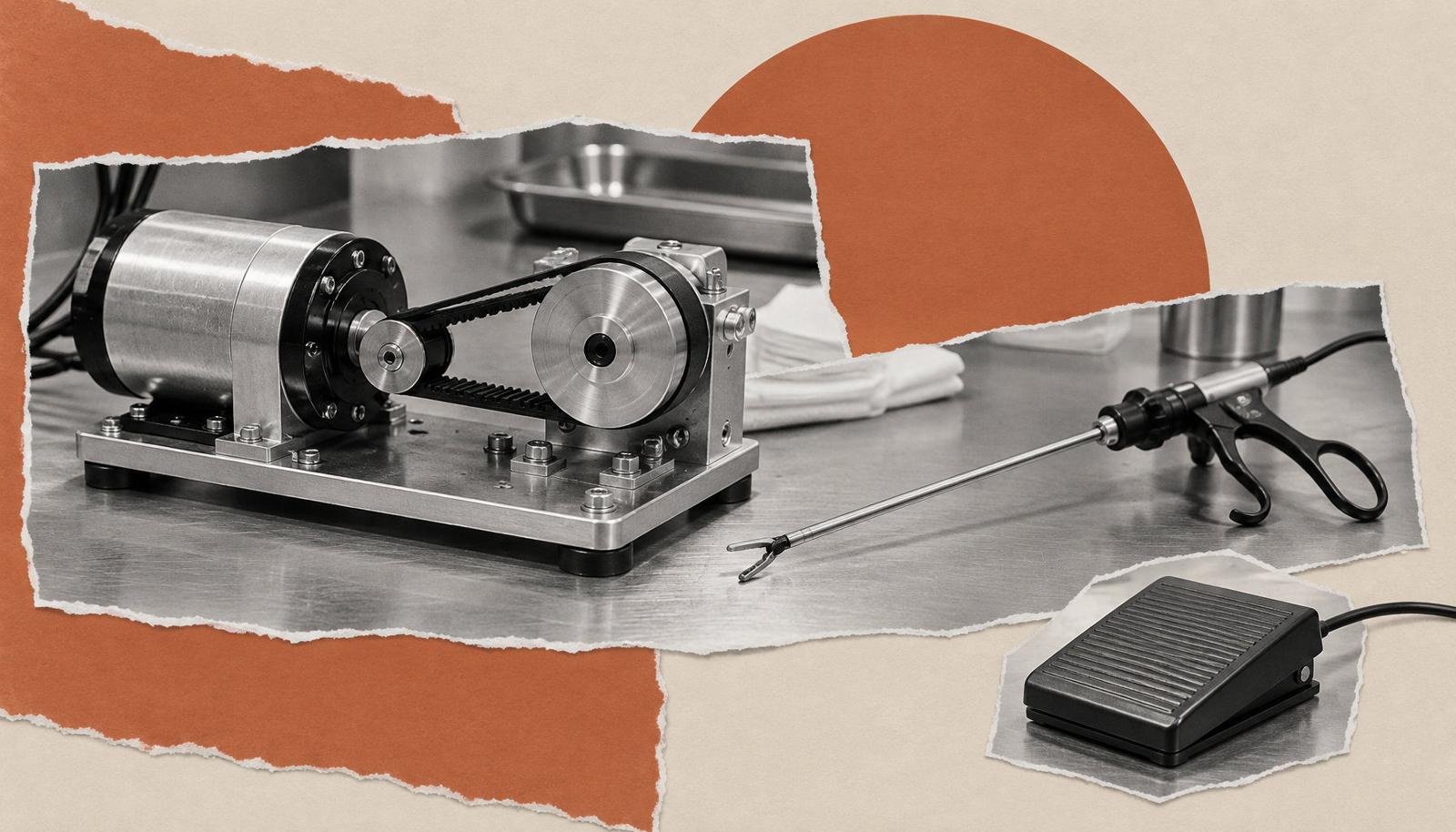
An adapter for research
A preprint submitted on November 16 describes an open-source module that lets researchers operate da Vinci X/Xi laparoscopic instruments from a UR5/UR5e robotic arm. The paper, by Douglas McDonough and eight co-authors, says the module combines instrument-motion control with electrosurgical activation and records when commands occur and where they originate.
Source arxiv.org
The preprint is marked as submitted to the International Symposium on Medical Robotics. Researcher Ravi Prakash’s website says the module can be built from open CAD, firmware and driver files; the paper places them in the ARTS repository, which it describes as an open-source three-arm research platform.
Motors and energy control
The paper describes five motors transmitting torque through timing belts to spring-loaded drive discs. The researcher’s site describes it as a five-motor driver for da Vinci X/Xi instruments, including the SureForm 45 stapler, on a UR5/UR5e arm.
For electrosurgery, an interposer accepts software commands, gives the surgeon’s foot pedals priority and records the source of each activation request. The paper describes the interposer, called ESU-TAP v2, as a custom circuit board between the foot pedals and the electrosurgical unit; monopolar cut, monopolar coagulation and bipolar outputs can be activated from software through ROS 2.
Tests on the bench and tissue
In bench testing, the interposer recorded all 12 activation and deactivation events from six pedal presses, according to the preprint. That test concerns command recording; it is distinct from the paper’s demonstrations using surgical instruments on tissue.
The ex vivo demonstrations included monopolar and bipolar coagulation of splenic tissue, as well as monopolar cutting during gallbladder dissection. The paper also reports optical tracking of a Fenestrated Bipolar Forceps: after calibration, pitch and yaw gains changed from 0.904 and 1.14 to 1.00 and 1.02, respectively.
Recording actions
The authors say the module is intended to let researchers record instrument motion and video alongside the timing and source of electrosurgical commands during laparoscopic tasks. The paper describes research hardware and ex vivo demonstrations, not a clinical deployment or tests on patients.
The paper’s stated contribution is the instrument module and its electrosurgical interposer.
Sources
- Original source · Preprint arXiv arXiv:2611.21771
Other pages read
- Ravi Prakash raprakashvi.github.io
- GitHub github.com
Related stories
- Researchers publish open three-arm surgical robot platform
- Autoware 2.0 Adds AI Planning Alongside Rule-Based Driving
- FDA clears Medtronic’s Hugo robot for specified general surgeries
- Continuum grasper combines traction and cutting in one endoscope channel
- Soft hexapod reaches 4.72 m/s using pneumatic control