The Floor
Robotic system prints wound electronics onto curved dressings
An arXiv preprint describes a vision-guided robot that designs and prints wireless electrotherapy components directly onto a dressing fitted over a wound. The authors demonstrated fabrication and radio-frequency operation on a tissue-equivalent forearm phantom, not a patient.
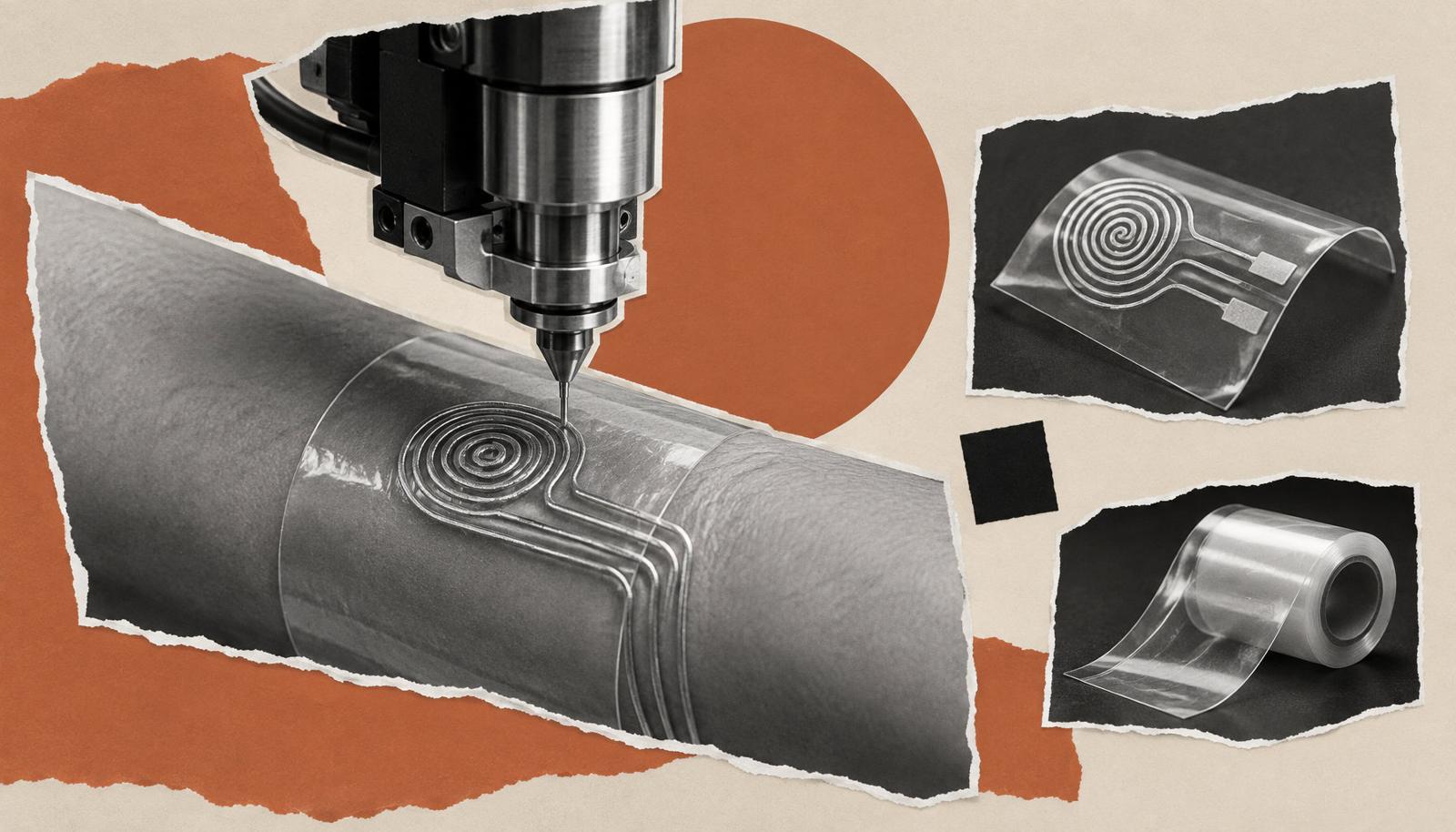
Printing designed around the wound
A robot-guided printing system described in an arXiv preprint is designed to build wireless wound-electrotherapy components directly on a dressing fitted over the target area. The authors say the system combines a 3D vision camera, a six-degree-of-freedom robotic arm and direct-ink-writing with software for wound analysis and radio-frequency design.
Instead of making a device on a flat sheet and transferring it to the body, the proposed workflow starts with a transparent polyurethane dressing placed over the wound. The system scans the covered area, estimates its shape and curvature, and uses that geometry to design a receiving coil and interdigitated electrodes. A robot then prints the components onto the dressing.
The authors’ design process accounts for both the dressing’s curved shape and the electrical loading of the tissue beneath it. Those factors can affect the wireless device’s resonant behavior, the paper says. The printed device includes a receiving coil, an insulating layer and electrodes; an external excitation coil supplies radio-frequency energy wirelessly.
Phantom tests and measured performance
The preprint describes a system that segments a wound from color images and combines the resulting mask with depth data to estimate wound dimensions and nearby surface curvature. The researchers evaluated the vision process using wound phantoms with different shapes, skin appearances and surface geometries.
Across five wound-phantom geometries, the reported mean absolute errors were 0.45 mm for width and 0.39 mm for length. The paper reports a mean absolute percentage error of 10.74% for projected wound area across 15 measurements. Curvature estimates had a mean absolute error of 2.57 mm across nine measurements.
In tests under different lighting, the AI method detected all 16 wounds in each condition; color-based segmentation found 9 of 16 under ambient light and 2 of 16 in each controlled color-temperature condition. These results are from the study’s phantom tests, not clinical wound assessments.
In one simulation, the same device geometry resonated at 24.9970 MHz on a curved surface and 24.2803 MHz in a planar configuration. For a separate forearm-phantom demonstration, the team used measured tissue-equivalent dielectric properties and local curvature in its design calculations. The paper reports that the robot printed the device onto a dressing on the phantom, where measured resonance was 25.68 MHz.
Clinical questions remain
The system’s full workflow, including printing and drying, took approximately 11 minutes 15 seconds, the paper reports. Of that time, computational steps took 65 seconds, robotic printing took 190 seconds across four passes, and intermediate and final drying took 420 seconds. Dressing placement and ink loading remained manual.
The authors say the approach is intended primarily for superficial skin wounds on curved body areas that can be covered by a conformal transparent dressing. They note that effective stimulation conditions for pulsed radio-frequency operation have not been established, and that the electric-field simulations do not demonstrate therapeutic efficacy.
The arXiv record lists Hiroyuki Tetsuka, Jiaju Ma, Naomi Kumano and Minoru Hirano as the authors. The preprint says biological response, safety and therapeutic efficacy still require evaluation in clinically relevant wound models.
Sources
- Original source · Preprint AI-guided robotic in situ fabrication of curvature- and tissue-adaptive wireless bioelectronics arXiv:2611.17638
Related stories
- Continuum grasper combines traction and cutting in one endoscope channel
- Preprint puts robot control policies inside 3D route planning
- Preprint proposes robot planning with explicit, reusable safety rules
- Preprint models how imitation policies discount noisy object readings
- Preprint finds vision features vary across insertion tasks