The Floor
Researchers report wearable thumb aided four one-handed tasks
Researchers tested a camera-guided robotic thumb in four laboratory tasks, including unscrewing a bottle cap and stirring tea. In trials with three wearers, reported success varied with the user, task and object placement.
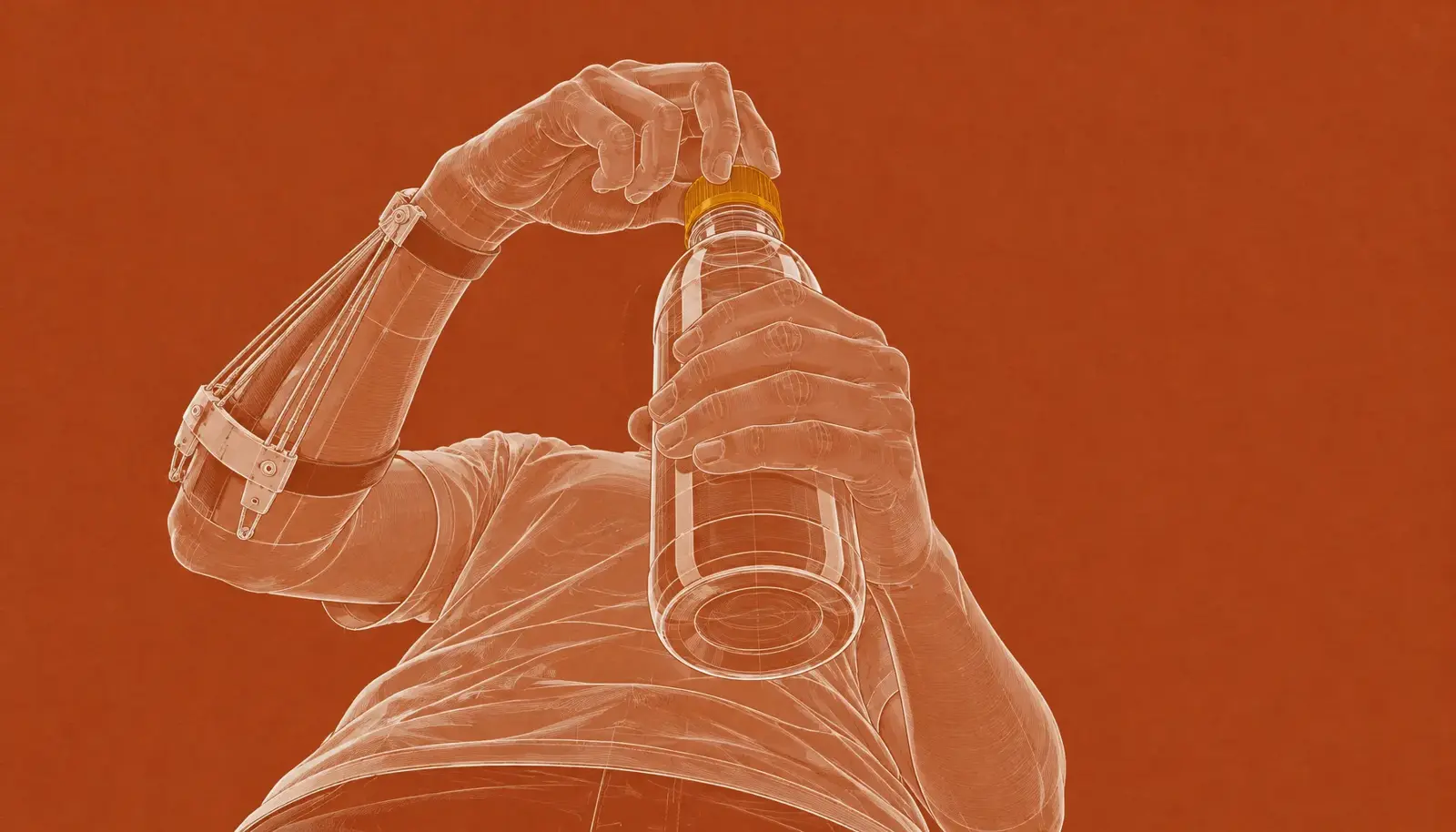
A wearable assist for one-handed tasks
Researchers at the University of California San Diego tested a camera-guided robotic thumb in laboratory experiments, where three wearers attempted four tasks using one hand. The tasks were picking up a cube, unscrewing a bottle cap, stirring tea and transferring a ball from one location to another, according to a report on the system.
Source dx.doi.org
The system, called EgoThumb, is presented in an arXiv preprint submitted on October 27. Its authors describe it as a vision-driven robotic thumb intended to help a person hold an object while their natural fingers manipulate it; the paper says the system is fully open-source.
Camera-led movement
EgoThumb has a compact finger driven by tendons, with its actuation relocated to the forearm, according to the paper. Tech Xplore reports that the thumb has three joints, each driven by two tendons—one for bending and one for straightening—and that small motors are mounted on the forearm rather than the hand.
A small, wide-angle camera sits near the palm and captures the wearer’s hand, the robotic thumb and nearby objects, Tech Xplore reports. The research team trained an imitation-learning model on human demonstrations; during data collection, a person controlled the thumb through a foot-operated interface.
After training, the model predicts movements from camera images and the thumb’s current joint positions, according to Tech Xplore. The paper describes the policy as mapping egocentric images directly to continuous joint positions. In the initial prototype, the AI model that analyzes images and plans movements ran on an external computer connected to the thumb, the report says.
Results varied with the setting
The extra thumb helped wearers complete all four types of task using one hand, according to the report. In the initial evaluation, the researchers ran 10 trials per task per user, with objects placed in areas represented during training. Average success across the four tasks was 90% for the demonstrator and 92.5% and 87.5% for two new users, respectively, Jiawei Fu and his colleagues reported.
A separate tea-stirring test produced average success rates of approximately 67% and 73% across three users in two previously unseen settings, respectively. The researchers also found that performance declined on some tasks when they expanded the areas where objects were initially found or needed to be placed.
Next steps
The researchers have not tested soldering with EgoThumb, Tech Xplore reports. Fu told the outlet that soldering wires inspired the work, but the study examined the underlying capability through simpler tasks, including holding a bottle while a person unscrews its cap.
The team would like to make the thumb more compact and comfortable by improving how the camera is integrated into the wearable hardware, according to the report. It is also interested in adding tactile sensors. The arXiv record says the paper was accepted to the IEEE/RSJ International Conference on Intelligent Robots and Systems.
Sources
- Original source · Paper arXiv dx.doi.org
Other pages read
- Tech Xplore techxplore.com
Related stories
- UniLatent preprint tests robot-to-robot transfer in simulation and on arms
- Hsu and Stone Introduce ELA Preprint for Learning Robot Policies from Video Demonstrations
- Preprint models how imitation policies discount noisy object readings
- ALOHA Lightning preprint targets faster learned manipulation
- Bimanual CTR Raises Worst-State Success from 56% to 76%