The Floor
UniLatent preprint tests robot-to-robot transfer in simulation and on arms
Researchers have presented UniLatent, a method that aligns visual observations to transfer learned tasks between robot arms. The preprint reports simulation results and physical tests that used target-robot demonstrations for fine-tuning.
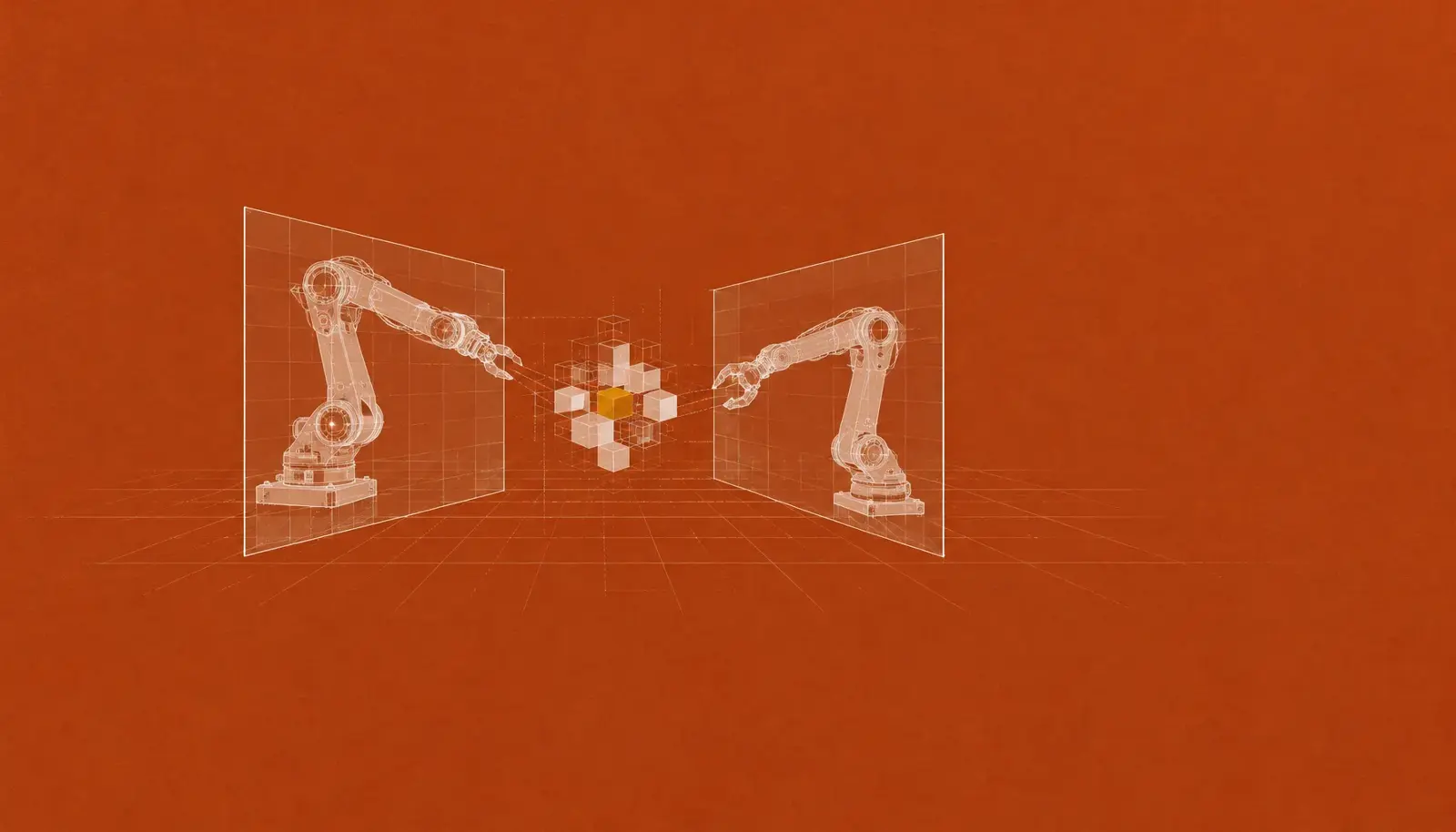
Researchers have presented UniLatent, a method for transferring learned tasks between robot arms by aligning their visual observations rather than translating images of one robot into another. In the preprint submitted on November 6, the team reports zero-shot tests in simulation and physical-arm tests that used target-robot demonstrations for fine-tuning.
The work addresses a problem in reusing demonstrations: a robot trained from images of one arm may encounter a different-looking machine when a policy is applied elsewhere. The researchers test whether a shared representation can bridge that visual difference while the robots use a common end-effector action interface.
Matching observations
UniLatent uses simulated pairs of images showing source and target robots at matched end-effector poses, under the same camera and randomized scenes. The pairs train a source visual encoder to match features from a target encoder whose parameters stay fixed.
A policy is then trained on encoded demonstrations from the source robot. When applied to the target, it receives observations encoded by the fixed target encoder, without generating a translated image at test time.
Both encoders start from the same pretrained DINOv2 model. For alignment, the study renders about 100,000 generic image pairs, optionally supplemented with 10,000 task-specific pairs; the generic pairs vary scene factors including backgrounds and lighting.
Simulation results
In simulation, the team used Franka as the source robot and transferred policies to xArm and Sawyer arms without target demonstrations. The tasks were closing a box lid, placing a cup in a bowl and pushing a ball into a goal.
The researchers collected 300 simulated Franka demonstrations per task through teleoperation, then replayed and filtered them. Each method was evaluated over 100 closed-loop rollouts per task and robot, with initial states drawn from random seeds separate from training.
Across the six target task-and-robot settings, the preprint reports an average success rate of 76.0% for UniLatent and 44.5% for the researchers’ adapted pixel-translation baseline, RoVi-Aug*. That adapted baseline used the same paired renderings and aligned encoder but decoded features back into images for policy training.
Physical-arm tests and limits
For physical tests, the researchers reversed the transfer direction, using xArm demonstrations to train policies for a Franka arm. The tasks were closing a drawer, closing a box lid and wiping a table.
They collected 150 teleoperated source demonstrations for the drawer task and 61 for each of the other tasks. The transferred policy was fine-tuned with 10 Franka demonstrations per task; each setting was tested over 10 rollouts per task, with success requiring completion within 25 seconds.
The paper reports 27/30 successful target rollouts for UniLatent, compared with 23/30 for RoVi-Aug pretraining and 11/30 for training on target demonstrations alone. The physical comparison used the original diffusion-based RoVi-Aug pipeline rather than the adapted simulation baseline.
The authors say UniLatent currently targets single-arm robots with seven degrees of freedom, parallel-jaw grippers and a shared end-effector action interface. Their real-world experiments used a single physical setup, and the paper says robustness to clutter, lighting, distractors and broader object variation remains unestablished. Applying the method to external source datasets also remains to be demonstrated.
Sources
- Original source · Preprint UniLatent: Cross-Embodiment Transfer via Latent Observation Alignment arXiv:2611.10061
Related stories
- Hsu and Stone Introduce ELA Preprint for Learning Robot Policies from Video Demonstrations
- VICTR Preprint Reports 23.8% Success on Unseen Out-of-Domain Real-World Robot Tasks
- ACE-CaP-0 preprint reports 92.1% success in robot trials
- Preprint proposes a flow model for broader robot IK
- Researchers report wearable thumb aided four one-handed tasks