The Floor
Preprint proposes a flow model for broader robot IK
A November 11 arXiv preprint presents GenGenIK, a conditional-flow model for generating robot configurations across multi-target, multi-arm and scene-aware inverse-kinematics tasks. In tests reported by the authors, it solved 92.7% to 100% of five simulated path-task families when given 32 samples, with first-solution times of 20.2 to 36.1 milliseconds.
A sampler for more than one pose
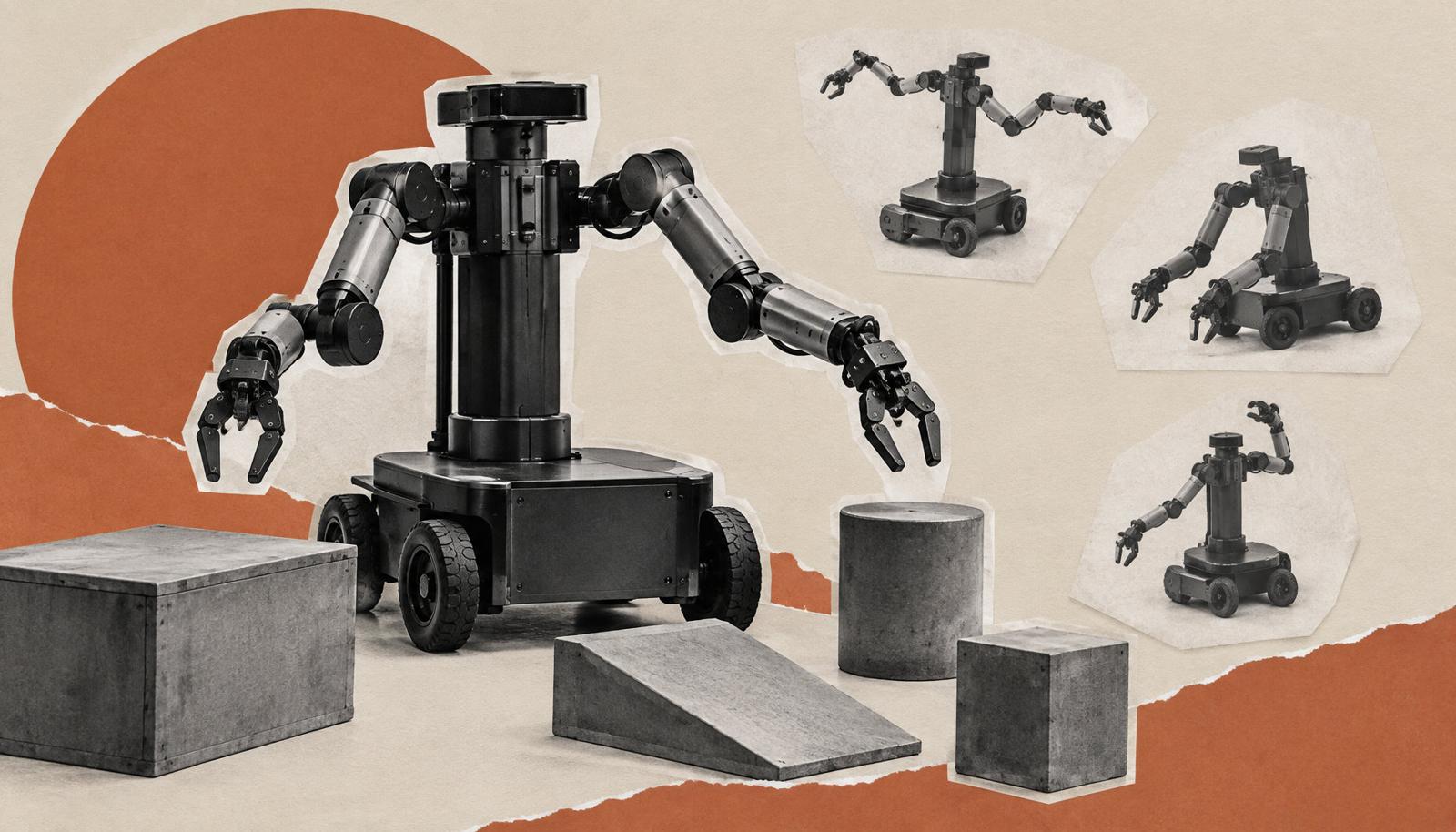
A conditional-flow model in a new robotics preprint is designed to generate multiple whole-body inverse-kinematics solutions while accounting for mobile bases, several end-effectors, sequences of targets and surrounding scene geometry. The November 11 arXiv paper introduces the system as GenGenIK and reports tests on manipulation tasks that include reaching through clutter and producing configurations for an entire task path, rather than solving only for one end-effector pose.
Authors Kaitlyn Zhang, Tomás Lozano-Pérez and Leslie Pack Kaelbling describe the approach as a Transformer trained to generate robot configurations or trajectories from task and scene conditions. Its masked representation allows a shared model to handle different numbers of targets and end-effectors, mobile bases, and cases where part of a configuration or trajectory is already specified. The model can also take preferences into account, including requested postures, manipulability and stability.
Testing paths and scenes
For five path-task families, the study compared GenGenIK with cuRobo on the Rainbow RB-Y1 robot. Each family used 150 problems from 150 distinct scenes, and each problem was evaluated with 32 samples. The tasks were door or drawer manipulation, pushing, bimanual lifting, flipping an object upright and picking up an object from beneath a table.
The authors report success rates of 92.7% to 100% for GenGenIK, with times to a first valid solution between 20.2 and 36.1 milliseconds. In the same tests, cuRobo’s success rates ranged from 22.0% to 92.0%, and its reported first-solution times ranged from 167.3 to 1,067.2 milliseconds. For the bimanual lift task, GenGenIK achieved 92.7% success with a 36.1-millisecond first-solution time; cuRobo recorded 42.7% and 940.0 milliseconds.
The path evaluation checked validity at specified targets and along interpolated configurations between targets; bimanual and under-table tasks also included a quasi-static stability requirement. In a separate test, the researchers examined whether solving for the full path helped choose a starting configuration that could be extended through the task. They report that 58.2% of valid first-target configurations from full-path-conditioned GenGenIK could be continued through the task, compared with 24.3% for cuRobo samples conditioned only on the first target.
Scene information and preferences
For scene-aware point IK, the researchers tested 1,024 grasp problems from 252 held-out iTHOR and ProcTHOR scenes. With full scene information, GenGenIK reached an 80.9% success rate with one sample and 98.2% with eight. With partial scene observations, the model trained on partial clouds recorded 61.4% success with one sample and 90.1% with eight.
The paper also reports that the model’s sampled solutions shifted toward requested preferences, such as a specified elbow position or base distance. For differentiable objectives, the authors applied guidance during sampling; on the G1 robot, they report a 28.42% manipulability gain and a 68.74% reduction in static-stability violations. These are results from the paper’s evaluations, not a report of a physical robot deployment.
Limits in transfer
The authors tested whether a model trained across task families could handle a family omitted from its training data. It retained a 97.3% success rate on pushing and reached 76.7% on flip-up, but its success rate on held-out under-table pickup fell to 0%.
In its conclusion, the paper reports that a one-step sampler followed by numerical refinement cut solve time by up to 34 times relative to batched numerical optimization. The results are based on the study’s robot models, scene data and evaluation procedures.
Sources
- Original source · Preprint Generalized Inverse Kinematics via Conditional Flow arXiv:2611.15565