The Floor
Preprint uses scooping forces to estimate granular properties
A preprint describes a robot-learning system that estimates grain size and bulk density from force and torque signals recorded while scooping. Tests on 26 granular materials included trials with materials left out of training and a spoon-transport task.
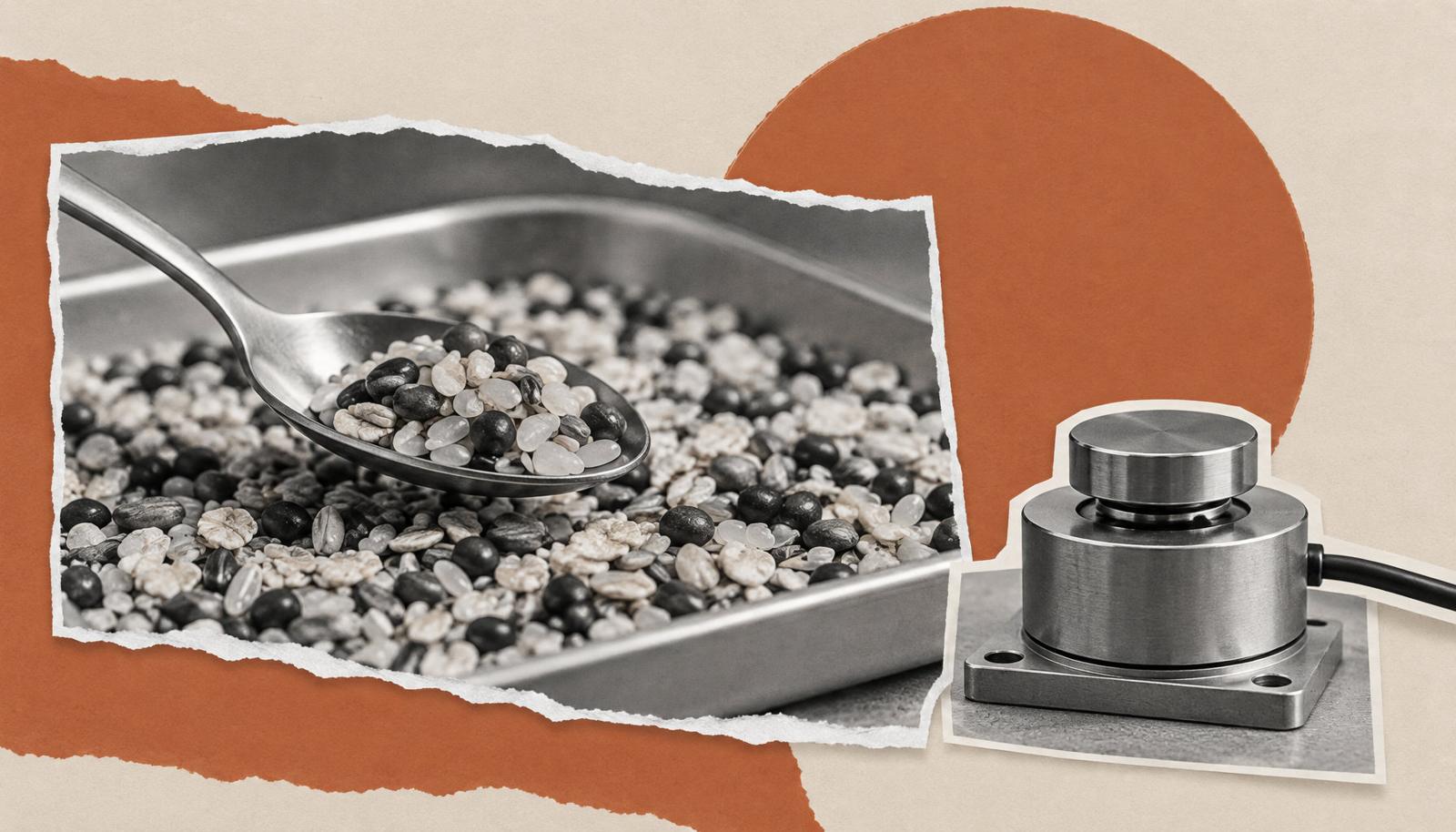
Force signals turn a scoop into a material probe
A robot-learning system estimates grain size and bulk density from force and torque signals recorded while scooping, according to a preprint submitted to arXiv on November 11, 2026. The authors, Samuli Hynninen, Mohammad Amman, Meri Mäkelä, Anirvan Dutta and Ville Kyrki, describe the work as interactive perception: the robot probes material with a spoon, and a model updates its estimate as the interaction unfolds.
The method, called Latent Filter++, combines a learnable frequency-and-time filter with a causal model of changing internal states. Its input is raw force-torque data, rather than a hand-designed signal-processing step. The authors say the model uses the changing signal to represent both slower loads from bulk contact and faster fluctuations from individual grain contacts.
Testing across materials
Experiments used a Franka Emika Panda arm carrying a spoon, with a six-axis force-torque sensor between the end-effector and spoon. The researchers collected 1,316 recordings across 26 everyday materials, including beans, seeds, grains, flakes, gravel, powders and sawdust. Each recording captured 14 seconds of measurements at 500 hertz; the dataset included 40 to 50 interactions per material.
The paper reports that, when five materials were withheld from training, the model’s errors were 0.50 for grain size and 0.17 for bulk density, compared with 0.63 and 0.20 for the supervised model in the same test. The authors express these property predictions and errors in log10 units, where an error of 0.30 corresponds to a factor of two. With all materials included, the supervised model had a lower grain-size error, while the proposed model’s bulk-density error was slightly lower.
Small-sample adaptation and transport
For a new material, the team tested adding a small number of its scoops to the property-specific readout without retraining the latent filter. In the leave-one-out test, grain-size error fell from 0.455 with one added scoop to 0.231 with 40; the readout also improved its bulk-density estimates as more examples were added.
A separate real-world task examined whether the estimates tracked how quickly material could be carried without spilling from the spoon. The test covered 12 materials selected from the larger set, and included only materials that spilled within the robot’s kinematic limits. The paper reports a correlation of 0.74 between grain size and maximum acceleration before spilling; the correlation for density was 0.21.
Limits reported by the authors
The authors say bulk density was estimated more reliably than grain size, while angle of repose was poorly estimated from the scooping signals. They also report that the model did not reliably extrapolate beyond the range represented in its training data. Adapting to a new material currently requires manually selected scoop examples; the paper identifies autonomous selection of additional interactions as future work.
Sources
- Original source · Preprint Interactive Perception of Granular Materials via Robotic Scooping and Force-Torque Sensing arXiv:2611.15339