The Floor
ScaleVLA paper tests a 552B model for robot control
A paper posted on November 16 describes ScaleVLA, which pairs a 552-billion-parameter vision-language model with a trainable action module. Its authors report better results than smaller backbones on several simulated tasks and real-world charger insertion, alongside higher inference latency.
A larger backbone, with a separate action model
A paper posted on November 16 describes ScaleVLA, which connects a 552-billion-parameter DeepSeek-V4.1-Flash-1017 vision-language backbone to a trainable diffusion transformer that generates continuous robot actions. The authors compare backbones ranging from 2 billion to 552 billion parameters, keeping the action architecture, its initialization, robot demonstrations and optimization budget fixed.
The action head was trained on robot demonstrations, while the backbone supplied visual and language features. The paper says the policy generates action chunks without autoregressive reasoning or text generation at each control step.
Benchmark results
On LIBERO-Goal, the authors report 87.8% success with 10 demonstrations per task for ScaleVLA, compared with 85.6% for a 2-billion-parameter backbone trained with 50 demonstrations. In the paper’s LIBERO-PRO evaluation, which tested policies under environment and object perturbations without retraining, ScaleVLA reached 45.1% average success; the smaller backbones scored at most 31.3%.
For RoboCasa kitchen tasks in out-of-distribution scenes, the paper reports 30.7% success using 30 generated demonstrations per task and 54.9% using 100. On DexJoCo, a set of five bimanual dexterous tasks, ScaleVLA reached a 42.1% average with object randomization; with full randomization, its average was 24.4%.
Charger insertion and latency
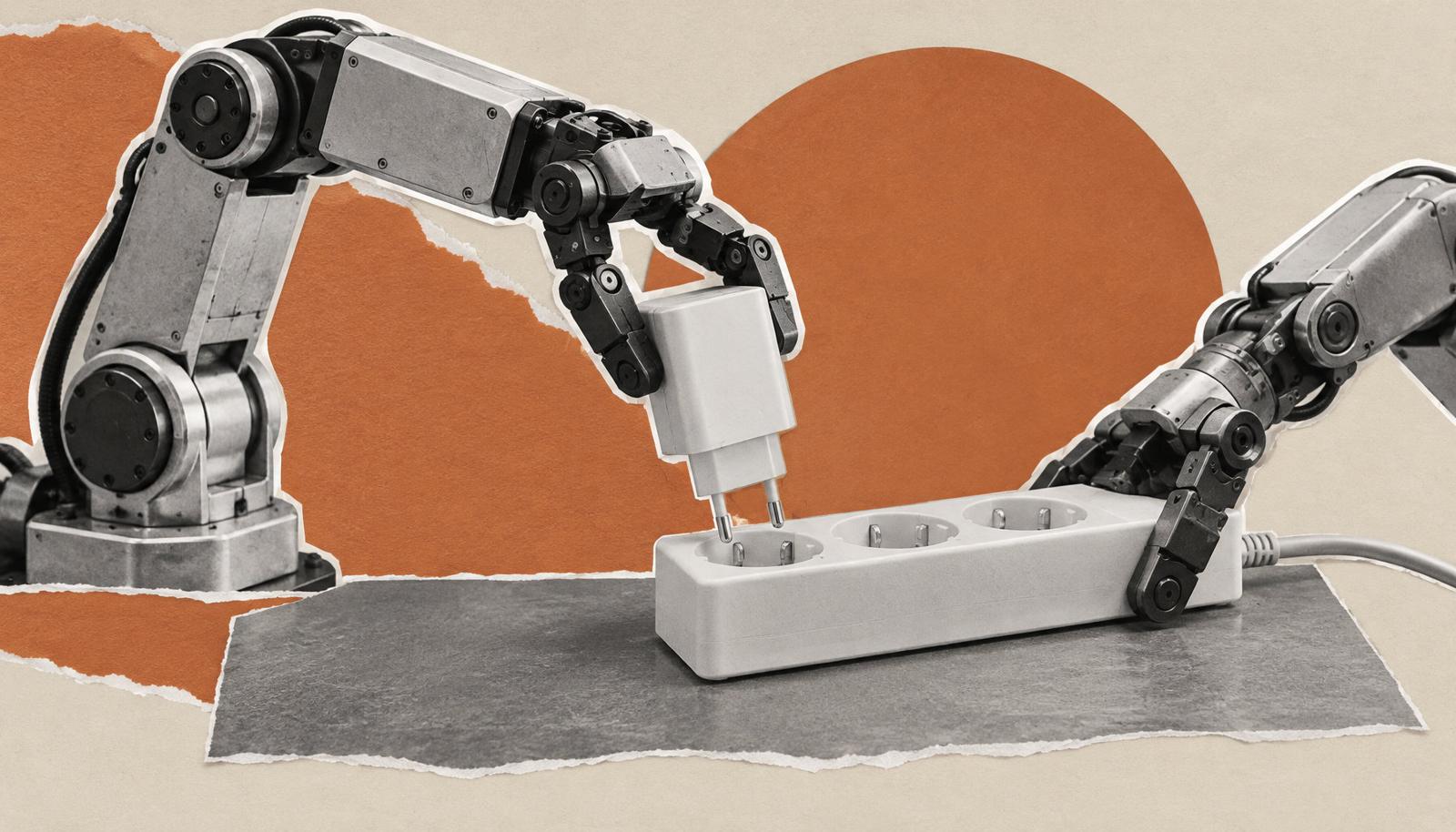
On a real bimanual robot, ScaleVLA inserted a charger plug in nine of 10 trials near the reference layout used in training, compared with four of 10 for the 2-billion-parameter backbone. In 15 out-of-distribution trials, where the charger or power strip was shifted, rotated or moved beyond most training placements, ScaleVLA succeeded in eight. The researchers say the training set included teleoperated demonstrations, with extra segments focused on insertion.
The paper reports a median latency of 215.8 milliseconds per action chunk in RoboCasa, measured using four H200 GPUs; the smaller comparison backbones each used one GPU. In the real-robot charger task, median round-trip latency was 384 milliseconds per chunk. The paper identifies DeepSeek-V4.1-Flash as a sparse mixture-of-experts model and says ScaleVLA reads its features once per action chunk.
Sources
- Original source · Preprint ScaleVLA: Scaling Vision-Language-Action Models to 552 Billion Parameters arXiv:2611.21607