The Floor
Preprint tests low-cost mobile robot on toilet-cleaning task
Researchers tested a mobile two-arm robot on a staged toilet-cleaning task using several vision-language-action models. The paper reports that one model led the autonomous trials, while progress and memory additions did not improve their baselines.
Strongest result in the trials
A model fine-tuned for a low-cost mobile two-arm robot fully removed a toilet-seat smudge in 60% of autonomous trials, rising to 90% with one human intervention that repositioned the robot after it got stuck, the authors report in an arXiv preprint. The paper, submitted on November 11, compares four vision-language-action models on the same physical platform and cleaning task.
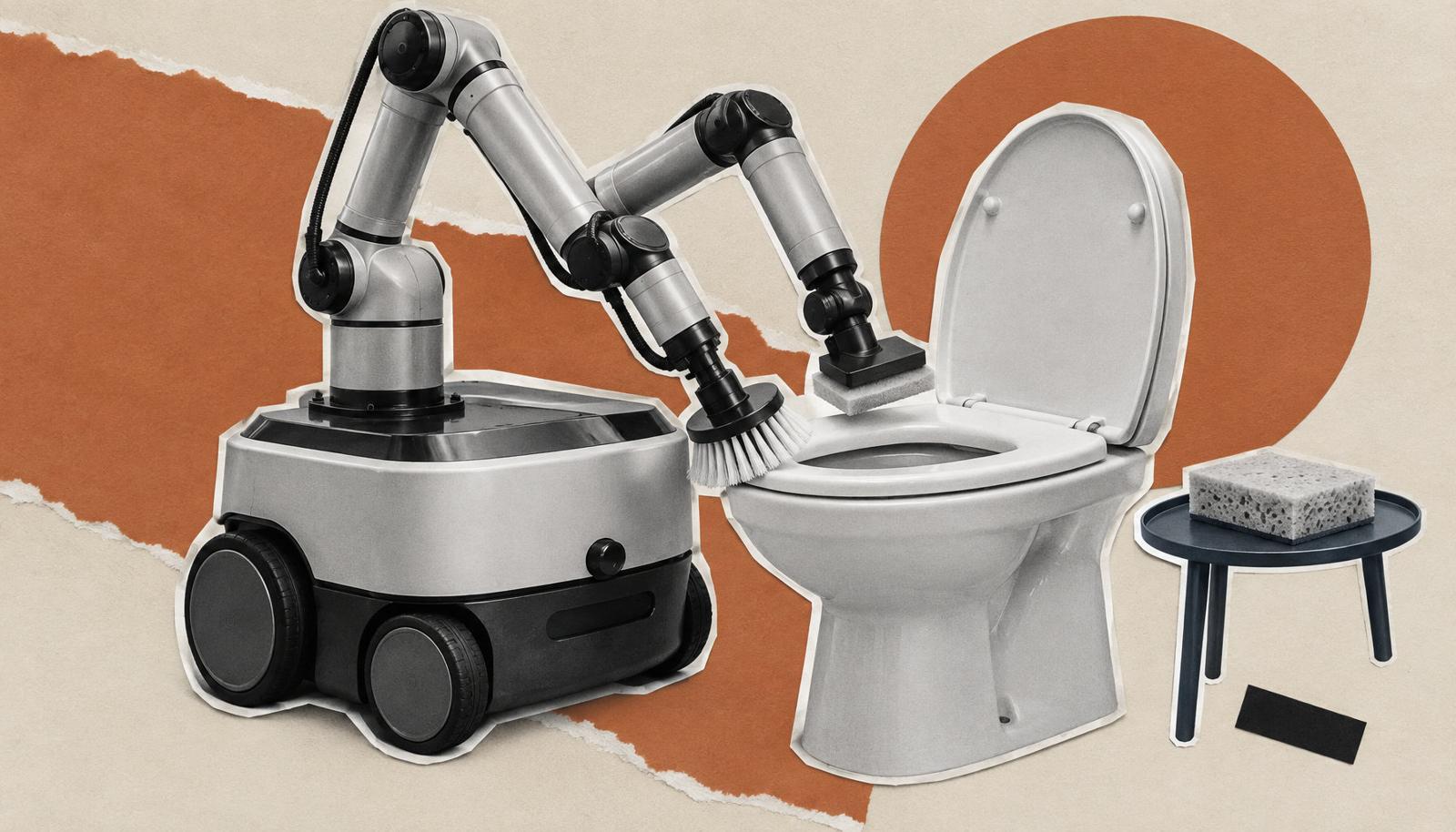
The platform combines two LeRobot SO-101 arms with a TurtleBot 4 mobile base and a LeRobot–ROS 2 software stack. The authors put the complete platform’s cost at approximately €3,200, including the TurtleBot 4, two follower arms and two leader arms used for teleoperation, cameras, hardware and custom printed parts.
A five-stage cleaning task
The task used an open toilet seat marked with a black food-coloring smudge and a sponge placed on a nearby table. The five consecutive stages were to pick up the sponge and drive to the seat, scrub with its rough side, flip it using both arms, wipe with its soft side, then put the sponge away and return to the starting position.
Researchers varied the toilet and table orientations, sponge position and smudge size and location between trials. They kept lighting, the toilet model and the background arrangement constant, and used the same sponge and soapy-water mixture. The paper describes the results as a physical evaluation under these conditions, rather than a test across different bathrooms or toilet models.
Demonstrations and model results
The training set contained 250 teleoperation demonstrations recorded at 30 Hz. Of those demonstrations, 200 were standard trajectories, while the other 50 were correction trajectories gathered through a human-in-the-loop process. The team fine-tuned the evaluated models on this dataset and ran 20 rollouts per policy, except for GR00T, which was tested in five rollouts.
The paper defines strict success as complete removal of the smudge. Relaxed success allows small residual marks that are barely visible in camera images. In the authors’ trials, π0 achieved 60% strict and 70% relaxed success; a single human intervention to recover from a stuck state raised the reported rate to 90%. The paper identifies getting stuck under the seat and failing to move to the next stage as its main failure modes.
The π0 version with SARM-derived task-progress signals scored 40% strict, 55% relaxed and 65% with human intervention. The π0.5 baseline reached 25% strict and 55% relaxed success, with no additional successful completions after human intervention. Adding short-term observation memory to π0.5 produced 10% success across the reported criteria. SmolVLA and GR00T each recorded 0% success in their evaluations; the paper says SmolVLA often failed to reach the sponge, while GR00T struggled to pick it up.
Limits of the comparison
The paper notes that π0.5 was only partially open-sourced for the evaluation. The tested version supported training and inference of its action head but lacked some components described in the original system, so the authors say the comparison does not represent the complete π0.5 model.
The work is a preprint that has been submitted to IEEE for possible publication. Its results come from one staged cleaning task with fixed lighting and toilet model, and the authors identify reliable deployment on mobile bimanual hardware as an ongoing challenge.
Sources
- Original source · Preprint Low-Cost Mobile Bimanual Manipulation for Long-Horizon Toilet Cleaning arXiv:2611.15381