The Floor
ArXiv paper details quadruped control across four arm morphologies
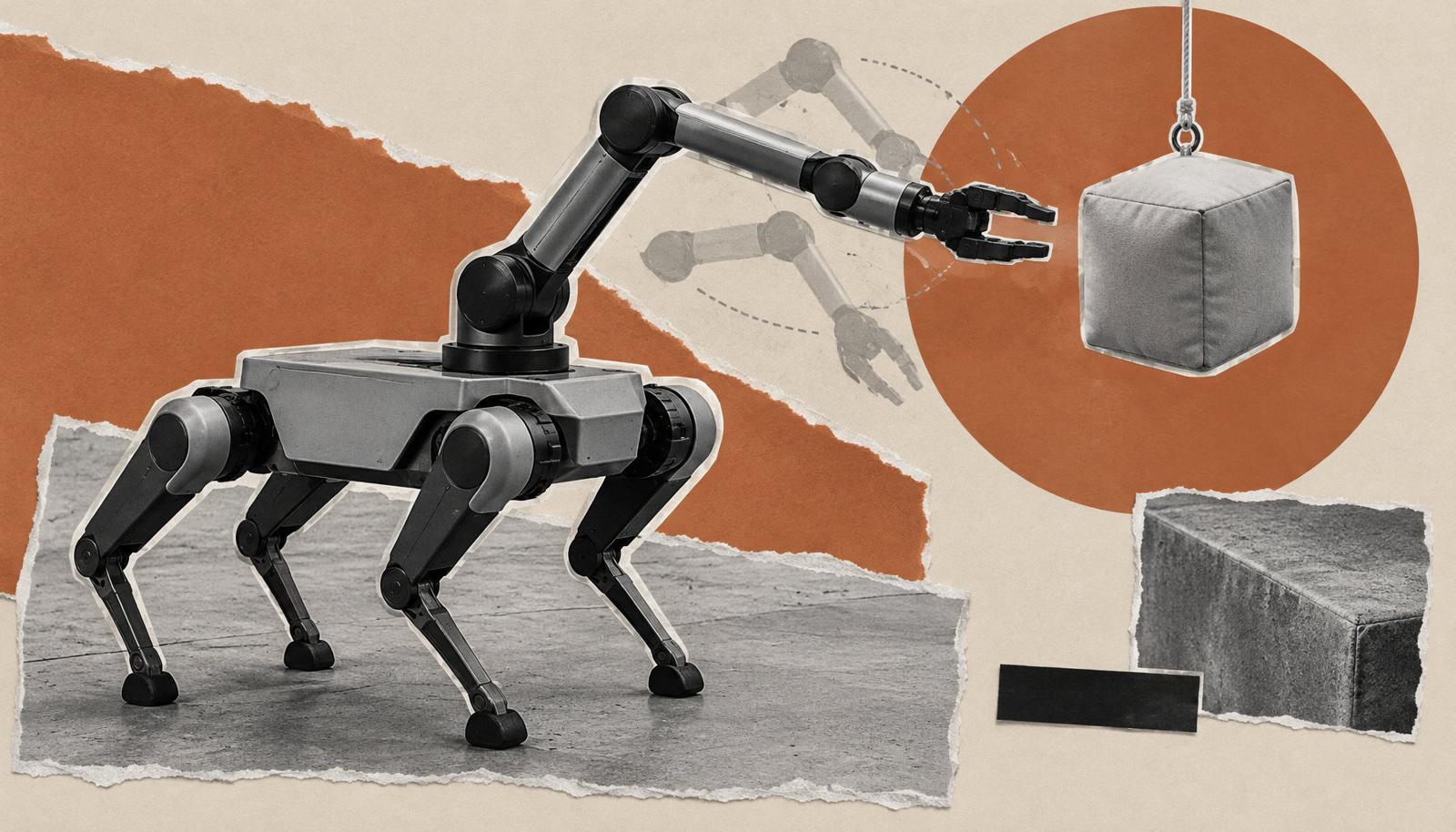
A controller uses an end-effector trajectory to coordinate a quadruped’s mounted arm and base across four arm families. The paper reports simulation results and a language-conditioned pick-and-place demonstration on a physical Go2–ARX5 system.
One trajectory for arm and base
A single end-effector trajectory can serve as the command for coordinating a quadruped’s mounted arm and mobile base across four arm families, the authors report in an arXiv paper. The paper was posted on November 11, 2026. Its controller, PolyMorphWBC, is designed to decide how the arm and base share the motion without requiring a task-level command for the base.
The controller previews upcoming end-effector targets to determine the base motion, while an arm-specific inverse-kinematics module tracks the current target. A frozen locomotion backend carries out the resulting base command. The paper describes cross-arm reuse through morphology information derived from each arm’s robot description, combined with online feedback about residual forces and torques.
Four kinds of mounted arm
The study tests four families of six-degree-of-freedom arms, with different joint layouts. Their anchor models are ARX X5, PiPER, Compact xArm6 and Compact MICO. The authors procedurally varied arm placement, link geometry and inertial properties within each family while using a common Unitree Go2 base.
For each family, the researchers generated 256 training morphologies, 32 for validation and 32 held out for testing. That made 1,024 training, 128 validation and 128 held-out arm configurations across the four families. They also evaluated the anchor models separately, without policy fine-tuning. Training used IsaacLab; the paper says the coordinator and locomotion backend were kept fixed for the held-out morphology tests.
Results in simulation
Across held-out trajectories and arm morphologies in IsaacLab, the paper reports a 93.95% trajectory completion rate, 2.30-centimeter mean position error and 4.81-degree mean orientation error. For trajectories classified as extended reach because a target was more than one meter ahead of the initial base position, completion was 94.83%, with 1.94-centimeter position error and 3.86-degree orientation error.
The authors also compared PolyMorphWBC with UMI-on-Legs in MuJoCo on four trajectories, including vertical and horizontal paths. Across those tests, reported position errors for PolyMorphWBC ranged from 1.38 to 2.04 centimeters and orientation errors from 2.01 to 2.38 degrees. For UMI-on-Legs, the corresponding ranges were 4.77 to 7.31 centimeters and 22.72 to 76.57 degrees; the abstract summarizes the reductions as 69–72% for position error and 91–97% for orientation error.
Go2–ARX5 hardware demonstration
On a physical Go2 equipped with an ARX X5 arm, the researchers demonstrated teleoperation through end-effector commands and a language-conditioned extended-reach pick-and-place task. For the latter, pi_0 supplied end-effector trajectories and gripper commands, while PolyMorphWBC coordinated the arm and base. The paper says neither the operator nor pi_0 supplied a base-motion command.
The authors describe the system as relying on a known arm model and smooth, low-speed end-effector trajectories on a common Go2 base. They identify extending the framework to other mobile bases and contact-rich manipulation as future work.
Sources
- Original source · Preprint PolyMorphWBC: Whole-Body Control from End-Effector Trajectories for Quadrupedal Mobile Manipulation across Arm Morphologies with Extended Reach arXiv:2611.15117
Related stories
- Preprint tests low-cost mobile robot on toilet-cleaning task
- ScaleVLA paper tests a 552B model for robot control
- Preprint: FORGE combines humanoid walking, foot placement and contact control
- MERL paper reports TacSushi falls to 37.5% on held-out foods
- ILA preprint reports motion guidance across three humanoid trackers