The Floor
ILA preprint reports motion guidance across three humanoid trackers
An arXiv preprint describes ILA, an adapter intended to let humanoid robots yield to physical guidance without changing their pretrained motion trackers. The authors report lower guidance-target error across three trackers and hardware trials on a G1 robot.
A reference adapter for physical guidance
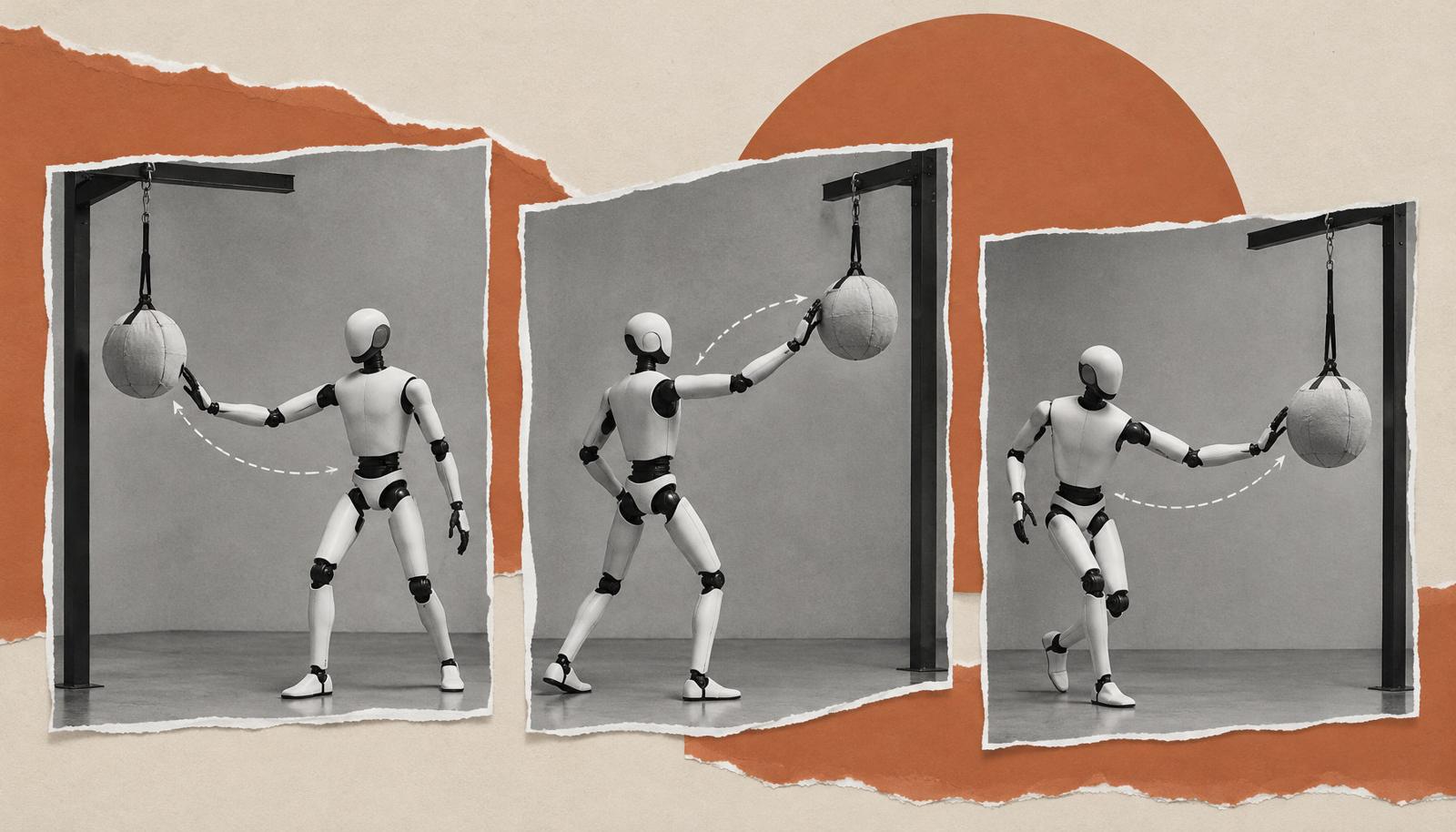
An adapter described in a November 11 arXiv preprint is designed to let humanoid robots yield to physical guidance while keeping their existing motion-tracking policies unchanged. The authors report lower guidance-target error across three motion trackers, with tests in simulation and on a physical robot.
The method, called ILA, adjusts the motion reference rather than changing the tracker that executes it. The paper says the adapter uses the robot’s observation history to predict corrections, while the pretrained tracker continues to handle whole-body movement and stabilization. The adapter itself is trained entirely in simulation, using paired nominal and modified motion references to represent how a robot should yield, hold a guided pose and return to its original motion.
Reuse across different trackers
The preprint reports that the same trained adapter was connected to three independently trained trackers: MT-Std, MimicLite and Sonic. Deterministic mappings align observations and motion references for the different systems; the adapter and target tracker parameters remain fixed during transfer, according to the paper.
In those evaluations, the authors report guidance-target error reductions of 68.1% for MT-Std, 63.6% for MimicLite and 75.4% for Sonic, each compared with the corresponding original tracker. The study also compared ILA with full-policy finetuning. The paper reports stronger guidance and better post-release recovery for ILA than for the finetuning runs it evaluated, while noting that the increase in no-force tracking error differed among trackers.
Tests on a physical robot
Hardware experiments used a G1 humanoid and examined wrist pulling, a one-arm disturbance while the other hand supported an object, and a human-led handshake. Each method had ten physical trials per task; falls and safety-related terminations counted as failures, the paper states.
For the wrist-pull task, all three ILA-equipped trackers reached the prescribed target in all ten trials. The authors also report that the ILA-equipped systems maintained object support during the disturbance task and completed all ten handshake trials. These are results from the reported tasks and trial setup, rather than evidence of performance across other tasks or conditions.
The paper reports that ILA’s standalone inference took 0.51 ms on the G1 controller. It ran as a separate, asynchronous trajectory-generation process, alongside a 20 ms control cycle. The preprint describes its results as supporting a reusable extension to pretrained trackers, but says the method depends on mappings between the adapter’s input and output representation and each target tracker.
Publication status
The authors are affiliated with Harbin Institute of Technology, Shenzhen, and the National University of Singapore. The arXiv manuscript says it was submitted to the IEEE for possible publication; the record presents it as a preprint.
Sources
- Original source · Preprint ILA: A Transferable Interface-Level Adapter for Compliant Humanoid Motion Tracking arXiv:2611.14985
Related stories
- Preprint turns one RGB image into humanoid motion references
- Virtual-joint method reuses humanoid locomotion training across three robots
- Preprint: FORGE combines humanoid walking, foot placement and contact control
- Preprint reports humanoid reached 50 cm farther by bracing
- Preprint tests simulated planner for humanoid groups around people