The Floor
Preprint turns one RGB image into humanoid motion references
A preprint describes a pipeline that reconstructs a scene from one RGB image, generates a human interaction and retargets it for a humanoid robot. The authors report an 89% success rate in simulation and a 70% rate across 50 physical trials on a Unitree G1.
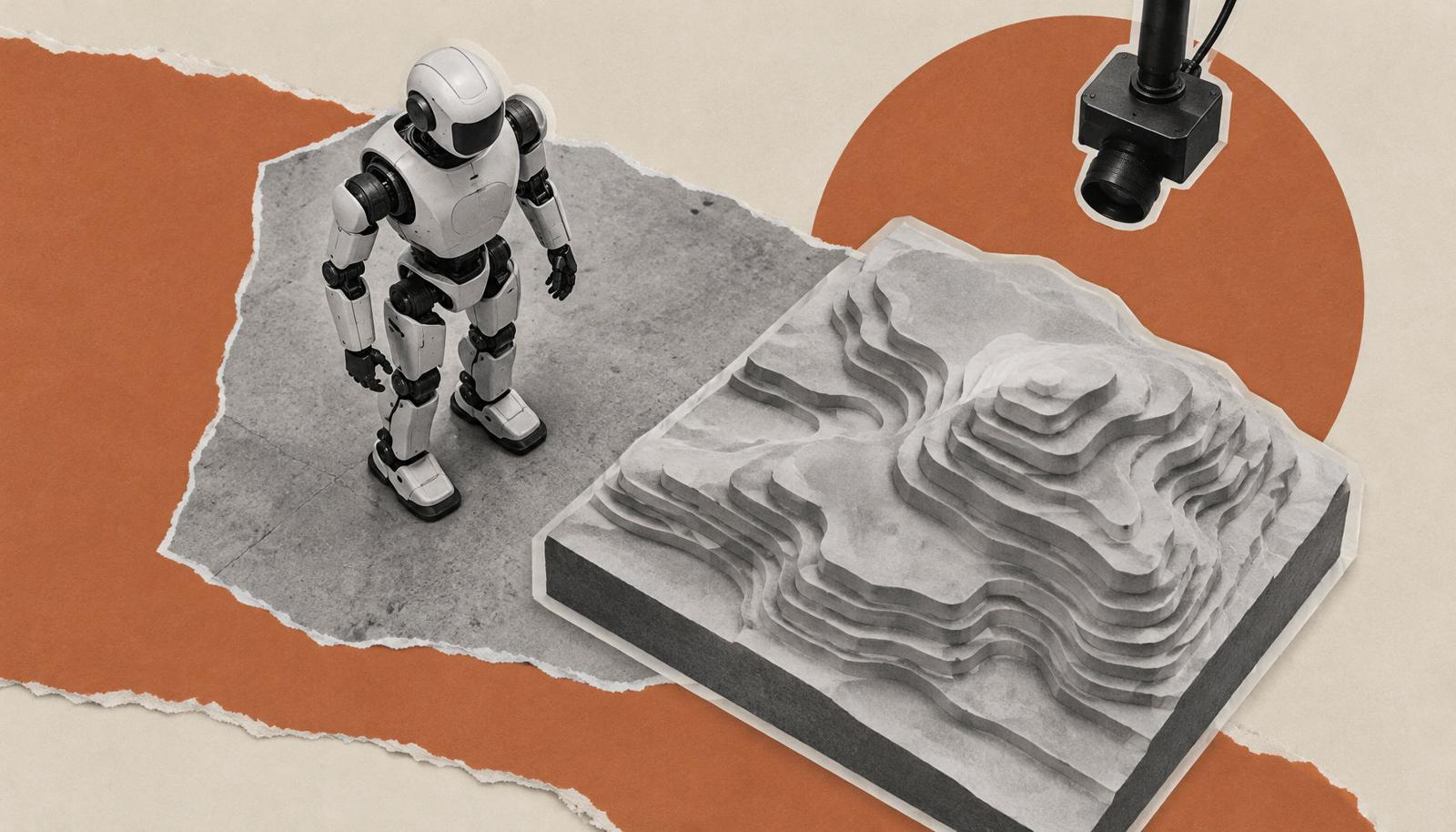
From image to motion reference
A single RGB image can seed a pipeline that reconstructs a scene, generates a human interaction and produces a humanoid motion reference, according to a preprint posted to arXiv on November 11. The paper reports an 89% success rate in simulation and a 70% success rate across 50 physical trials on a Unitree G1.
The system does not produce low-level robot commands directly from the image. It builds a reference motion, which a separately trained tracker uses alongside its observations to generate control commands.
Two rounds of geometric correction
The pipeline first reconstructs visible scene geometry with SAM 3D Objects and generates a human interaction conditioned on that reconstruction. It then adjusts the interaction to better match the reconstructed scene before transferring the motion to the robot.
The first refinement stage, Joint Metric Interaction Refinement (JMIR), aligns the human motion with the scene while preserving the generated interaction structure. General Motion Retargeting (GMR) transfers that motion to the Unitree G1. A second stage, Contact Guided Residual Retargeting (CGRR), corrects support mismatches introduced by differences between the human and robot bodies, including their proportions, foot geometry and joint limits.
The resulting reference can be passed to pretrained humanoid motion trackers without scene-specific policy fine-tuning, the authors say. The paper evaluates it with MimicLite, GMT and SONIC, as well as Humanoid-GPT.
Simulation and robot trials
In a matched comparison with GRAIL, the paper reports that the combined refinement stages took 87 seconds, compared with 480 seconds for GRAIL, a 5.5-times speedup. The comparison used the same source interaction and reconstructed mesh, and the reported 87 seconds included both JMIR and CGRR.
In simulation, the complete pipeline achieved an 89% success rate across 100 trials for the reported variant. The paper also describes physical tests on five terrain categories, with 10 trials per category. The robot completed 35 of the 50 trials successfully, for a reported success rate of 70%; a trial counted as successful when the robot completed the prescribed interaction without falling or triggering an emergency termination.
Tracker tests held the generated robot reference fixed while changing the tracking backend. Without scene-specific fine-tuning, the paper reports success rates of 50% for Humanoid-GPT, 70% for MimicLite, 60% for GMT and 60% for SONIC, each over 10 trials. A task-specific fine-tuned SONIC configuration reached 90% across 10 trials, with 30 hours of adaptation time.
Scope of the method
The experiments focus on interactions that depend on environmental support.
Sources
- Original source · Preprint From a Single RGB Image to Robot Execution: Metric Scene Alignment and Contact-Guided Retargeting arXiv:2611.14981
Related stories
- NVIDIA details SOMA tool for mapping human motion to humanoids
- ILA preprint reports motion guidance across three humanoid trackers
- Preprint: FORGE combines humanoid walking, foot placement and contact control
- Virtual-joint method reuses humanoid locomotion training across three robots
- Preprint tests simulated planner for humanoid groups around people