The Floor
Preprint reports humanoid reached 50 cm farther by bracing
A Unitree H1-2 humanoid extended its reach by about 50 cm by leaning on a table for support. The preprint reports 89% success reaching commanded targets and 81% success completing the reach-and-recovery cycle in 54 hardware trials.
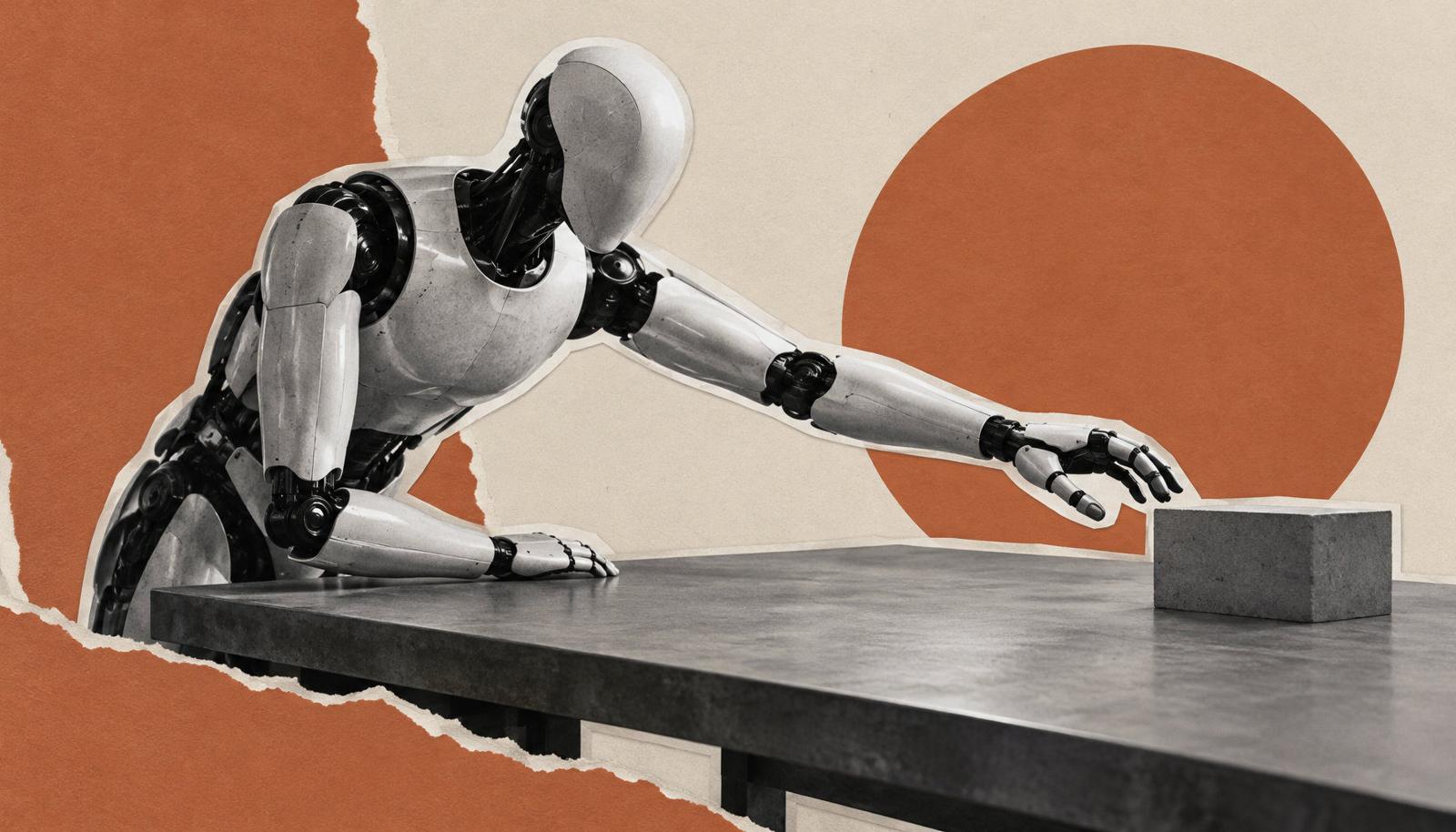
Reach beyond the stance
A humanoid robot extended its reach by about 50 cm by leaning on a table for support, according to a preprint posted November 14 by Allen Devaraj, William Xie and Nikolaus Correll. The study used a Unitree H1-2 humanoid and reports 89% success reaching commanded targets and 81% success completing the reach-and-recovery cycle in 54 trials.
Source arxiv.org
The preprint says the robot reached about 50 cm beyond its unbraced standing workspace. It also reports that the robot held the loaded posture for more than four minutes.
Control and sensing
The researchers’ preprint describes supported reaching as a task that couples manipulation with balance. The robot must lean forward, establish an upper-body support contact, reach a target and then release that contact to recover.
The study used sampling-based model predictive control in simulation and transferred the controller to the physical robot. The preprint says the controller ran at 34 Hz on a laptop, with the deployed configuration using 20 rollouts across a one-second planning horizon.
For state estimation, the paper compares internal odometry, internal odometry fused with LiDAR, and internal odometry fused with AprilTag fiducials. It says the fiducials reduced horizontal position drift compared with internal odometry and the LiDAR-fused estimate; the researchers used the fiducial-based estimate for the remaining experiments.
Hardware trials
The study reports reaching the commanded target in 89% of trials and completing the full cycle in 81%, across 54 trials spanning six targets and three table heights. The paper gives the counts as 48 successful commanded reaches and 44 full reach-and-recovery cycles, each out of 54 attempts.
For maximum-extent reaches, the preprint reports 11 successes in 15 hardware trials. It measures the gripper tip at a maximum of 130 ± 10 cm from the ankle midpoint, compared with about 80 cm for the same stance without bracing.
The tests varied table height while keeping the controller unchanged. At the tallest table, two deeper lateral target positions failed before the robot reached them; at the other two table heights, the study reports successful holds at all six target positions.
Where trials failed
In four failed maximum-reach trials, the robot fell forward after bracing and triggered an emergency stop. The paper’s analysis says successful trials loaded the forearm progressively and unloaded it gradually during recovery, while failed trials developed a higher force near brace onset and maintained a more variable load.
The authors say the 81% full-cycle success rate does not yet provide the reliability required for autonomous deployment. The paper identifies further work on brace-contact planning, object retrieval under varying payloads and operation across different support surfaces.
Sources
- Original source · Preprint arXiv arXiv:2611.19100
Related stories
- Preprint tests simulated planner for humanoid groups around people
- Preprint: FORGE combines humanoid walking, foot placement and contact control
- ILA preprint reports motion guidance across three humanoid trackers
- Preprint proposes affine-field control for safer robot collectives
- Preprint Finds VLA Reactivity Depends on Execution Strategy