The Floor
MERL paper reports TacSushi falls to 37.5% on held-out foods
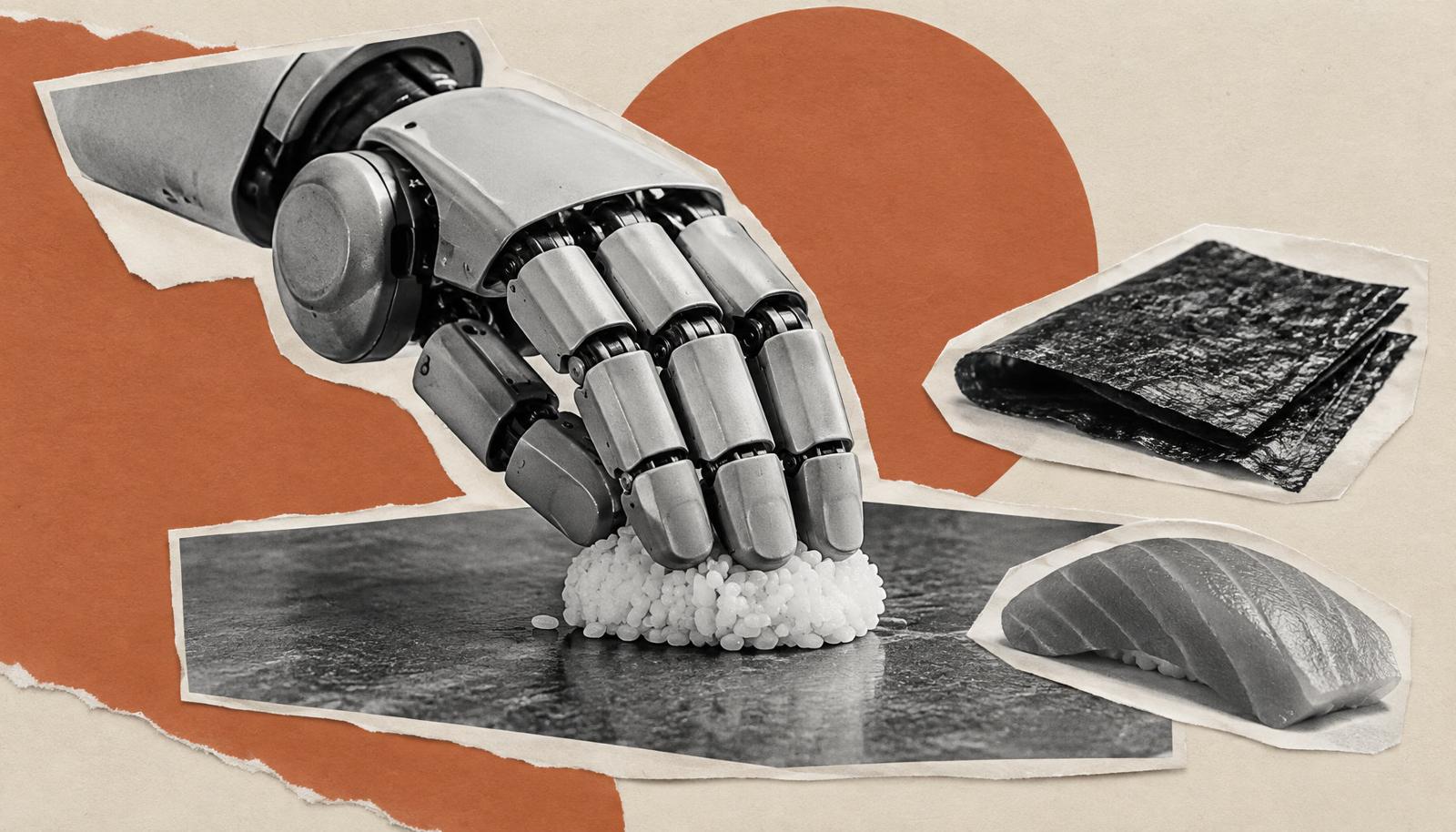
A November 13 paper reports that TacSushi averaged 68.3% success on three familiar food tasks but 37.5% on two held-out ingredients. The real-robot evaluation covered 600 rollouts and scored outcomes using human and vision-language-model ratings.
Held-out ingredients remain difficult
A November 13, 2026, Mitsubishi Electric Research Laboratories paper reports that TacSushi achieved 68.3% average success on three familiar food-manipulation tasks, compared with 37.5% on two held-out ingredients. The study tested the tactile-grounded policy on a real robot across 600 rollouts, with outcomes scored using ratings from people and vision-language models.
The authors are Haodi Hu, Kaen Kogashi and Toshiaki Koike-Akino. The paper, presented at the 2026 Conference on Robot Learning workshop on dexterous manipulation, says the results show gains from tactile-input fusion and training-time prediction, alongside a marked drop when the ingredients change.
Touch guides action; prediction trains the policy
The system controls a four-finger Shadow Dexterous Hand Lite equipped with tactile sensors on all four fingertips. Each sensor contains 17 three-axis taxels, giving the hand 68 taxels and 204 raw tactile channels; the hand has 13 actuators and 16 observed joints.
For deployed control, the policy combines camera images, a language instruction and hand-state data with current fingertip readings. A learned gate adjusts how tactile features enter the representation used to generate actions, rather than simply joining touch and visual features together.
During training, a separate decoder predicts logged future images, task progress, relative contact risk and tactile summaries, using the demonstrated action and the current state. Failed demonstrations still contribute information about their recorded outcomes, but their actions are excluded as imitation targets. At deployment, the decoder and action encoder are removed; the robot acts using current observations rather than predicted future outcomes.
Scores depend on the ingredients and evaluation rule
The evaluation covered rice-ball shaping, seaweed wrapping and surf-clam placement, followed by tests using black rice and salmon as held-out ingredient variants. The paper says neither held-out ingredient was used for task-specific adaptation. Each of six methods was evaluated in 20 trials for each of the five conditions, for 600 rollouts in total.
Each terminal image received five human ratings and one rating from each of three vision-language models on a five-point visual-quality scale. A trial counted as successful when the eight ratings averaged at least 3, a rule intended to assess visible completion and damage.
Full TacSushi reached 75% success on rice-ball shaping, 60% on seaweed wrapping and 70% on surf-clam placement. On the held-out ingredients, its success rates were 35% for black rice and 40% for salmon. In a matched comparison using gated tactile fusion, adding training-time consequence supervision raised average success from 36.7% to 68.3% on the familiar tasks and from 10.0% to 37.5% on held-out ingredients, according to the paper.
The paper also reports a descriptive pooled success rate of 56% across the five conditions, compared with 31% for its strongest system baseline, GR00T with tactile input.
Limits on what the results establish
The authors say their success measure combines human and model ratings of terminal appearance; the model ratings are not independent ground truth and could affect outcomes near the success threshold. They also note that reported intervals capture rollout variation for fixed checkpoints, not uncertainty across training runs or evaluators.
Its evaluation kept the learned manipulation objectives and workspace while changing the ingredients.
Sources
- Original source Mitsubishi Electric Research Laboratories merl.com
Related stories
- TouchTwin uses tactile recordings to build simulated hand demonstrations
- Paper reports 3.8 ms refinement for robot policies in simulation
- Heave-Ho paper reports humanoid teams carrying loads without network links
- ArXiv paper details quadruped control across four arm morphologies
- ACE-CaP-0 preprint reports 92.1% success in robot trials