The Floor
AthenaZero Puts Robot Mechanics at the Center of Dexterity
AthenaZero, a bimanual robot from the Robotics and AI Institute, threw a tennis ball at 30.8 meters per second and caught balls in laboratory tests. Its low-inertia design enabled fast contact, but the team’s paper also documents limits in sustained lifting, positioning accuracy and hand grip force.
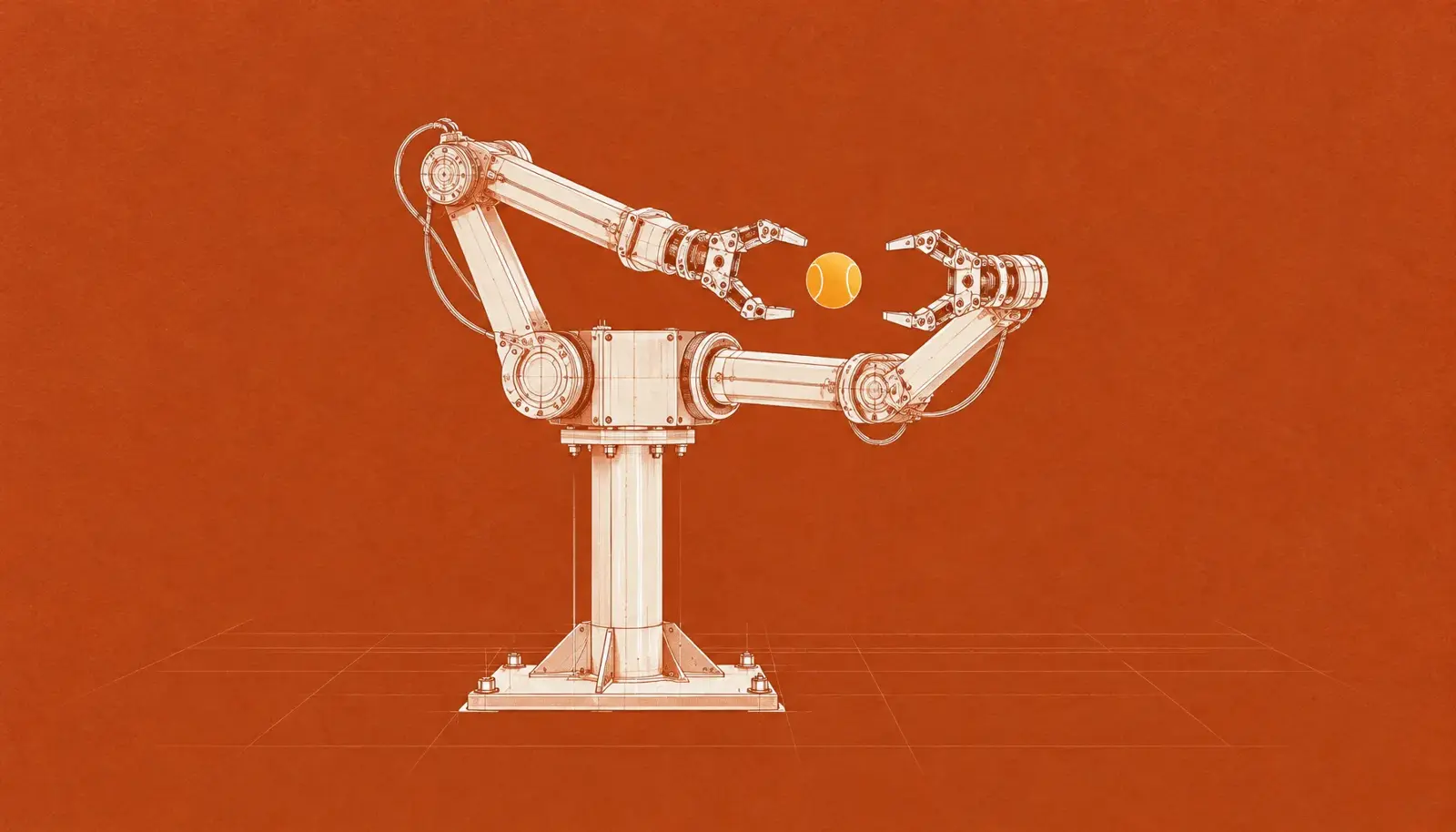
A 30.8 m/s throw starts with lighter mechanics
AthenaZero threw a tennis ball at 30.8 meters per second—about 69 mph—in a test of how robot hardware shapes fast manipulation. The result came from a one-arm configuration; in a separate two-arm test, the robot accurately threw a baseball at 21.4 m/s across 7.3 meters. The researchers posted their paper to arXiv on September 15, 2026, arguing that dexterity depends not only on control algorithms but on how much inertia a robot must move.
“AthenaZero is a bimanual manipulator designed to minimize inertia without compromising control authority,” write Andrew S. Morgan and co-authors in the paper. Their design aims to let the arms accelerate quickly and yield when they meet an object, rather than behave like high-gear-ratio industrial arms built to hold a position with stiffness.
Motors move toward the torso
AthenaZero stands about 1.6 meters tall and combines a one-degree-of-freedom torso, two seven-degree-of-freedom arms and two six-degree-of-freedom hands. Its 22 actuators coordinate across 27 joints. Quasi-direct-drive actuators use lower gear reductions, while transmissions move some motors closer to the robot’s center and lightweight links reduce mass farther out along the arms.
The design targets effective mass: the apparent mass a robot presents at a point of contact, which changes with its posture and direction of motion. AthenaZero’s lower effective mass makes it easier to accelerate an arm and absorb a collision. In a one-kilogram pendulum test, the researchers measured effective mass of 0.83 kg at AthenaZero’s wrist, compared with 3.3 kg for a Franka Research 3 arm under the test conditions.
That compliance comes with a cost. With a 1.8 kg load, AthenaZero’s average end-effector positioning error was 12 mm, compared with about 3 mm unloaded. The paper says it does not match the millimeter-level precision associated with conventional collaborative robots.
Three baseball tasks test timing and contact
The team tested throwing, catching and batting in a controlled lab, with two AthenaZero robots facing each other 7.3 meters apart. The system caught a baseball at up to 18.3 m/s and made solid bat contact with a tennis ball at a maximum pitch speed of 13.9 m/s. The paper’s higher figure of 35.0 m/s for batting is an extrapolation based on reaction time at the 18.4-meter distance from a standard pitcher’s mound, not a speed tested in the lab.
Batting required real-time adjustment: a swing just 2 milliseconds too early or too late could miss. The robot tracked the ball and changed its swing based on the projected path through a strike zone. In demonstrations, two robots sustained batting practice for about three minutes; the team also tested catch and batting with a human taking one robot’s place.
Static loads expose the tradeoffs
The researchers deliberately prioritized low inertia over long-duration holding capacity. Thermal safeguards trigger when motor temperatures exceed 80°C, and the robot cannot depend on holding loads above 2 kg at full arm extension for prolonged periods. Off-the-shelf motor drivers also capped current at 70 A, below the motors’ 130 A peak rating, limiting torque available for fast maneuvers.
Remote actuation reduces mass at the hands, but long Bowden cables introduce friction that limits grasping force. AthenaZero’s baseball trials show what its mechanics can support under controlled conditions; the paper leaves the practical boundary clear: the robot trades sustained force, grip strength and positional accuracy for lower inertia and faster physical interaction.
Sources
- Original source · Preprint AthenaZero: A low-inertia, bimanual robot for dynamic manipulation arXiv:2609.19194
Related stories
- Recursia Tests a Shared Stack for Robot Skill Improvement
- Hsu and Stone Introduce ELA Preprint for Learning Robot Policies from Video Demonstrations
- Researchers Demonstrate a Bistable Origami Robot for Multimodal Motion and Grasping in Nonuniform Magnetic Fields
- VICTR Preprint Reports 23.8% Success on Unseen Out-of-Domain Real-World Robot Tasks
- ExRL learns when to replan robot actions, researchers report