The Floor
Recursia Tests a Shared Stack for Robot Skill Improvement
A research team tested Recursia, a system that improves shared robot software components for composing manipulation skills. The paper reports gains in simulation and higher average success than a baseline across three physical robot tasks.
“Individually competent robot skills can fail when composed: tools may lack a required capability, completion signals may misrepresent physical progress, and one skill may leave a state that violates its successor’s prerequisites.”
Yangzhi Chen, Feiran Liu, Zishuo Wang, Zijian Jin, Xin Zhu, Lecheng Ruan and Wenjuan Han, authors of the paper, write
The authors describe Recursia, a system designed to improve the shared software a robot uses to carry out sequences of tasks—not just the program for one task. Their tests cover simulated long-horizon manipulation and a physical Franka FR3 robot equipped with a Franka Hand. The results suggest repairs to shared components can transfer to new task combinations, though the physical evaluation spans only three target tasks.
Recursia repairs the interfaces between skills
Recursia treats a robot’s executable stack as the persistent unit of improvement. That stack includes tools, reusable skills with execution contracts, handoffs between skills and task verifiers. The distinction matters because a robot can complete one action yet leave the scene in a state that prevents the next action from starting.
For example, a motion tool can report that it finished without confirming the robot reached its intended pose. A grasp-and-place skill can also leave an object correctly positioned while making the next target hard to identify or reach. Recursia uses execution traces from source tasks to locate the first supported failure, then proposes a missing tool or a repair to a shared component.
Proposed changes do not enter the stack automatically. The authors apply generality checks to screen out task-specific patches, test whether a repair works as intended, and compare the changed stack with its predecessor under paired selection and regression tests. Accepted changes are retained; target tasks then use the frozen stack through declarative adapters, without target-side code repair.
Simulation gains vary by perturbation
On LIBERO-Pro Long, Recursia reached a 28.4% success rate under position perturbations and 53.4% under task-specification perturbations. The paper reports improvements over ASPIRE of 5.8 percentage points and 15.1 points, respectively. The benchmark contains 10 long-horizon tasks, with 500 evaluation episodes for each perturbation axis.
The paper reports that the ASPIRE comparison rates come from an existing comparison, rather than a newly run matched test. The authors also describe non-monotonic results as the system gains source-task experience: performance does not rise steadily at every improvement checkpoint. Those details make the headline gains useful evidence for the approach, not proof that each new repair reliably improves every task.
Three physical tasks, ten trials each
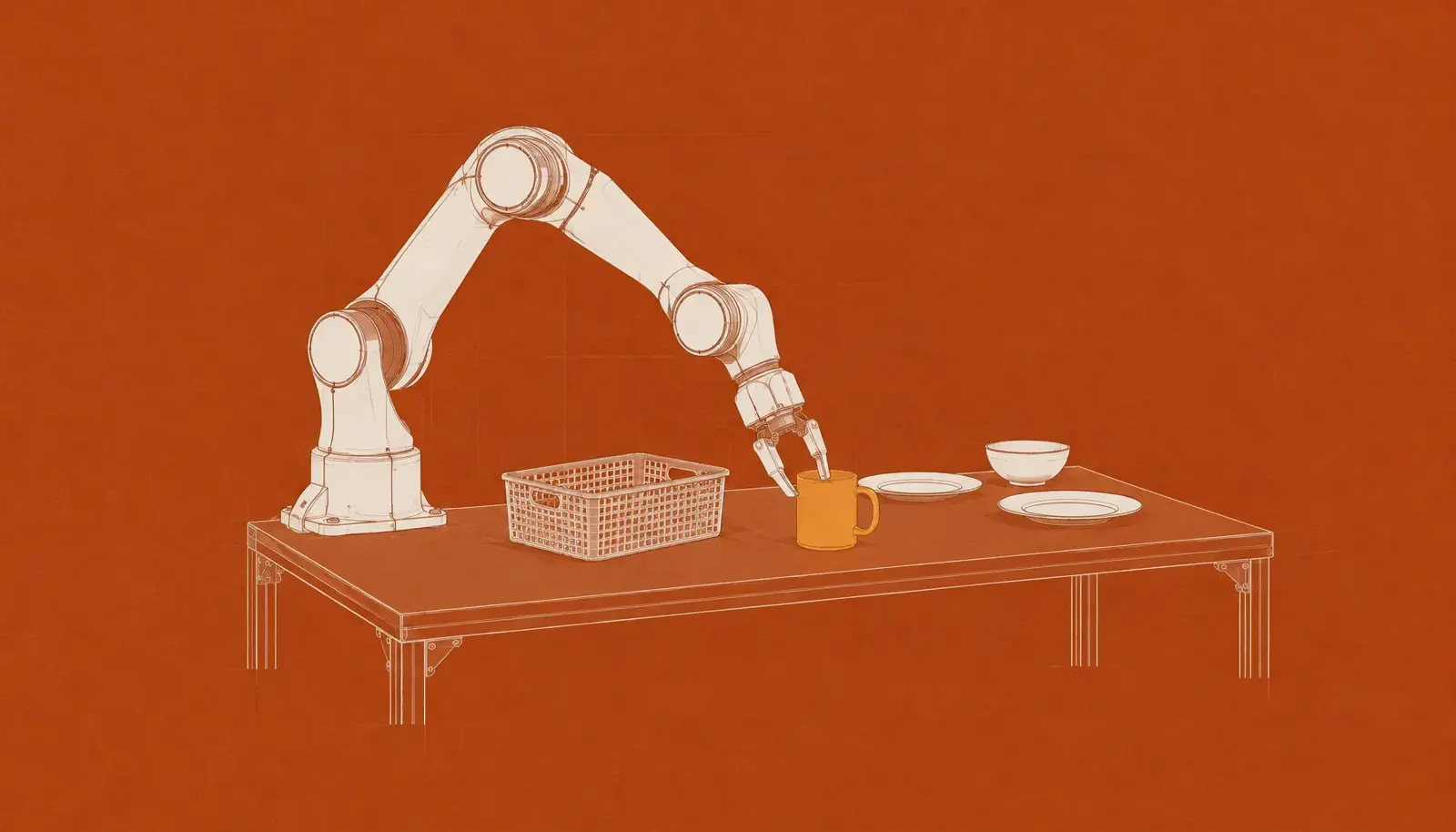
On the Franka FR3, Recursia averaged 66.7% success across three physical target tasks, versus 26.7% for a Skill Document Only baseline. The tasks involved placing a mug and milk carton in one basket, swapping white and blue mugs between plates, and placing a mug inside a bowl after moving the bowl. The paper reports success rates for Recursia and the baseline of 20% versus 0%, 80% versus 60%, and 100% versus 20%, respectively.
Each task was run 10 times per method, and people assessed whether each trial succeeded. The source tasks used to prepare the system were completed before target evaluation; corrections during a physical trial did not update the persistent stack. The small number of trials and manual scoring limit how much can be inferred from the 40-point average difference.
Real-robot learning still faces a diagnosis gap
The paper’s own limitations point to a gap between the simulated improvement loop and hardware deployment. Source-side diagnosis uses ground truth in simulation, where failed runs can be reset and replayed; comparable evidence may be incomplete, costly or difficult to obtain on a physical robot. The authors say the experiments also do not test transfer between different robot embodiments, so repairs may depend on the FR3’s kinematics, gripper or controller conventions.
Recursia’s central claim is narrower than a robot that learns autonomously from any experience: it tests whether validated changes to shared execution code can help with new combinations of familiar manipulation skills. In the physical tests, that frozen code stack completed the bowl-and-mug dependency task in all 10 trials.
Sources
- Original source · Preprint Learning to Compose: Recursive Self-Improvement of Shared Executable Stacks for Zero-Shot Long-Horizon Robot Manipulation arXiv:2610.24464