The Floor
Leet’s Team Finds RoboDojo Scores Doubling Every 44.5 Days
A study of seven frontier multimodal models found RoboDojo manipulation scores rose quickly between July and September 2026. The strongest models still made mostly partial progress on physical robot tasks, while speed and API costs varied sharply.
Scores rise; full task completion stays rare
Frontier multimodal models are getting better at directing physical robot arms, but the strongest systems still struggle to finish ordinary manipulation tasks within a limited action budget. A paper submitted to arXiv on October 18 reports a 44.5-day doubling time for benchmark performance from July through September 2026, even as its top models typically made partial progress rather than completing whole tasks.
“We find that current frontier models can directly control real robotic arms to perform a variety of manipulation tasks but are not yet precise or efficient enough to complete them within a practical action budget,” write Christopher Leet et al. in “The Bitter Lesson Comes to Robotics.” The authors say the results show both fast improvement and a gap between making useful moves and reliably finishing a job.
Seven models faced six physical tasks
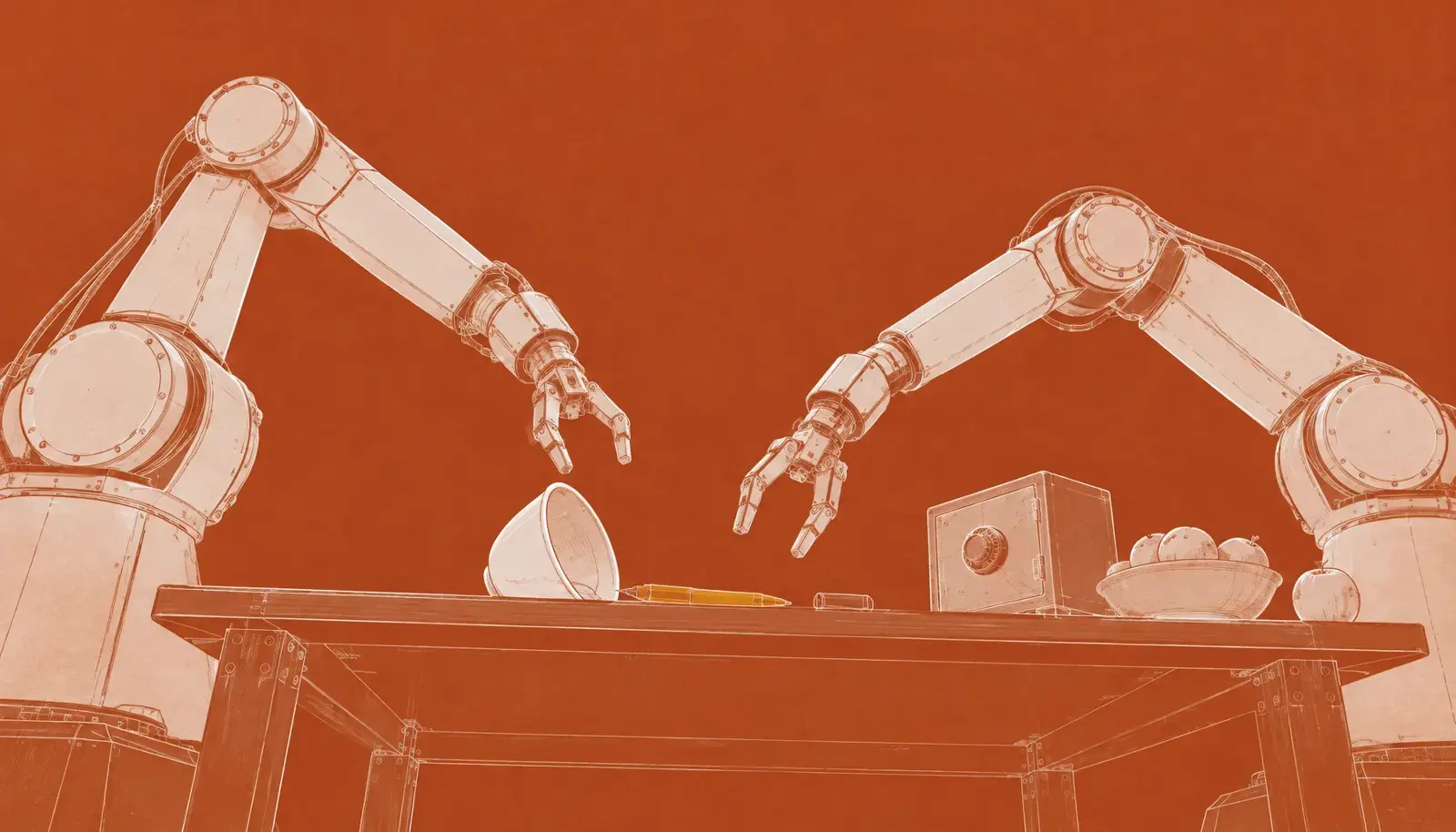
The researchers tested seven models across 12 model-and-reasoning configurations on a bimanual I2RT YAM robot. The set included models from OpenAI, Anthropic and Google, and each configuration attempted 20 trials on each of six RoboDojo tasks: stacking bowls, putting objects into a safe and closing it, sorting objects, capping a pen, packing and pouring fruit, and standing bottles upright.
The robot provided arm and gripper feedback along with three camera views: two wrist-mounted and one overhead. Models received the task, operating instructions and initial observations, then issued tool-based commands for Cartesian end-effector positions and gripper settings. Each trial stopped when the model finished, gave up or used its budget of 40 actions.
Two software guards checked the requested movements before execution. One kept commands within the arms’ operating limits; the other restricted how far an arm could move in a single action. The researchers scored cumulative subtasks as well as full-task outcomes, so a model could earn credit for progress even if it did not finish.
Fast improvement masks a completion gap
Across record-setting model configurations released between July and September, the authors’ fitted trend corresponds to benchmark performance doubling every 44.5 days. They estimate a 95% confidence interval of 35.0 to 50.9 days. The estimate describes a short run of results from a particular benchmark, not a guarantee that future models will keep improving at that pace.
The best configurations scored an average of 45% to 48% across tasks, but the paper says those scores mostly reflect consistent partial progress rather than occasional end-to-end success. The bottle task exposed a particularly sharp limit: across 140 trials, only five resulted in one bottle standing upright, and none stood two. The authors attribute the difficulty in part to the bottles’ distance from the robot base and constraints on the arm’s reach and end-effector pitch.
Speed and API cost pull in different directions
Performance was not the only measure that changed. The highest recorded rate rose from 12.4 subtasks per hour for GPT-5.6 Sol to 54.4 for GPT-6 Astra with high reasoning effort and ultrafast service, a 4.4-fold increase across 57 days. The lowest recorded API cost per subtask fell from $2.36 for GPT-5.6 Sol to $0.38 for Gemini 3.8 Flash, a 6.2-fold decrease across 55 days.
Those gains did not produce one clear winner. GPT-6 Astra with ultrafast service completed a subtask in an average of 1.1 minutes, but cost $4.51 per subtask. Gemini 3.8 Flash cost $0.38 per subtask, but took an average of 4.18 minutes. The paper also cautions that the speed and cost trend estimates rest on only three record-setting configurations for each measure.
Physical mistakes still consume the action budget
Some failures came from basic grasping: GPT-5.6 Sol and GPT-6 Sol closed their grippers without securing an object in 64% and 59% of attempts, respectively. Stronger models were better at compensating for physical effects such as arm sag and camera parallax, but they could still make errors that ended a trial, including knocking an object off the table or squeezing a curved pen lid out of reach.
The study’s results therefore hinge on a distinction between improving benchmark scores and delivering reliable task completion. Its measurements show that recent models make progress more quickly and at lower cost on some trials, while physical execution, time and API expense remain competing constraints—and the 40-action limit makes each one visible.
Sources
- Original source · Preprint The Bitter Lesson Comes to Robotics arXiv:2610.25287