The Floor
Boston Dynamics Tests Wheeled Whole-Body Control on Atlas
Boston Dynamics replaced Atlas’s feet with wheels to test a learned whole-body controller on real actuator hardware. The company says the research testbed showed how simulation-trained control could transfer to the robot and let the team probe its motors at their limits.
A testbed for actuator limits
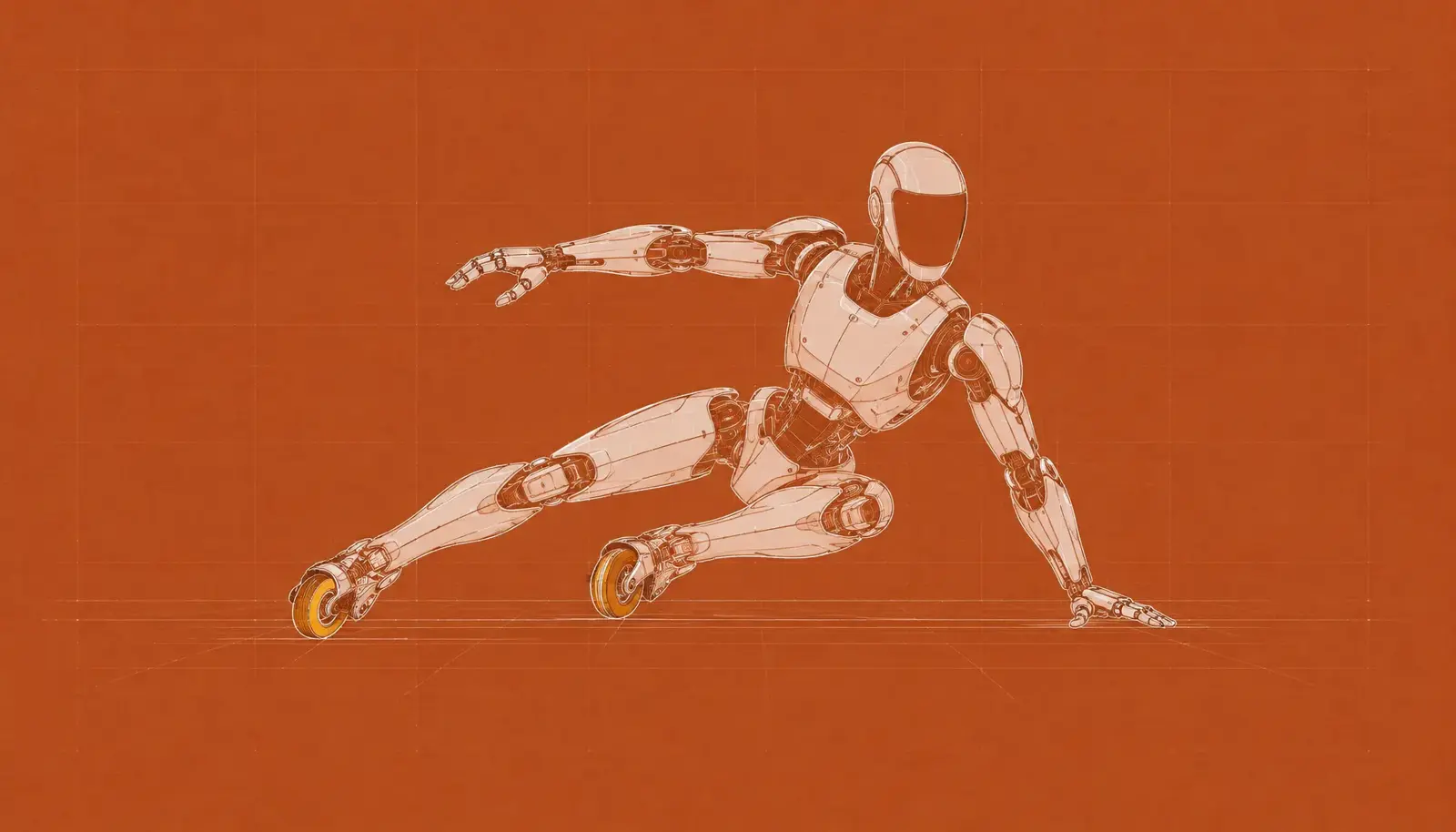
Boston Dynamics tested Atlas with wheels in place of feet to see how a learned whole-body controller worked with real actuator hardware. The company described the wheeled robot as a research testbed, not a product, and said the project was meant to push its actuators to their limits. Its stated goal was to check how faithfully a learned whole-body controller could work with real actuators running near the edges of their performance ranges.
The post was written by Xiaoyu (Andy) Wu, a controls engineer on the Atlas team. Wu said, “The wheels weren’t really the point of this.” He explained that the work was about examining how motors and actuators behaved in demanding situations, as well as whether control tuning held up under those conditions.
Changing the hardware and model
The team chose wheels because driving on them would make the motors deliver high torque and speed continuously while carrying a load. The company said each launch, turn and stop on wheels would push the motors across their full torque-speed range. The mechanical change used a custom adapter to attach an off-the-shelf scooter rim to an existing ankle actuator; Boston Dynamics said that adapter was the only new part in the build.
In the software model, each wheel was treated as an ankle that could spin continuously, replacing the feet in the baseline robot model. The company says reinforcement-learning training ran the robot through millions of simulations before it was tested on hardware. To make that training useful, engineers checked low-level control settings across software setups and tuned the simulated motor model against measurements from the robot.
Boston Dynamics said changes to the reward composition, training commands and posture control helped smooth rolling emerge while the robot remained stable and easy to drive. Wu said the simulation-trained behavior transferred “basically perfectly” to the physical robot.
Moves learned from motion data
Some of the movements came from a library of human motion-capture data, and Wu looked for clips with substantial foot sliding. For side dashes, the policy learned to steer the wheels and roll where a person would slide their feet. Wu said he was surprised that training produced that behavior.
The 360-degree jump followed a recorded human motion through a trajectory-tracking policy, and the company said it worked on the first try. Wu said the jump was lower risk than it looked because the motion came from a motion-capture recording. The company’s account describes the lower body rolling into position during the windup before the jump.
Work returning to the standard setup
The next project Wu described is improving policy responses to actuator failures and studying behaviors that reinforcement learning might produce in response. Boston Dynamics said it is applying the project’s lessons to its standard configuration, including work on actuator dynamics and whole-body reinforcement learning.
The company said integrating actuator behavior with whole-body learning is part of its ongoing work to improve policy robustness against failure modes and expand Atlas’s capabilities. It framed the wheeled configuration as a way to explore the interaction between motor control, hardware and learning, rather than as a product configuration.
Sources
- Original source · Blog post Boston Dynamics bostondynamics.com
Companies in this story
Related stories
- Boston Dynamics Gives Atlas Four-Finger Hands With 13 DoF
- Boston Dynamics Workers Urge Company to Halt ICE Robot-Dog Sale
- Boston Dynamics Taps Amazon AI Leader Rohit Prasad as CEO
- Researchers present low-cost TAG testbed for coupled robot control
- Georgia Tech Study Finds No Best Humanoid Steering Strategy