The Floor
AstroBench Records 6 Captures in 400 Generalist-Policy Trials
AstroBench tests free-floating object capture in simulated spacecraft conditions, where contact can push an unsupported target away. A frozen π0.5 policy captured 6 of 400 targets, while a separate cube-trained ACT policy captured 14 of 20.
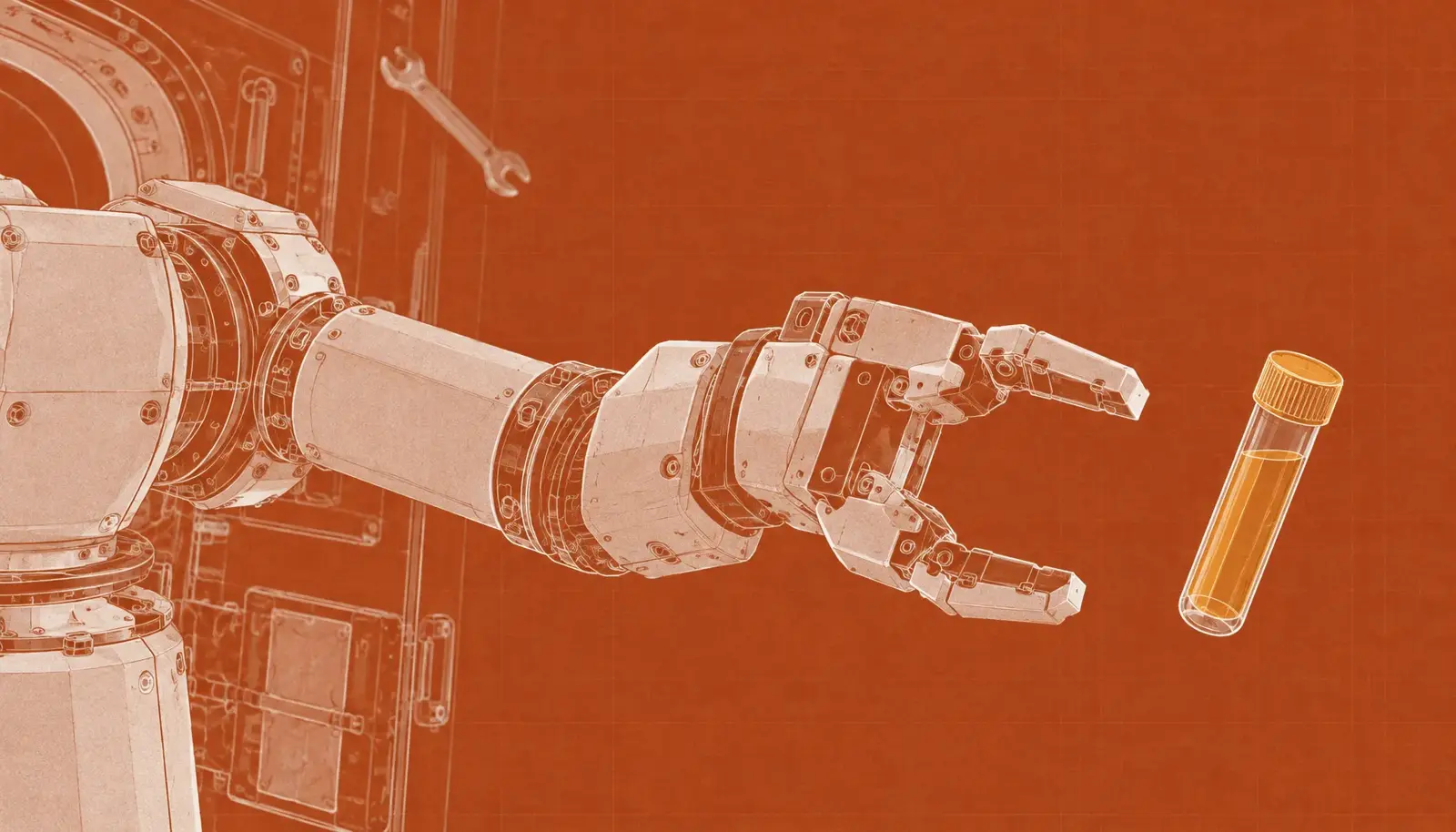
A frozen generalist robot policy captured a free-floating object in 6 of 400 simulated attempts, according to AstroBench, a benchmark for space-oriented manipulation submitted to arXiv on October 22, 2026. The evaluation puts a fixed-base arm in a zero-gravity simulation and gives it objects that can move when the gripper makes contact. A separate, cube-specific policy succeeded more often on its narrowly defined task, but the authors caution against treating the two results as a direct model comparison.
Six captures across twenty objects
The AstroBench team tested an existing π0.5 DROID joint-position checkpoint without adapting it to the benchmark. In 200 attempts with initially stationary targets, it captured two; in 200 attempts with moving targets, it captured four. Those results amount to capture rates of 1% and 2%, respectively, and 1.5% overall.
The 400 attempts covered twenty object identities, with ten repetitions per object in each condition. The two stationary captures involved a small hammer and a sample tube; all four moving-target captures involved pliers. The authors report that two moving-target attempts were rejected at the action-limit interface, while the other unsuccessful attempts did not satisfy the benchmark’s capture test.
That test requires measured gripper closure and contact with the target; a closing command or apparent overlap in an image does not count. The paper defines success as an acquisition event during the attempt, not as proof that a robot can perform the full sequence of catching, stabilizing and retaining an object throughout a mission.
A cube-trained policy answers a different question
For a separate experiment, the researchers trained an ACT policy specifically for a Rubik’s cube using 400 demonstrations. It captured the cube in 8 of 10 attempts from fixed positions when initially stationary and 6 of 10 when the cube began moving. The paper presents those results as evidence of task-specific capture behavior, not as a fair contest against π0.5.
The experiments differ in training, object coverage, capture-detector revision, episode duration and action scheduling. π0.5 executes a 15-action chunk—one second of commands—before receiving a new observation, while ACT updates its command at every control step. The authors suggest feedback timing as a mechanism worth testing, but say their results do not establish that it caused the performance gap.
AstroBench spans capture, storage and servicing
The benchmark extends beyond the two capture studies. Its task catalog includes four initial-motion tracks—static, drifting, tumbling and faster tumbling—and workcells modeled on MELFI sample storage and Robotic Refueling Mission servicing. Across those workcells, it defines nine task types and 29 task-target combinations, including sample-card handling, cap removal and captive-screw operations.
An asset inventory drawn from metadata-filtered Objaverse records 8,414 object instances for possible expansion, while five spacecraft-cabin visual contexts provide variation in the scene background. Those catalog counts describe the benchmark’s available assets and tasks, not the scope of the reported policy trials: the π0.5 experiment covers twenty objects, and the ACT experiment covers one cube.
The benchmark separates a grasp from a mission
The authors frame AstroBench as a way to study what happens when a robot contacts an unsupported object. Even a target that starts at rest can be pushed or set rotating by the approach, so the task couples perception, alignment, timing and contact. The paper says the recorded failures do not identify which of those factors most often prevented capture.
Its workcell models and task definitions offer a route to testing later stages of space manipulation, but the reported policy results concern capture only. The authors also describe the simulation as a controlled research setting, not a claim of flight-hardware fidelity: contact and mechanism models use authored parameters and approximations. “The results document difficult direct transfer for the tested generalist checkpoint and successful task-specific capture behavior, while identifying concrete settings for studying motion-aware perception and contact-sensitive control,” write Zizhe Wang, Jia Deng, Xin Lu, Zehao Jia, Yi Huang and Yao Zhu in the paper.
AstroBench’s central result is therefore bounded but useful: the tested generalist checkpoint rarely acquired these unsupported targets, while a policy trained for one cube performed substantially better on its own fixed-position test. The benchmark’s public release includes task definitions, scoring tools and editable workcell assets, giving researchers a shared setup for separating object motion, geometry and control feedback in future experiments.
Sources
- Original source · Preprint AstroBench: Benchmarking Free-Floating Capture and Space Robotic Manipulation arXiv:2610.31064
Other pages read
- GitHub github.com
Related stories
- Bimanual CTR Raises Worst-State Success from 56% to 76%
- Hsu and Stone Introduce ELA Preprint for Learning Robot Policies from Video Demonstrations
- NASA and Google Test a Deep-Space Medical-Support Robot
- Ropedia’s DONIC Tracks Two Robot Hands With One Policy
- Humanoid Controller Uses Its Torso to Reposition Objects in 45 of 50 Trials