The Floor
NASA and Google Test a Deep-Space Medical-Support Robot
NASA and Google Public Sector are testing a proof-of-concept robot designed to handle spacecraft logistics and prepare medical equipment. In an early lab task, the system achieved an 85% baseline success rate while locating and moving a medical bag.
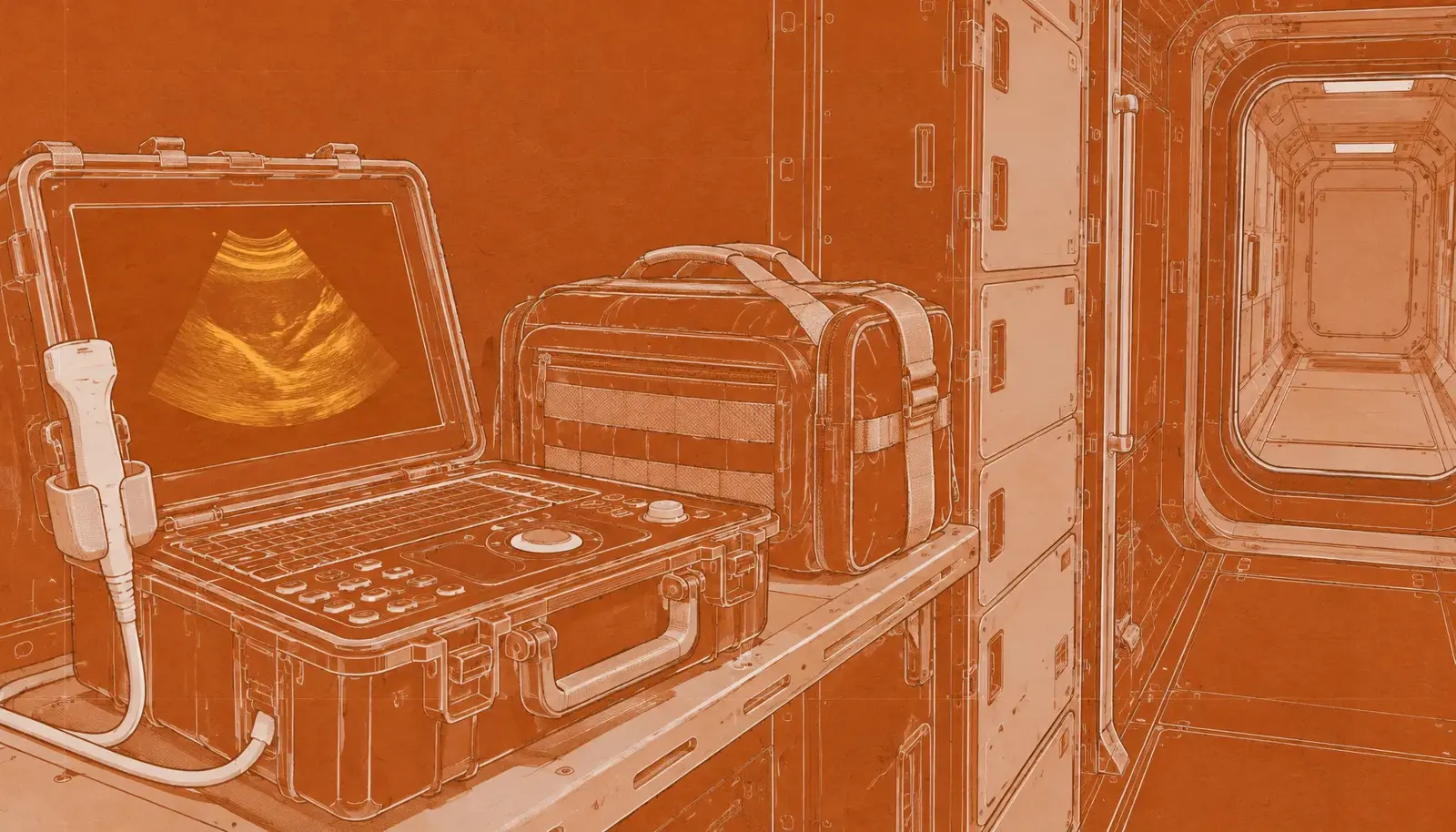
An 85% baseline success rate is the early result from a NASA-Google test of a robot tasked with locating and moving a medical bag. The proof-of-concept system, described by Google Cloud on October 27, is intended to handle routine cargo and equipment tasks on future Moon and Mars missions, then help prepare medical tools when crew members need care. The result comes from early lab testing, not a spaceflight demonstration.
A robot to fetch the ultrasound
NASA’s Human Research Program, Johnson Space Center Robotics Team and Jet Propulsion Laboratory worked with Google Public Sector on the system, according to Google. The proposed robot is a general-purpose payload handler: it could organize tools, secure compartments and manage equipment, rather than serve only as a medical device. That flexibility matters for small crews, whose time is divided between maintenance, health needs and science work.
Google’s example is an astronaut with severe back pain, which can be a symptom of kidney stones. The robot could retrieve and prepare an ultrasound machine so the crew medical officer can focus on analyzing the scan and treating the patient. The company describes the robot as physical assistance under human direction, not a replacement for medical judgment.
Testing movement before hardware
The team tested the system at Johnson Space Center’s iMETRO facility, using Google DeepMind’s MuJoCo physics simulator to train and test movements in a virtual environment before working with real hardware. In the reported pick-and-place task, an eye-to-hand camera setup supported spatial awareness as the robot searched for and moved the medical bag. Google says the open-source Pi0 model, developed by Physical Intelligence, reached an initial 85% baseline success rate in these early lab environments.
Google describes that figure as a starting point for more training and safety work, not as a measure of clinical performance or readiness for a mission. The blog does not provide the number of task attempts behind the percentage or a comparison with another model. Astronauts could issue English text prompts through a vision-language-action model, but the proposed system would remain under crew supervision.
Local computing for a long communications delay
A Mars mission could face round-trip communication delays of up to 44 minutes, Google’s Jim Kelly writes, making immediate guidance from Earth difficult. “An astronaut on a future deep space mission to Mars could face severe operational challenges—including round-trip communication latencies of up to 44 minutes, making real-time medical guidance for crew nearly impossible.”Jim Kelly, vice president, Federal, Google Public Sector
Google says it used its G4 cloud instances to fine-tune the 4-billion-parameter Pi0 model in 2.5 hours, then demonstrated that the fine-tuned models could run locally on compact, energy-efficient edge devices. The team tested about 15 devices over two years to identify hardware suited to the low-power constraints of future Mars missions. Local operation matters because a spacecraft cannot depend on continuous access to Earth-based data centers.
What the 85% result does not establish
The announcement describes a proof of concept, with further training and safety refinement still ahead. It gives no deployment date, flight-test plan or detailed account of how the robot would handle mistakes around a patient or medical equipment. For now, the concrete benchmark is a lab task: finding and moving a medical bag with an 85% baseline success rate.
Sources
- Original source · Blog post Google Cloud Blog cloud.google.com
Related stories
- AstroBench Records 6 Captures in 400 Generalist-Policy Trials
- NASA Runs Dragonfly Through Its First Full Simulated Flight
- NASA Selects Momentus to Formulate a Robotic Resupply Mission
- iFLYTEK Bundles Robot Board, Dev Kit and Software Into Super Brain Platform 3.0
- Kodiak Secures Binding DTL Deal for 75 Driverless Trucks