The Floor
NASA Runs Dragonfly Through Its First Full Simulated Flight
NASA’s Dragonfly completed its most comprehensive simulated first flight to date on flight-like avionics at Johns Hopkins APL. The test brought together flight software, navigation cameras, inertial sensors and lidar ahead of the rotorcraft’s planned mission to Saturn’s moon Titan.
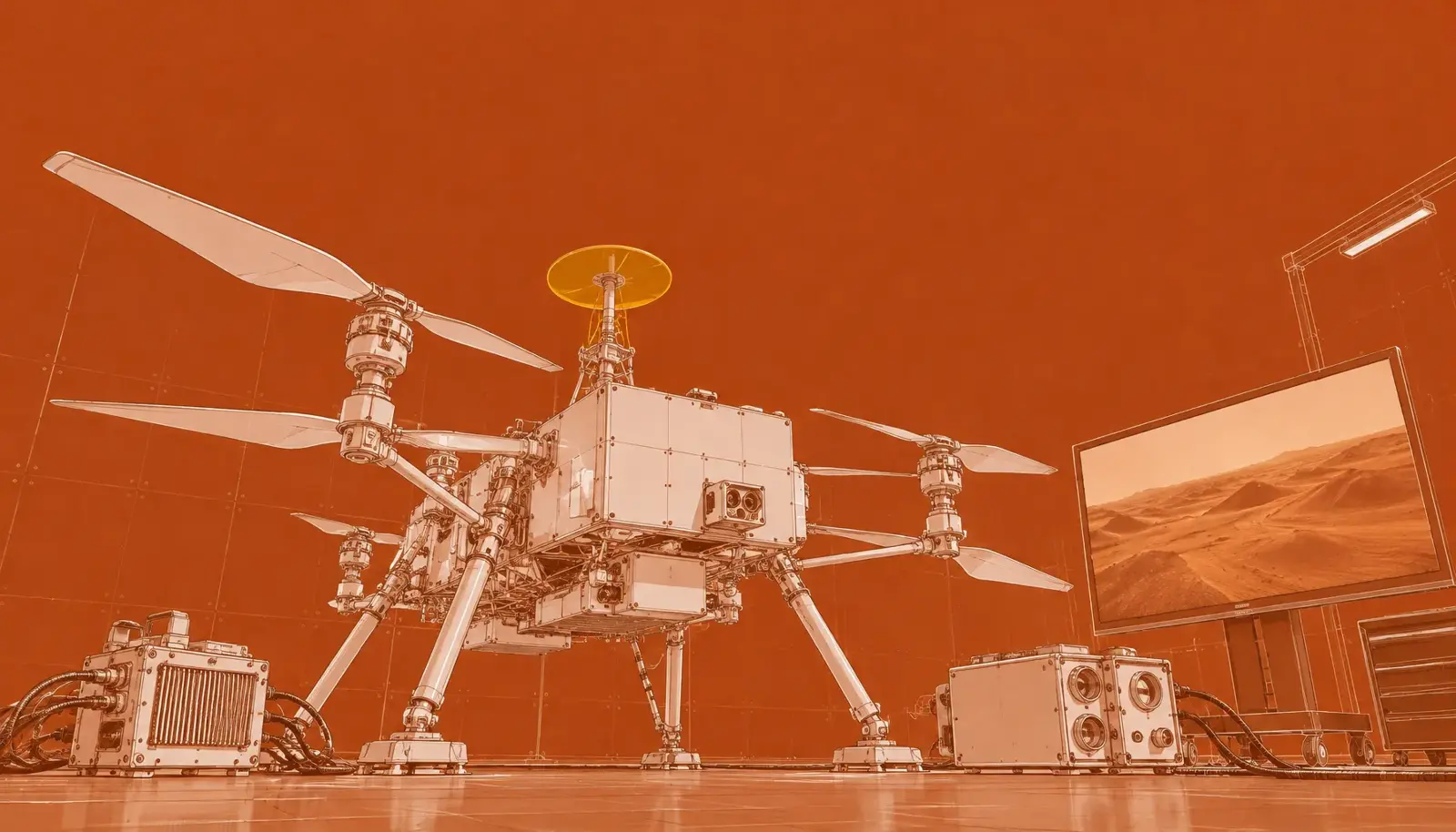
In NASA’s first full simulation of Dragonfly’s initial flight, the rotorcraft separates from its protective backshell, scans simulated Titan terrain, selects a safe landing site, then turns and descends. The touchdown happens not on Saturn’s largest moon but on a computer testbed at the Johns Hopkins Applied Physics Laboratory in Laurel, Maryland. NASA reported the test on October 23, saying it was the most comprehensive real-time rehearsal yet on flight-like avionics.
Flight-like computers, simulated Titan
The run brought together flight software and simulated inputs from the navigation cameras, inertial measurement units and lidar that Dragonfly will use on Titan. A custom camera emulator, using graphics processing units, generated the views the rotorcraft’s cameras would see during flight. NASA says it rendered each simulated scene in roughly the same 20-to-70-millisecond exposure times planned for those cameras.
The team also generated simulated terrain for lidar, which measures altitude and slope and helps identify hazards. Running the flight sequence on flight-like hardware let engineers examine how the systems interact, including the timing of information moving between onboard processes. The test therefore covered more than the planned path: it exercised the sensors, computing and software together in real time.
“The cool thing about first flight is that it’s our most challenging flight.”
Zach Putnam, Dragonfly mobility subsystem lead engineer at APL
From a spinning rotor to a landing sequence
Dragonfly’s flight capabilities have been built up through successive tests, NASA says. Early work simulated the spin of a single rotor; later exercises demonstrated a short repositioning flight and a partial scouting flight, adding sensors and capabilities along the way. Installing lidar supplied the final piece needed for this full simulation.
The milestone does not mean Dragonfly has flown on its actual flight system. NASA says the team plans to run the first-flight sequence on the rotorcraft’s flight system and avionics, then test other flight profiles and deliberately introduce faults to check how it responds. Those tests will examine autonomous responses; the simulated success alone does not establish how the vehicle will perform on Titan.
Autonomy for a distant moon
Dragonfly is scheduled to launch no earlier than 2028 and make a six-year journey to Titan. NASA plans a three-year mission there, with the rotorcraft flying among multiple locations to study the moon’s chemistry, geology and atmosphere. Because it will fly without real-time help from Earth, its onboard systems must carry out the flight decisions.
NASA is also testing the mechanism that will lower Dragonfly from its stowed position inside the backshell before release. At Lockheed Martin in Colorado, engineers have conducted static tests with representative mass, deployment tests and checks at different angles to assess loading, movement and whether the mechanism locks into place. Those ground tests address a separate part of the descent sequence: positioning the rotorcraft to begin its first flight.
Sources
- Original source · Government or agency page NASA Science science.nasa.gov