The Floor
Hawk 3.0 Covers 49% More Distance on a Shallow Takeoff
A meter-scale flapping-wing robot called Hawk 3.0 covered 49% more total distance with a 15-degree takeoff than with a 65-degree takeoff in tests reported by Cyborg and Bionic Systems. The study links low-speed pitch control to the interaction between wing flapping and wing flexibility.
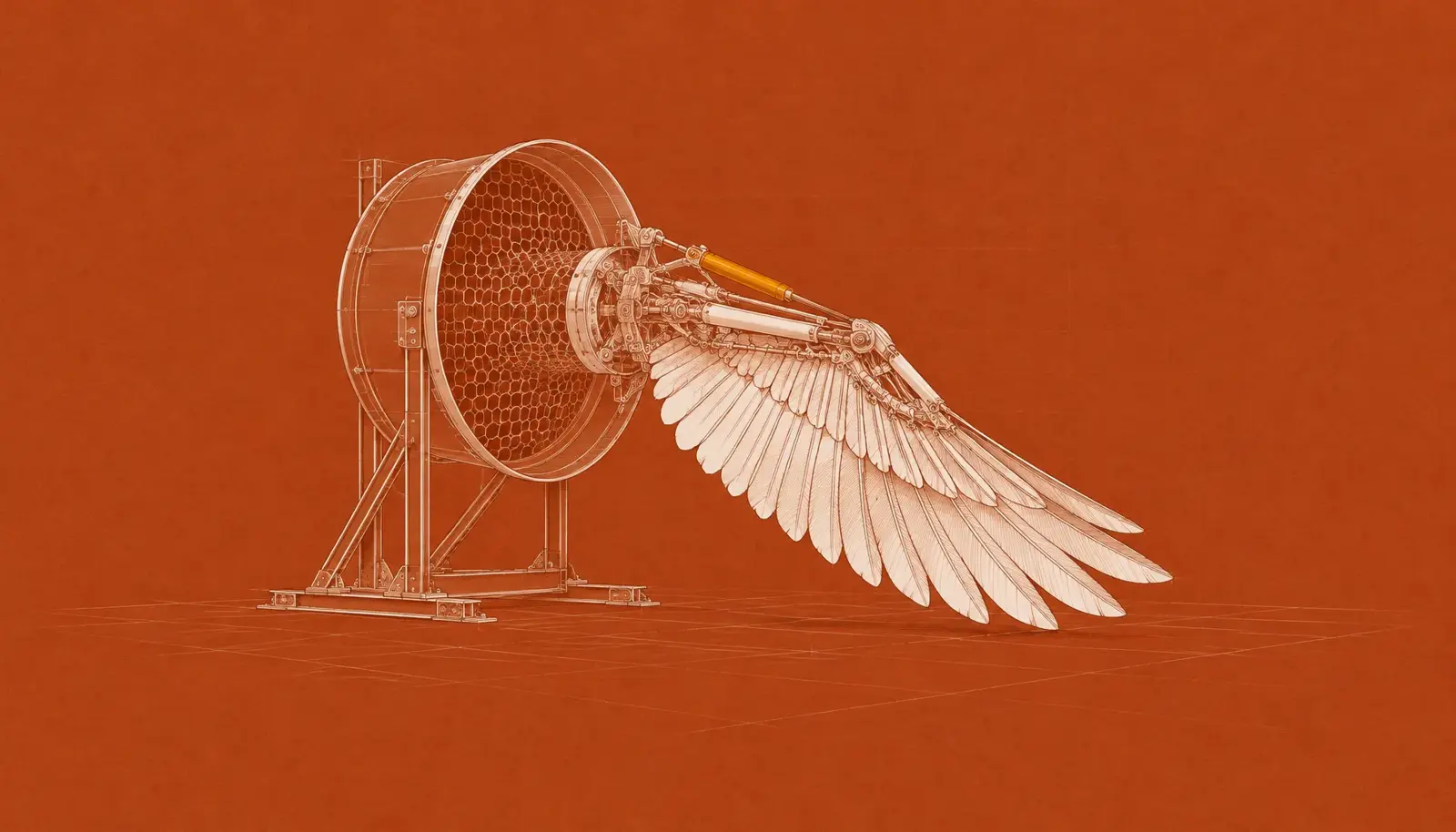
“Under the tested conditions, the 15° low-angle strategy increased the total flight distance by 49% relative to that of the 65° strategy and reached a comparable altitude at the 3-s evaluation time.”
Haoyu Wang et al., “Birdlike Takeoff Strategies Enabled by Flapping–Pitch Effect in a Meter-Scale Flapping-Wing Robot”
That result comes from Hawk 3.0, a meter-scale flapping-wing robot the researchers used to compare shallow and steep takeoffs under controlled conditions. The paper, published October 16 in Cyborg and Bionic Systems, examines how launch angle trades early acceleration against climb. Its finding is specific to the tested robot and conditions, not a claim that shallow takeoffs always outperform steep ones.
At three seconds, the shallow launch had gone farther
The team compared takeoff angles of 15 and 65 degrees and used three seconds after release as a common evaluation point. At that mark, the strategies had reached comparable altitude-, speed- and energy-related states, while the 15-degree trajectory had covered 49% more total distance. A shallow path favors building forward speed; a steep one gains altitude more quickly.
The researchers chose the three-second mark to look beyond the initial release transient and compare distance after the robot had established flight. The measurement captures a particular interval and platform, rather than a general rule for bird flight or aircraft design. The authors frame the result as engineering evidence that may help interpret some avian takeoff strategies.
Wing motion supplies pitch authority at low speed
Hawk 3.0 has a 1.82-meter wingspan, weighs between 955 and 1,105 grams at takeoff, and can flap at up to 5 hertz. The study identifies a flapping–pitch effect: changing the wing’s motion and its interaction with airflow redistributes aerodynamic forces, producing pitching moments. That gives the robot a way to adjust pitch when conventional control surfaces have limited authority at very low airspeeds.
The effect changes as the robot accelerates. The researchers’ simulations show that flapping-induced pitch authority is strongest near zero and at low speed, while the tail becomes more influential as airspeed rises. The team used a lattice-Boltzmann-based, two-way fluid–structure interaction model to connect airflow, flexible-wing deformation and the vehicle’s motion through the takeoff sequence.
A fixed linkage limits what the prototype can test
The prototype’s mean flap angle is set by a linkage before each flight; the robot cannot adjust it continuously in the air. The researchers say lightweight servo-driven linkages or adjustable wing mounts could provide that control in future versions. That limitation matters because the paper’s comparison concerns preset takeoff strategies, not an aircraft dynamically switching between them.
Birds also combine wing motion with a leg-powered launch, active wing reshaping and sensory feedback, all within species-specific environments and escape situations. Hawk 3.0 isolates aerodynamic and aeroelastic effects under repeatable conditions, so its flights cannot reproduce that full biological context. In the reported comparison, the 15-degree setting covered 49% more total distance than the 65-degree setting by the three-second evaluation point.
Sources
- Original source · Paper Cyborg and Bionic Systems spj.science.org