The Floor
Unitree Go2 Study Finds Assistive Robot Explanations Need Restraint
A small study tested spoken explanations on a Unitree Go2 robot, finding higher satisfaction ratings for explanations that combined obstacle information with the robot’s planned route. Because the comparison also changed frame history and update interval, it cannot show that speaking less often alone produced the difference.
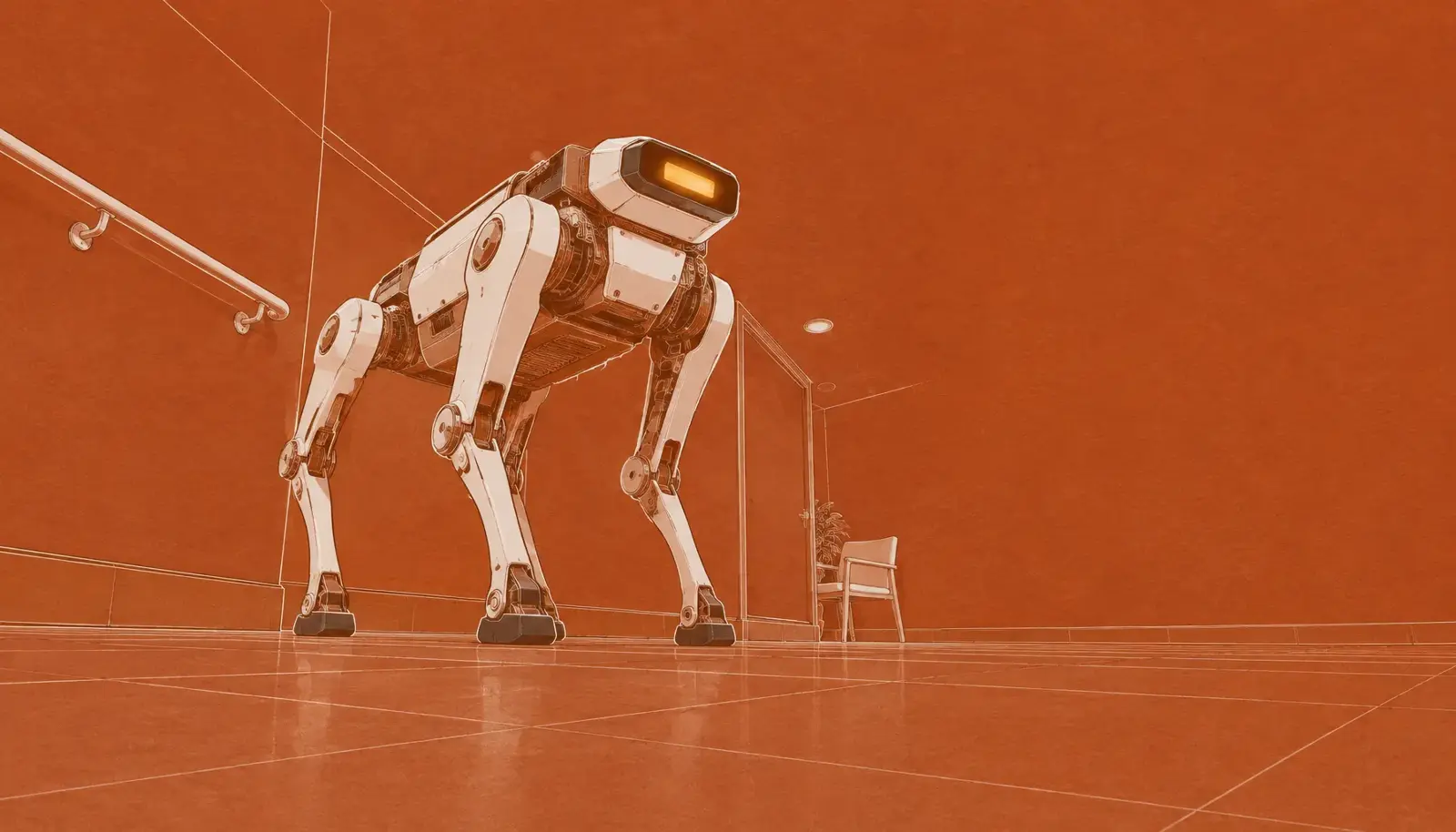
A guide robot that explains why it is turning may earn more trust—but more frequent updates did not receive the highest ratings in a small study. Posted to arXiv on October 20, the study by Courtney Young, Yi Lian, J. Taery Kim and Sehoon Ha tested LLM-generated spoken explanations on a Unitree Go2 quadruped. Participants rated explanations that combined obstacle information with the robot’s planned route more favorably than another condition that also included route information. The study does not establish that explanations cause trust to rise.
Obstacle alerts meet planned routes
The team’s Context-Aware Navigation Explanation framework gives a language model two kinds of information: objects detected by the robot’s camera and waypoints from its navigation planner. It uses those inputs to generate short spoken descriptions of what the robot intends to do. The paper describes Claude Haiku 4.5 as set to a 50-token maximum and says generated responses were constrained to phrases of at most eight words. A Bluetooth speaker mounted on the Go2 delivered the explanations.
The study compared three conditions. In the first, the model received obstacle information and spoke every three seconds. In the second, it also received planned navigation information—including turns—and kept the same three-second interval. A third condition included obstacle and route information, used a longer history of camera frames, and generated explanations every two seconds. Because the third condition changed both frame history and update frequency, its ratings cannot be attributed to more frequent speech alone.
More frequent speech did not win
Twelve people completed indoor hallway trials: two participants who identified as blind or visually impaired, and 10 sighted participants who wore eye masks. Each person tried all three explanation conditions on two routes, then rated trust and explanation quality on five-point scales. The researchers found a strong correlation between explanation satisfaction and trust across participants: r = 0.949.
The second condition, with both obstacle and route information at a three-second interval, received the highest average ratings. Its mean trust score was 3.81 out of 5, compared with 3.49 for the third condition; that trust difference did not remain statistically significant after the study’s multiple-comparison correction. Satisfaction was 3.74 for the second condition and 3.26 for the third, a difference that did survive correction. The second condition also scored above obstacle-only explanations, but that difference was not statistically significant after correction.
“Through a user study, we show that explanation satisfaction is strongly correlated with user trust, suggesting that improving explanation quality is critical for increasing trust in assistive robotic systems.”
The authors of Navigation Explainability for Object Avoidance with LLMs for Assistive Robots write
Two blind participants, and a hallway that missed hazards
The findings are preliminary. Only two of the 12 participants were blind or visually impaired; the other 10 experienced the routes while wearing eye masks. The study measured participants’ ratings after brief trials, not long-term reliance on a guide robot or performance in varied public environments. The authors also report that the perception system did not detect walls or support beams, which led to minor collisions.
Explanations could also be wrong: the robot sometimes announced a turn that was not ahead. That mismatch lowered one participant’s satisfaction, a practical risk when spoken guidance does not match the robot’s motion. The paper says the researchers plan larger studies with more blind and low-vision participants, alongside work on haptic feedback, emergency alerts and safety-aware control.
Clarity mattered more than chatter
Participants favored explanations that named an obstacle and described an action, helping them prepare for the robot’s next movement. The two blind or visually impaired participants preferred qualitative distance cues such as “near” or “coming up,” while some sighted participants preferred exact measurements. Those differing preferences suggest that a single fixed speaking style may not suit every user.
For now, the study supports a narrower conclusion: in this small, controlled trial, the condition combining what the robot detects with where it plans to go received higher satisfaction ratings than the condition with the same types of information but a longer frame history and more frequent updates. The results do not isolate the effect of update frequency, nor prove safer navigation or a general increase in trust among blind and low-vision users.
Sources
- Original source · Preprint Navigation Explainability for Object Avoidance with LLMs for Assistive Robots arXiv:2610.28920