The Floor
Northwestern preprint proposes four-factor robot risk filter
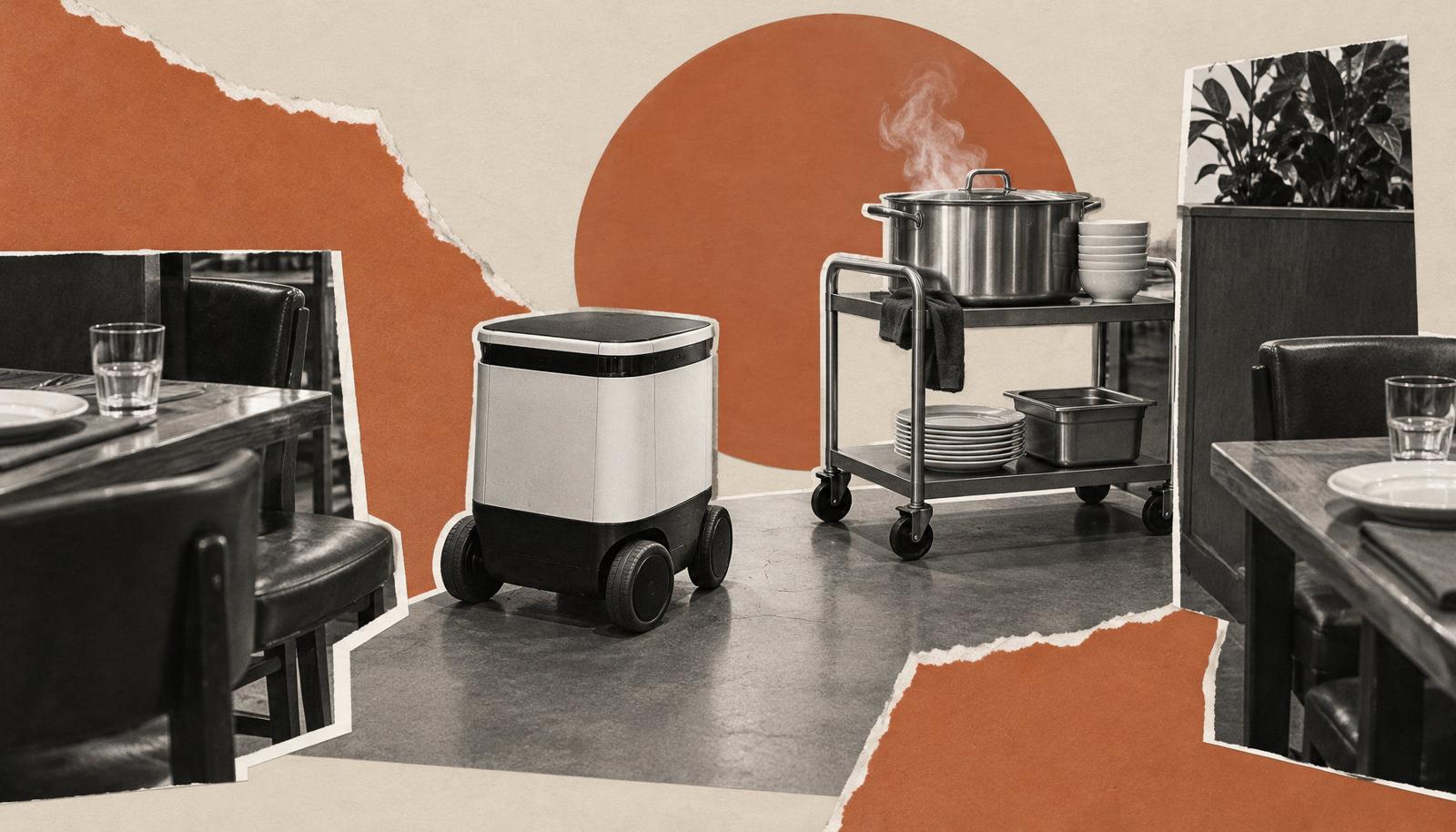
A preprint proposes a navigation safety layer that scores objects and people by four kinds of risk, then adjusts a robot’s route. The authors tested it in simulation, including a restaurant delivery scenario and comparisons involving a steaming pot and a floor opening.
A continuous score for navigation risk
A proposed robot navigation safety layer would score people and objects by their physical properties and interaction with a robot’s route, rather than classify each as simply safe or unsafe. The approach, called Continuous Risk Assessment (CRA), is described in a preprint submitted to arXiv on November 17 by Lihao Zheng, Ying Wu, Chen Jiang and Randy Freeman of Northwestern University.
The framework combines camera images with LiDAR observations to estimate four factors for each assessed object or person: kinetic, potential, contact-severity and thermal risk. It combines the estimates into a continuous score, then uses that score in a safety filter that monitors and can intervene in navigation commands.
How the filter works
CRA associates camera-detected objects with LiDAR returns, which provide information about their position and dimensions. The system estimates kinetic risk from an object’s mass and its motion relative to the robot; potential risk from mass and vertical height; contact severity from visual contours and exposed parts; and thermal risk from visible steam, smoke or flames.
Each factor reflects both its estimated severity and the likelihood that the robot will encounter it along its planned route. The method also accounts for confidence in the evidence: when estimates are uncertain, factor scores below a preset fallback level move toward that level. Scores for the four factors are then combined into one value for each object or person.
That score changes the navigation safety fields around an object. A model-predictive control layer adjusts the nominal commands to follow a risk-conditioned guidance field, while an analytical control barrier function filters the command at execution. The paper describes this as online monitoring and intervention in open-world navigation.
Tests were in simulation
The authors evaluated CRA in NVIDIA Isaac Sim 6.0.1 using a simulated Nova Carter differential-drive robot, a front-facing RGB camera and a 32-channel Hesai PandarXT-32 LiDAR operating at 10 hertz. They tested separate risk factors and combined scenarios, then ran a simulated restaurant delivery mission in which the robot carried meals between a service bar and two dining areas.
For one contact-risk analysis, the paper reports evaluating 50 sharp objects and 50 rounded or blunt objects. CRA assigned the sharp objects a higher mean risk score, 0.709, than the rounded or blunt objects, 0.576. In a simulated test involving a human carrying a steaming pot, the authors report that CRA produced a larger measured detour than the baseline Safe-SAGE controller, which detected human risk but not the pot’s additional risks.
The paper also describes a shallow-hole scenario: with CRA, the robot went around the hole and reached its goal, while the baseline controller continued along the nominal route and fell into it. The authors say they plan to evaluate the framework in real-world environments and more complex social interactions; the reported navigation experiments were conducted in simulation.
Sources
- Original source · Preprint CRA: Continuous Risk Assessment for Safety-critical Visual Navigation arXiv:2611.22080
Related stories
- ForagerSim Tests Whether Robot Policies Can Build Useful Maps
- Preprint proposes certifying robot safety through recoverability
- Preprint proposes robot planning with explicit, reusable safety rules
- Preprint tests robot navigation with uncalibrated external cameras
- Preprint proposes reflection-robust stereo visual-inertial odometry